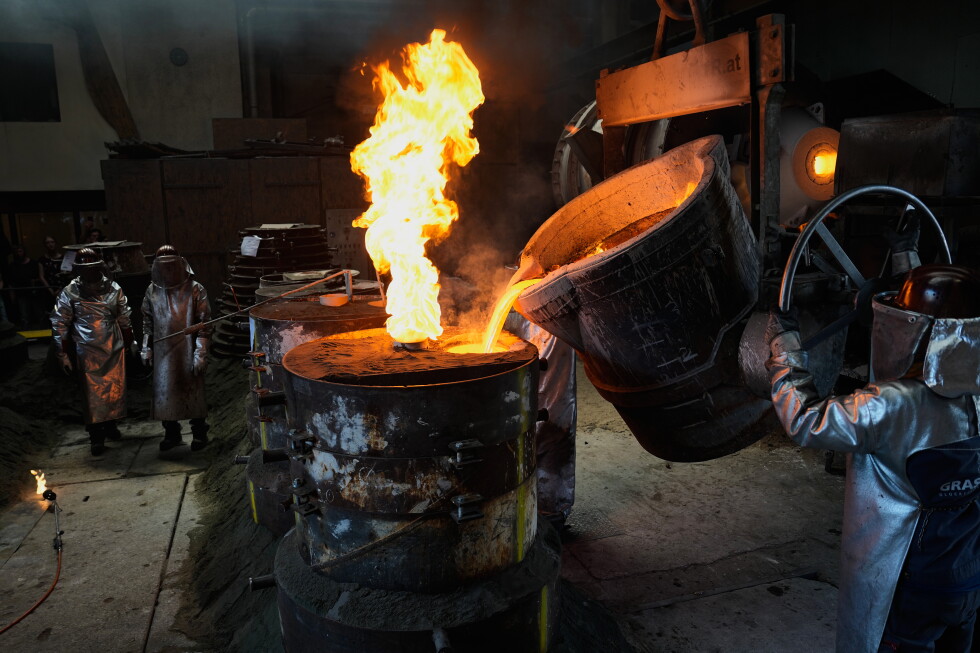
Tucked in the mountain city of Innsbruck, western Austria, one of Europe’s last remaining bell foundries hums with activity as artisans clad in heat-resistant protective gear work to pour glowing molten bronze into custom-shaped molds. For the Grassmayr Bell Foundry, a family-owned enterprise tracing its origins back to 1599, this routine of crafting massive, ton-weight bells for religious communities across the continent has persisted through centuries of upheaval — from continental wars and widespread famines to global pandemics and crippling economic downturns.
Today, the legacy is carried forward by brothers Johannes and Peter Grassmayr, the latest generation to steward the centuries-old trade. What was once a crowded craft with hundreds of foundries operating across Europe during the late medieval Renaissance has dwindled to just a handful of active operations on the continent. For Grassmayr, the key to outlasting competitors and navigating centuries of change lies in a rare balance: unwavering dedication to time-honored craftsmanship paired with deliberate adoption of cutting-edge innovation.
“Certain core practices have not changed in 400 years, but we have pushed for significant innovation, particularly over the past two decades, that has transformed how we work,” Johannes Grassmayr explained in an interview with the Associated Press.
A full production cycle for a single custom bell takes three to four months from start to finish. In decades past, cleaning and polishing a newly cast bell accounted for 30% of total production labor. Today, modern digital and mechanical tools have cut that processing time to just one-tenth of the original schedule. The foundry keeps many of its most innovative proprietary processes private: this includes a specialized high-pressure sandblasting cleaning chamber, as well as custom-built software applications designed to model and predict the unique acoustic profile of each individual bell.
Even with the advantages of modern technology, the most labor-intensive and high-stakes step of the process — designing and crafting the molds for large, multi-ton bells — still takes up to six months of careful work. As Johannes emphasizes, a bell is not simply a hunk of cast metal: it is a precision musical instrument that requires accurate calculation, careful shaping, and controlled casting to achieve the desired tone.
The greatest risk during casting comes from the extreme pressure generated by tons of liquid bronze. For a large multi-ton bell, molten bronze can exert up to 125 metric tons of pressure against the inner walls of the mold. To prevent catastrophic collapse, the foundry sources only highest-quality clay for mold construction, then encases the clay form in reinforced steel sleeves engineered to withstand these extreme forces.
Beyond the inherent technical challenges of bell casting, the foundry now faces mounting modern economic pressures that threaten its long-term stability. Shifting cultural trends have led to a sharp decline in new church construction across Europe, drastically reducing demand for new custom bells. Compounding this challenge are skyrocketing operational costs spurred by recent global events: energy prices have surged following the outbreak of war in Ukraine, and labor costs have jumped 30% across the industry since the 2020 COVID-19 pandemic.
For finished bells, the single largest cost driver remains raw material prices. Premium bronze, blended to a traditional ratio of 80% copper and 20% tin to produce the best acoustic quality, has seen explosive price growth in recent years. Just a few years ago, bronze cost 8 euros (roughly $9.23) per kilogram; today, that same kilogram costs 23 euros ($26.17). This volatility makes long-term pricing impossible for the foundry.
“That’s why I can’t even predict what a bell will cost a year from now,” Johannes said. “I just hope we see metal prices fall again in the near future.”
To adapt to shrinking demand for new bells and offset rising costs, the Grassmayr team has increasingly expanded into a new line of work: restoring historic defective bells, leveraging modern technology to repair and refinish centuries-old pieces that remain important to communities. To date, the foundry has restored hundreds of damaged bells from 12 different European countries.
Despite the challenges, the foundry’s work reaches across the globe: Grassmayr bells now hang in churches and public buildings in more than 100 countries, from Japan to the United States. Some of the brothers’ most iconic works include a 25-metric-ton bell cast in 2016 for Romania’s National Cathedral in Bucharest, standing 3.3 meters tall, and a 15-metric-ton bell installed in a church on Israel’s Mount Tabor.
As he showed AP journalists a set of recently cast bells, left to cool for a full week before being removed from their clay molds, Johannes pointed to the crisp, precise negative imprint left in the clay form. One of the newly finished bells was bound for a church in Zethau, Germany. “I’m very happy with how this casting turned out,” he said. “I’m particularly glad that the innovations we’ve rolled out over the past decades have helped us make bells that are ever more beautiful and better sounding than ever before.”