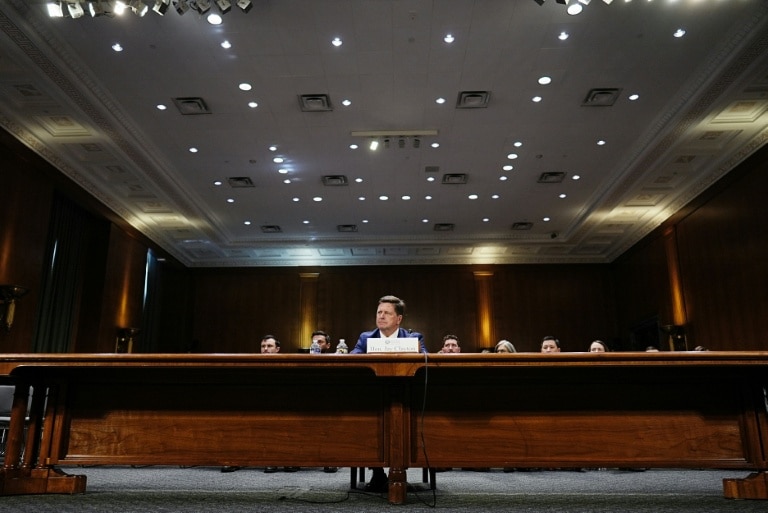
In a narrow, party-line vote held Tuesday, the United States Senate has approved Jay Clayton’s nomination to serve as President Donald Trump’s permanent director of national intelligence, placing a new top leader at the helm of the nation’s sprawling intelligence community just as Trump reignites unsubstantiated claims of widespread 2020 election fraud ahead of upcoming midterm elections. The final vote tally split along partisan lines, with 51 senators supporting the confirmation and all 47 Democratic members of the upper chamber opposing the nomination. Minutes after the vote concluded, Trump praised his nominee in a post on his social platform Truth Social, declaring “Jay is outstanding in every way, and will do a spectacular job as Director!”
Clayton, a former federal securities regulator and career federal prosecutor, takes over the role that was most recently held on an acting basis by Bill Pulte, a Trump loyalist whose lack of prior intelligence experience and sweeping policy moves sparked bipartisan alarm in Congress. He succeeds former Representative Tulsi Gabbard, who stepped down from the post just one month ago. The role he inherits oversees a network of 18 separate intelligence agencies that has been roiled by repeated leadership turnover and deep staff cuts in recent weeks.
The confirmation arrives at a moment of growing national concern that Trump is working to co-opt U.S. national security institutions to advance his political agenda, as he pushes to revisit the results of the 2020 presidential election and undermine public trust in the integrity of the upcoming midterm vote. Earlier this month, Trump delivered a primetime televised address from the White House to release declassified intelligence materials he claims prove Chinese interference in the 2020 election, while once again repeating his false assertion that the contest was stolen from him.
During Pulte’s short tenure as acting director, the former housing regulator drew fierce criticism for using his government position to refer several of Trump’s political opponents for potential criminal prosecution, while also pushing through aggressive staff reductions at the Office of the Director of National Intelligence. Just hours before Clayton’s confirmation vote, Pulte publicly announced that a fifth round of layoffs would cut the agency’s total staffing by roughly 30% within the coming weeks.
Democratic lawmakers initially signaled cautious optimism about Clayton as a more mainstream, experienced alternative to the controversial Pulte, but unified in opposition to his nomination after his appearance before the Senate Intelligence Committee. When repeatedly pressed by senators to directly answer whether current President Joe Biden legitimately won the 2020 presidential election, Clayton refused to give a clear affirmative response, only stating that Biden had been “certified” as the winner and asserting “I’m not an election denier.”
Mark Warner, the ranking Democratic vice chair of the Senate Intelligence Committee, acknowledged after the vote that he left Clayton’s confirmation hearing with “serious reservations about whether he would be willing to stand up to political pressure.” He added, “I sincerely hope he proves those concerns unfounded, because the Intelligence Community deserves steadier leadership than it has received in recent months.” Senate Democratic Leader Chuck Schumer went even further, previously describing Clayton’s performance during the confirmation hearing as “abysmal.”
Republican lawmakers defended Clayton’s record, pointing to his tenure as chairman of the U.S. Securities and Exchange Commission during Trump’s first term in office and his recent service as U.S. Attorney for the Southern District of New York. Senate Majority Leader John Thune, a Republican, argued that Clayton’s track record fighting transnational financial crime and leading high-stakes national security investigations made him a proven, capable leader at a moment when the United States faces growing global threats.
The confirmation of Clayton is also expected to unlock stalled negotiations over the reauthorization of Section 702 of the Foreign Intelligence Surveillance Act, a controversial surveillance authority that allows U.S. intelligence agencies to collect communications of foreign targets located overseas without requiring individual warrants. Congressional Democrats had refused to move forward with reauthorization while Pulte remained in the acting role, citing widespread fears that the Trump administration would misuse the broad surveillance authority for political purposes. However, legislative action on any extension is not expected before September, as the U.S. House of Representatives has already adjourned for its annual summer recess.”