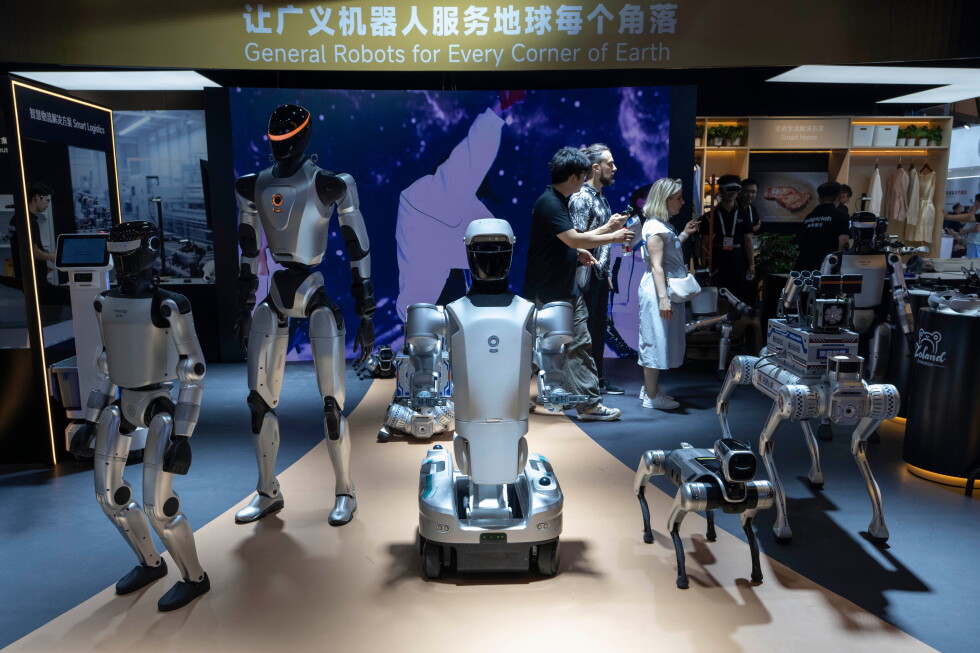
In a move that escalates the ongoing technological competition between the world’s two largest economies, the U.S. Federal Communications Commission (FCC) announced Tuesday it will block imports of Chinese-manufactured humanoid robots, four-legged quadrupeds commonly called robot dogs, and foreign-made power inverters, citing unsubstantiated national security and supply chain risk concerns.
This new restriction comes as part of a growing series of American trade barriers targeting Chinese technology, following earlier bans on Chinese-built drones and ongoing deliberations over limiting access to Chinese open-source artificial intelligence models — a sector where Chinese innovation has rapidly advanced in recent years. The decision is expected to add new strain to already tense bilateral relations ahead of the planned Trump-Xi summit scheduled for this September, which follows a high-profile meeting between the two leaders in Beijing this past May.
Industry data underscores China’s dominant position in the global humanoid robotics market: analysts estimate Chinese manufacturers hold roughly 85% of global market share, a figure confirmed by both Barclays and industry research firms. For 2025, Omdia data shows that of around 15,000 humanoid robots shipped worldwide, China’s two leading robotics firms — Unitree and AGIBOT — each delivered more than 5,000 units, while top U.S. competitors Tesla and Figure AI shipped only a few hundred units or fewer apiece.
Projections from Morgan Stanley indicate China’s domestic humanoid robot market could balloon to $15 billion by 2030, driven by aggressive manufacturing scaling and cost-cutting that has outpaced most Western rivals. Morningstar analyst Kangyuxiao Li explained that the import ban serves to protect emerging U.S. robotic developers from price competition and cuts off Chinese manufacturers from a high-value future export market. However, Li noted the restriction will not meaningfully slow China’s overall robotics advancement, thanks to the enormous size of China’s domestic manufacturing base and robust demand for Chinese robotics in other global export markets.
Unlike the U.S., China has actively expanded its robotics footprint across other major markets, with Europe identified as a key target for Chinese humanoid and advanced robot exports, per Omdia. Beijing has repeatedly pushed back against U.S. restrictions, framing its technological progress as a global economic opportunity rather than a security threat, even as Washington warns of a potential “China Shock 2.0” that could disrupt Western manufacturing and labor markets.
The ban also carries risks for cross-border tech collaboration between U.S. and Chinese firms, warned Omdia chief analyst Lian Jye Su. A high-profile example of this interconnectedness: in June, U.S. chip giant Nvidia unveiled a humanoid robot reference design that relies on the physical chassis built by Chinese robotics firm Unitree. Just recently, the Pentagon added Unitree to a list of Chinese companies it accuses of having ties to the Chinese military, a designation Beijing has said it “firmly opposes.”
Samm Sacks, a senior fellow focused on Chinese technology policy at Washington-based think tank New America, noted the new import ban is just the latest in a growing string of potential diplomatic flashpoints ahead of the September leadership meeting. “It’s a steady drumbeat of potential flashpoints heading into the Trump-Xi summit planned for September,” Sacks said.
FCC Chair Brendan Carr defended the agency’s decision in a formal statement, framing the ban as a necessary step to “secure America’s critical supply chains.”