MANILA, Philippines — A fresh maritime confrontation has escalated tensions in the South China Sea, just as top global diplomats gathered in the Philippine capital for high-stakes regional security negotiations. On Friday, the third such standoff in a single week, China’s coast guard deployed water cannons against two Philippine government fisheries vessels near Scarborough Shoal, marking the second consecutive day of clashes in that contested stretch of water.
The South China Sea has been a flashpoint for competing territorial claims for decades. China asserts sovereign rights over nearly the entire waterway, one of the world’s busiest and most economically critical global trade routes. This broad claim was formally rejected by a 2016 international arbitration ruling issued under the 1982 U.N. Convention on the Law of the Sea, though Beijing has refused to recognize the verdict.
According to Philippine coast guard officials, the incident unfolded when a Chinese coast guard vessel closed to within just 7 meters (23 feet) of a Philippine fisheries vessel in a maneuver Philippine authorities described as “reckless.” The close approach created a severe collision risk, the agency said, adding it strongly condemns the “dangerous and unprofessional actions of the China coast guard.” The Philippines maintains Scarborough Shoal is an integral part of its national territory, with its surrounding waters falling under the country’s territorial sea and exclusive economic zone.
In its own official statement, the Chinese coast guard offered a conflicting account. It said multiple Philippine vessels, including three coast guard craft, had entered what it considers Chinese territorial waters on Friday. The agency confirmed it issued verbal warnings, deployed interception maneuvers, and used water cannons to expel the Philippine ships. It issued a stark warning to Manila: “We sternly warn the Philippines to immediately cease its infringing and provocative actions or bear all consequences that may arise.”
Friday’s clash follows two other confrontations earlier in the week, including a violent encounter at Second Thomas Shoal on Monday that left two Philippine sailors injured. The Philippines says Chinese coast guard personnel struck the sailors with wooden poles, while China counters that Philippine sailors first attacked Chinese personnel with oars and long sticks.
The escalating series of incidents has placed South China Sea tensions at the top of the agenda for the annual Association of Southeast Asian Nations (ASEAN) foreign minister meetings, which have been hosted in Manila this week. Top diplomats from the 11-nation bloc and their global counterparts have held three days of closed-door talks focused heavily on the decades-long territorial dispute.
On Tuesday, ASEAN foreign ministers released a joint statement addressing the tensions, noting that “concerns were expressed by some ministers on the land reclamations, activities, serious incidents in the area, including actions that put the safety of all persons at risk, and damage to the marine environment.” The bloc confirmed it has seen “significant progress” in ongoing negotiations with China on a formal code of conduct designed to prevent large-scale armed conflict in the region, with a stated goal of concluding the negotiations before the end of 2025.
On the sidelines of the ASEAN talks, U.S. Secretary of State Marco Rubio and Chinese Foreign Minister Wang Yi held a bilateral meeting Wednesday to discuss Monday’s Second Thomas Shoal clash, with both sides describing the incident as “escalatory.”
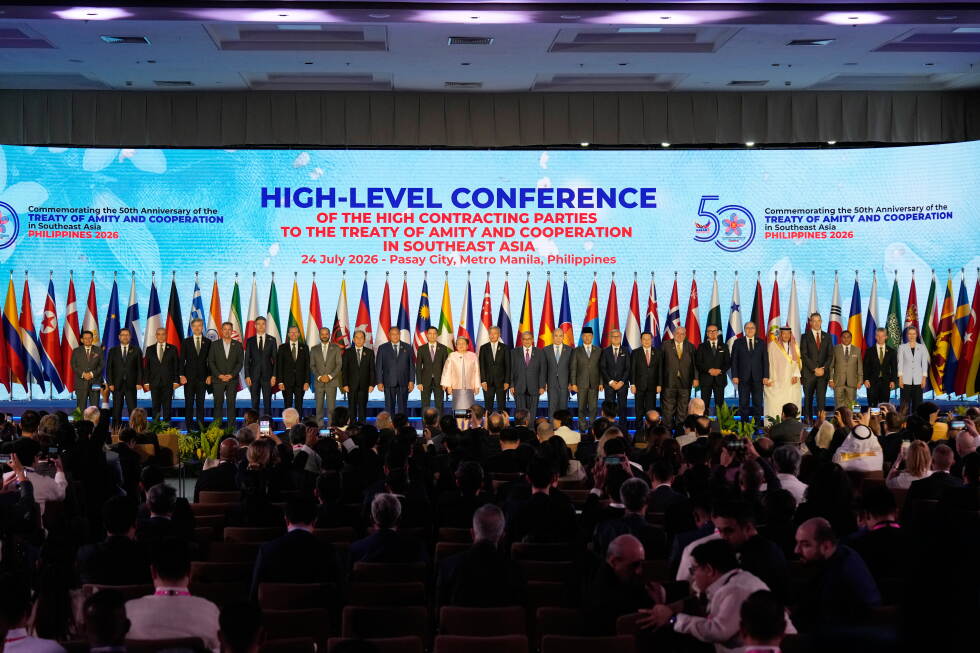
The week of diplomatic meetings in Manila concluded Friday with a commemoration of ASEAN’s 1976 Treaty of Amity and Cooperation, a landmark nonaggression pact for the region. In her remarks at the event, Philippine Foreign Secretary Theresa Lazaro emphasized the need to protect peace amid growing global uncertainty. “Peace is a daily choice,” Lazaro said. “It requires continuous labor, deliberate restraint, inclusive dialogue and an unyielding adherence to the rule of law.”
Contributions to this report were provided by Associated Press video journalist Joeal Calupitan in Manila and writer Ken Moritsugu in Beijing.