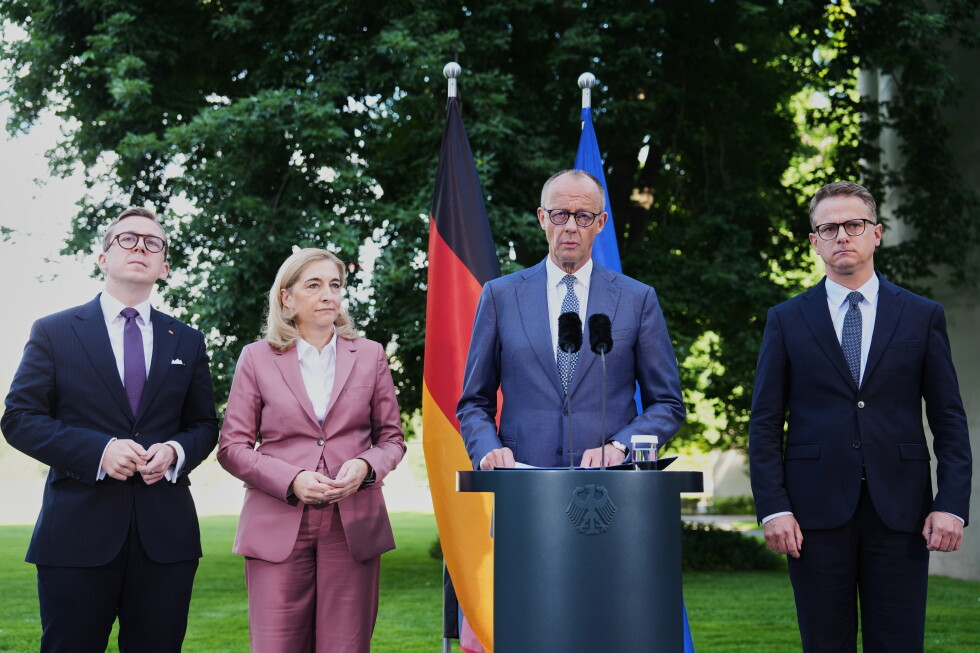
BERLIN – German Chancellor Friedrich Merz has announced a sweeping overhaul of top government and party leadership posts on Friday, a desperate gambit to revitalize his flagging, deeply unpopular administration ahead of pivotal September regional elections that could see the far-right Alternative for Germany (AfD) claim its first ever state governorship.
Merz, who took office less than 15 months ago on promises of sweeping economic reform and a recovery for Germany – the largest economy in Europe – after years of prolonged stagnation, has watched his agenda stall. His centrist grand coalition, an unlikely partnership between his center-right Union bloc and long-time rival center-left Social Democrats, has failed to convince voters of its ability to deliver tangible progress, dragging the chancellor’s approval ratings to historic lows. Against this backdrop of widespread public discontent, the far-right AfD has steadily climbed in polling, emerging as a serious contender in the upcoming regional votes.
The trigger for the reshuffle came last week, when senior Union ally Jens Spahn was forced to resign from his post as leader of the party’s parliamentary group – one of the most powerful positions in the governing coalition – over a damaging credibility scandal. It was revealed that Spahn and his husband had used a commercial surrogate in the United States to welcome a child, a practice that is illegal in Germany and explicitly opposed by Merz’s party, a position Spahn himself had publicly defended for years. The revelation sparked widespread accusations of political hypocrisy, creating an unwanted distraction for the coalition just as it was attempting to roll out its new reform agenda.
To fill Spahn’s vacant role, Merz has tapped his current chief of staff, Thorsten Frei, a seasoned party operative who previously served as the Union’s parliamentary chief whip during the bloc’s time in opposition, a post political analysts widely consider a better fit for his skill set. Taking Frei’s place as chancellery chief – a critical role responsible for coordinating the daily functions of the federal government – will be current Health Minister Nina Warken, a move that makes her the first woman to ever hold the position. Merz praised Warken for her recent success shepherding the government’s first major reform, a bill to curb soaring costs in Germany’s public health insurance system, through parliament, noting she has already proven she can “push through reforms against resistance.” He added that Warken is also well-versed in core security policy issues, a key priority for the chancellery.
Warken’s spot at the Health Ministry will go to Carsten Linnemann, current general secretary of Merz’s Christian Democratic Union (CDU) and a staunch conservative who has not previously held national government office. Merz argued that Linnemann’s steadfast commitment to the administration’s reform agenda makes him the right pick to continue overhauling German health policy. The chancellor confirmed that additional cabinet changes are still in the works, but declined to share specific details, saying final decisions would take “a few days yet, and perhaps more time.” He did not address widespread media reports that Transport Minister Patrick Schnieder is also set to be replaced, a change that comes after the coalition’s multi-billion euro infrastructure upgrade fund has failed to resolve persistent public frustration over systemic issues like unreliable national railway service.
Merz framed the personnel shakeup as a deliberate step to refocus the government on its reform mandate. “The personnel changes follow a clear line,” he said. “We want a government that works with great vigor and pleasure and also represents the personal diversity of our society and politics. We are a reform government and want to continue showing that.”
Political analysts say the reshuffle is a clear response to the high-stakes electoral calendar this fall. Three critical regional elections will be held in September, with the first taking place on September 6 in the eastern state of Saxony-Anhalt, where the AfD is currently polling strongly enough to win a parliamentary majority that would give it full control of a state government for the first time in the party’s history. For months, the coalition has been dogged by public anger over internal infighting, but in recent weeks Merz’s government has laid out an ambitious slate of potentially controversial policy changes, including a gradual increase in the retirement age to overhaul the country’s strained pension system, income tax cuts for low- and middle-income households, and widespread deregulation to cut bureaucratic red tape. Last week, Merz insisted that “the government has found its rhythm, despite some criticism,” adding that “we have delivered, and we have recognized the dimension of the tasks we face.”
Uwe Jun, a professor of political science at the University of Trier, told public broadcaster Deutschlandfunk that the reshuffle is intentionally designed to project competence and action ahead of the elections. “Friedrich Merz wants to show that this coalition is capable of acting, that he as chancellor is capable of acting,” Jun explained. “He wants to put it on a faster and stronger path now.”