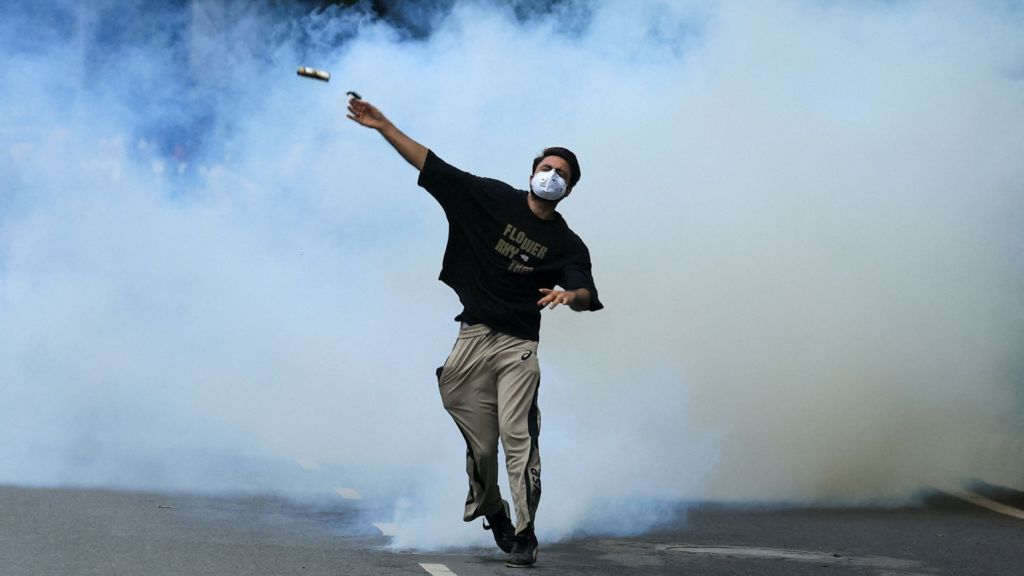
For millions of young Indians across the country, a deeply shared anxiety has curdled into mass public action: if the high-stakes exams that are supposed to unlock their futures cannot be trusted, what can be? That question, sparked by repeated, high-profile leaks of public examination papers, has grown into the largest student mobilization India has seen in years, led by the youth-driven Cockroach Janta Party (CJP) movement. Weeks of simmering frustration boiled over on Monday, when tens of thousands of young protesters attempted to march on India’s national parliament in New Delhi, met with aggressive police action including tear gas barrages and baton charges. In the days that followed, thousands more joined demonstrations across the capital, with protests showing no signs of slowing.
At the heart of the movement is prominent activist Sonam Wangchuk, who wrapped up a 26-day hunger strike in support of the CJP’s demands late Thursday. Wangchuk reported losing 24 pounds during his fast, drawing widespread public attention to the movement’s core demands: sweeping education reforms and the immediate resignation of India’s Education Minister Dharmendra Pradhan. Despite the end of Wangchuk’s hunger strike, student leaders have confirmed demonstrations will continue until their full demands are addressed.
The movement has sparked urgent national debate: is this just another fleeting student protest, or the starting point of a larger political shift in India? History offers conflicting precedent: student movements have occasionally reshaped Indian politics, such as the 1970s Nav Nirman agitation in Gujarat that helped catalyze Jayaprakash Narayan’s widespread campaign against then-Prime Minister Indira Gandhi. But many other large youth uprisings have faded quickly from public view after an explosive debut.
What makes the CJP movement unusual is not just its unprecedented size, but the broad, cross-cutning nature of the anger driving it. Unlike the largest high-profile protests against Prime Minister Narendra Modi’s ruling Bharatiya Janata Party (BJP) over the past decade — from the 2019 citizenship law protests to the 2020-2021 farm laws demonstrations — this movement is not rooted in ideological conflict, nor does it represent the narrow interests of a single community or social group.
Instead, it challenges a core promise of the Indian state: that the national examination system, seen by millions of young people as their primary path to upward social mobility, will be fair and accessible. As Yamini Aiyar, Senior Visiting Fellow at Brown University, explained to the BBC, the Indian education and exam system crosses traditional lines of caste, class, and gender to an extraordinary degree, meaning the protesters gathered do not represent any single narrow interest group.
Rahul Verma, a fellow at New Delhi-based independent think tank the Centre for Policy Research, frames this as a fundamentally unique political challenge to the ruling BJP. “This movement centres on administrative failure,” Verma noted. “The state’s inability to conduct examinations fairly and prevent paper leaks makes it a very different kind of political challenge.” This change in the nature of the grievance reshapes Indian political dynamics: unlike earlier protests rooted in ideology or specific policy disputes, this movement directly questions the BJP’s basic ability to govern. Many of the participating protesters, Verma adds, are not traditional opponents of the BJP — they are aspirational young Indians and their parents who view these public exams as their best chance for upward mobility. Because the anger centers on governance failure rather than ideological opposition, the BJP cannot easily mobilize its base or deploy the partisan counter-narratives that helped it overcome earlier protest movements.
Monday’s massive turnout confirmed that the movement’s momentum, which had built rapidly online, has successfully translated to on-the-street action. For weeks before the parliamentary march, comparisons to India’s 2011 anti-corruption movement focused on the CJP’s impressive digital reach, with skeptics questioning whether online enthusiasm would translate to offline turnout. Monday’s crowds put those doubts to rest.
Joyojit Pal, a University of Michigan professor specializing in technology and society, describes modern social media as “a tinderbox waiting to explode with the next thing,” where viral spread is driven by raw collective emotion. Long-simmering public frustration over a lack of government accountability created the conditions for this mass protest, Pal says, and the structure of social media makes similar large-scale eruptions increasingly likely in the future.
Analysts now agree the movement may have already crossed a critical tipping point, though its long-term trajectory depends almost entirely on the BJP government’s response. Aiyar notes that while established political groups including student unions, left-wing organizations, and Dalit rights group the Bhim Army joined the march, they were vastly outnumbered by a spontaneous, organic outpouring of students from every corner of India. “That’s unique compared to any significant protest in India’s recent history,” she says. What is more, the movement has already outgrown its origins as a CJP-led campaign and Wangchuk’s hunger strike: “The catalyst may have been the CJP, but it became bigger than them.” Protesters did not only turn out over the paper leaks themselves, she explains, but to claim a public space to express the deep, long-held frustration over shrinking opportunity that many young Indians carry. Memes, posters, and on-the-ground slogans all point to grievances that stretch far beyond the specific issue of examination security.
After initially leaving the response to junior ministers and party spokespeople, the BJP’s top national leadership stepped in to address the protests this week. Defence Minister Rajnath Singh accused opposition parties of using students as “a political tool,” while asserting the government remained committed to addressing protester concerns through parliamentary processes. Prime Minister Modi addressed the controversy publicly for the first time on Thursday, writing on X that “Nothing is more important than the welfare and future of our youth.” He announced the creation of fast-track courts to deliver “swift and stringent punishment” for anyone involved in organizing paper leaks, adding “Those who try to harm the future of our youth will not be spared.”
It remains unclear whether these promises will be enough to de-escalate the protests. Aiyar argues the movement has tapped into far broader national anxieties: a slowing economy, chronic job scarcity, and a growing sense that future generations will face fewer opportunities than their predecessors. “There is deep economic dissatisfaction and distress, which has translated into a lack of hope about the future,” she says. “This could reflect growing exhaustion with a government that has been in power for a long time. Its failure to deliver on the promises it built its reputation on may have reached a tipping point.” For Aiyar, the protests are about far more than a single administrative failure: protesters are sending a clear message that they are exhausted with the status quo, and demand a new kind of politics focused on good governance and tangible results, not just partisan rhetoric.
Whether this widespread frustration can coalesce into a lasting political movement remains an open question. Political scientist Suhas Palshikar argues the CJP movement may simply act as a temporary outlet for public anger before gradually losing momentum, similar to the post-repeal fade of the 2020-2021 farmers’ protests. “Where will the Cockroach movement go? Perhaps nowhere — it will allow venting of frustration and taper off,” he wrote on X. Palshikar also cautions against framing the movement as an inherently revolutionary Gen Z uprising, arguing that “It would be a mistake to imagine a youth movement or a Gen Z movement — these are only convenient myths for commentators.” The movement’s ideological and political identity remains fluid, he notes, and multiple competing political forces will almost certainly attempt to assert influence over it. That said, Palshikar acknowledges that protesters have already made one undeniable impact: they have proven young Indians are willing to confront the state directly, even in the face of harsh police repression, and have shown that street action is the only way to force the current regime to engage with public grievances. Whether that energy will endure, he argues, depends on multiple factors including state repression, media blackouts, internal leadership challenges, and the difficulty of building a lasting cross-group coalition.
Economist Surajit Mazumdar of Jawaharlal Nehru University in New Delhi agrees that the movement points to far larger shifts than just anger over paper leaks. “The current protest and the spontaneous response it has evoked is indicative of the widespread discontent of young people and students about the state of affairs in the country and in the education system which goes beyond the specific paper leak issue,” he told the BBC. Compared to earlier student mobilizations, Mazumdar says the current movement is broader and larger in scale, and rejects claims that it is post-ideological. Like the farmers’ movement before it, he argues, the CJP protests prove that “the democratic spirit is still alive in Indian society.”
For Aiyar, this democratic impulse is already reshaping the nature of Indian politics. “People are seeking accountability for governance in sites that are non-electoral,” she says. “The split between electoral legitimacy and democratic accountability outside electoral space is the new phenomenon of politics in India.” Only time will tell whether this shift proves to be the defining legacy of the CJP protests, or just a passing moment of widespread public anger.