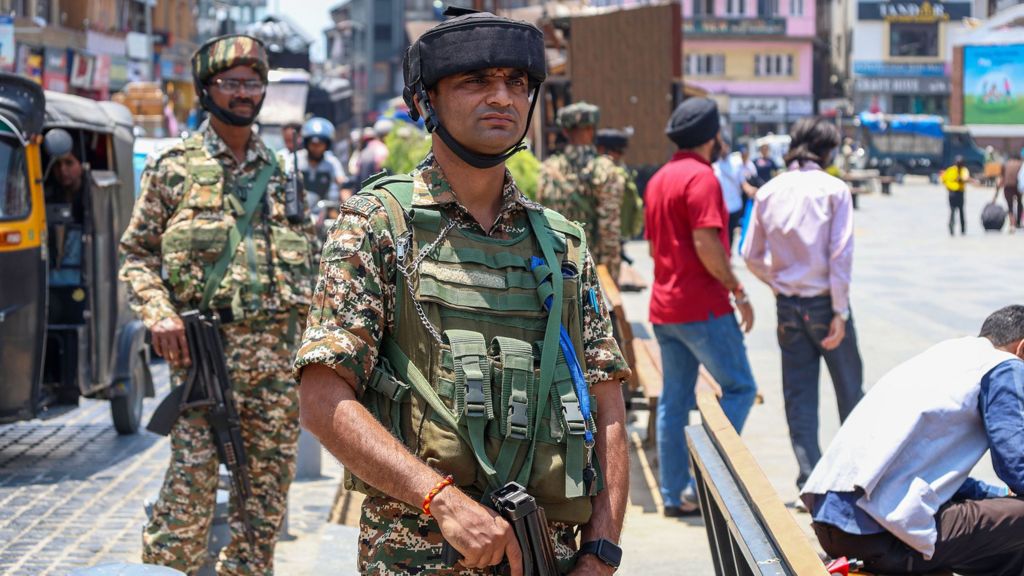
As Pakistan-administered Kashmir prepares to hold its legislative election starting July 27, the region has been swept by unprecedented waves of violent unrest that have claimed at least 40 lives ahead of polling day. Most of the fatalities – 34 in total – are civilian protesters, with six police and paramilitary personnel also killed in the clashes. Rawalakot, a major population center in the territory, has borne the brunt of the worst bloodshed, with ordinary civilians often caught in the crossfire of confrontations between security forces and demonstrators.
Naqash Zardad, a 30-year-old employee of the regional education department, was one such unintended victim. Zardad was tending to his buffalo farm on the outskirts of Rawalakot when nearby clashes between police and protesters erupted, blocking all routes leading back to his home. When gunfire rang out during the confrontation, a stray bullet struck Zardad, killing him instantly, his uncle Altaf Hussain confirmed in an interview with the BBC. His death is just one example of how ordinary residents have been trapped between two opposing sides in a mounting political crisis.
At the core of the unrest is a long-simmering dispute over 12 reserved legislative seats in the territory’s 53-member regional assembly. These seats were first established under 1970s legislation to guarantee political representation for Kashmiri refugees who fled from Indian-administered Kashmir to settle in Pakistan decades ago, on the premise that they would retain a voice in regional governance if the long-standing Kashmir dispute between India and Pakistan was eventually resolved. Today, however, the majority of people eligible for these seats do not actually reside in Pakistan-administered Kashmir, effectively barring local residents from contesting these positions and denying them proportional representation in the legislature.
The protest movement is led by the Joint Awami Action Committee (JAAC), an alliance of local activist groups that has organized widespread marches and demonstrations demanding the full abolition of the reserved seats. JAAC argues that all legislative seats should be reserved exclusively for permanent residents of the region to ensure fair and representative governance, and the group has stated it has no intention of contesting the upcoming election itself.
In response to the protests, the Pakistani government has designated JAAC a banned organization under national anti-terrorism laws and launched a widespread crackdown on demonstrators. Critics of the government’s response have accused security forces of using excessive lethal force to suppress the peaceful protest movement, a charge that has sparked international condemnation.
Large swathes of the local population have heeded JAAC’s call for protests, turning out in large crowds to demonstrate against the seat reservation policy. The unrest has upended the entire electoral process, forcing candidates from all major political parties to scale back their public campaigning dramatically. Candidates’ vehicles and campaign property have been targeted in arson attacks, and multiple candidates have been subjected to physical violence, with authorities blaming JAAC for these attacks. Today, most public political rallies have been canceled, with campaign meetings instead confined to private homes or small street corner gatherings.
Noreen Arif, the only female candidate running for the ruling Pakistan Muslim League-Nawaz (PML-N) party, confirmed that JAAC’s protest movement had forced her to move all campaign activities into private residences rather than hold public gatherings. Sardar Mukhtar Khan, a candidate from the main opposition Pakistan People’s Party (PPP), noted that the protest movement commands widespread support among young local residents, leaving candidates with no option but to run limited, low-key campaigns. “An election candidate has to move according to the mood of the people in his constituency,” Khan told the BBC.
It was only in the final week of campaigning that senior leaders from the PPP and PML-N held the first large public rallies of the election cycle, a marked departure from the open, large-scale campaigning that defined previous elections in the region. When the BBC visited the regional capital of Muzaffarabad in the lead-up to polling, reporters documented a pervasive atmosphere of tension and fear across the city. Most residents declined to speak publicly about the election: pro-election residents and candidates fear being labeled traitors or collaborators by JAAC supporters, while JAAC backers report persistent harassment and intimidation from law enforcement and intelligence agencies.
The Pakistani government has remained firm in its commitment to hold the election as scheduled, spread across three voting phases starting July 27. Ameer Muqam, Pakistan’s federal minister for Kashmir Affairs, framed the vote as the only path forward for the region. “Whoever people vote for should come into power and make decisions regarding their future and destiny. This authority shouldn’t belong to just a few hundred or thousand people; it should rest with the millions of residents living here in Kashmir to decide who they want to bring in,” Muqam told the BBC.
Not all local observers agree that proceeding with the vote is the right course of action. Zahid Amin, the former head of the Muzaffarabad Development Authority, argued that under current conditions, any election result would lack all credibility. The political context for the vote is already unstable: in the 2021 legislative election, Imran Khan’s Pakistan Tehreek-e-Insaf (PTI) won an outright majority, but the party was ousted from power in a 2022 no-confidence vote, and the region has seen four different prime ministers take office in the four years since. Political analysts describe the 2025 election outcome as too close to call.
The mounting violence and political crackdown have drawn significant international concern. United Nations High Commissioner for Human Rights Volker Türk issued a public statement on July 17 calling for “prompt, thorough and impartial investigations into all deaths that have occurred due to the unrest, both amongst protesters and members of security forces.” Türk also criticized the government’s decision to ban JAAC under anti-terrorism legislation, noting that “the criminalisation of a civil society organisation and imposition of strict limitations on gatherings raise serious concerns about infringements on the rights to freedom of expression, peaceful assembly and association.”
Neighboring India, which claims the entire territory of Kashmir alongside Pakistan, has blamed the unrest on “decades-long systemic exploitation and denial of fundamental rights” of local residents by Pakistan. The two nuclear-armed neighbors have each controlled part of Kashmir since independence from British rule, and the dispute has been a source of repeated cross-border conflict for decades. India has long accused Pakistan of sponsoring cross-border militant activity in Indian-administered Kashmir, a charge Pakistan consistently denies.
Bilawal Bhutto, chairman of the PPP, dismissed Indian statements on the unrest and called for an amicable resolution to the current crisis. Bhutto argued that both JAAC and the Pakistani government bear responsibility for the escalation of violence, and called for the establishment of a truth and reconciliation commission to address grievances, urging both sides to end the punishment of ordinary civilians. He also criticized the 40-day long shutdown of mobile phone and internet services across the region, noting that the prolonged blackout amounts to de facto collective punishment of the entire local population.
As polling day approaches, the region remains on edge, with deep divisions over the election and the future of political representation showing no signs of being resolved before votes are cast.