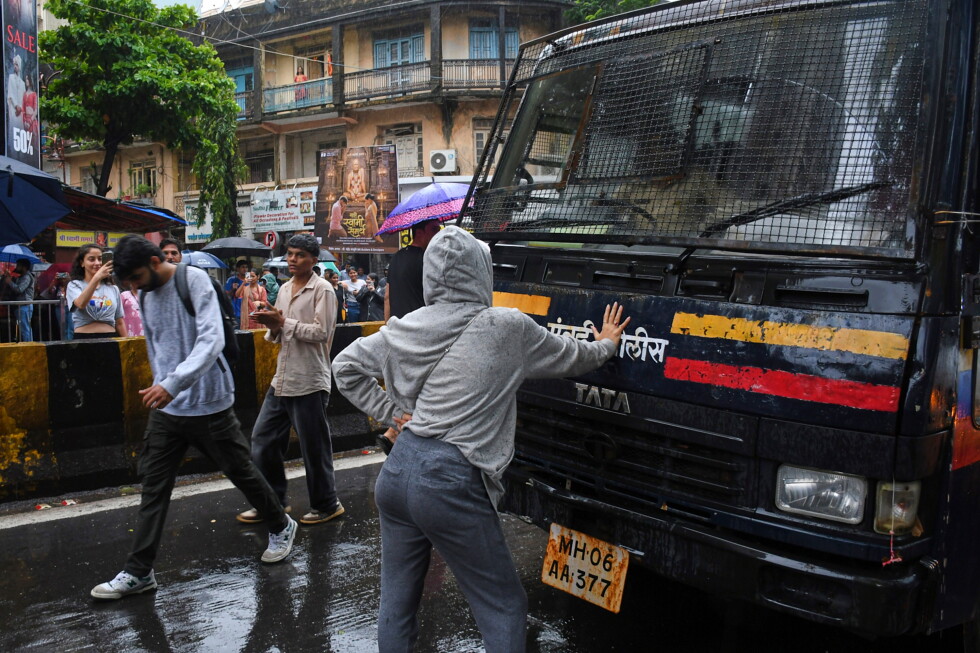
MUMBAI, India — A viral photo captured outside a Mumbai police precinct tells a story of quiet defiance that has come to define India’s spreading “Cockroach” protest movement: a blue police van fills the shot, and 27-year-old Rhiya Ahir plants herself in its path, her hoodie soaked through from a sudden downpour, one palm pressed firmly against the van’s cold metal exterior. Behind the windshield, uniformed officers look on. Inside the vehicle, a group of young demonstrators sat detained, swept up during a mass protest Wednesday in India’s financial and commercial hub. What began as a spontaneous act of solidarity for Ahir has turned her into an unexpected face of a movement that started more than a month ago and now resonates far beyond its original roots.
The protest movement, nicknamed the “Cockroach” protests by participants, first erupted over widespread allegations that highly competitive entrance exams for top medical school positions and coveted government jobs had been compromised by widespread question paper leaks. What started as outrage from young job and education seekers has rapidly swelled into a broader movement, drawing in working professionals, working-class families and longstanding critics of the government. It has become a public outlet for accumulated frustration across a wide swath of Indian society over systemic economic inequality, limited opportunities for young people, and perceived government indifference to widespread public concerns.
On the day of the Mumbai demonstration, Ahir told reporters she had only been waiting to meet friends before joining the planned protest when she spotted the police van carrying detained protesters. Instead of turning away, she approached the officers and asked a straightforward question: did they have the legal required paperwork to justify the detentions of the young activists?
Dissatisfied with the vague and inadequate response she received from the officers, Ahir first walked alongside the moving van as it prepared to depart, keeping pace to continue her challenge. When the vehicle accelerated and she could no longer keep up on foot, she made the split-second decision to step directly in front of the van, blocking its path completely.
Ahir recounted later that she could not stand by and watch as peaceful demonstrators, who were ordinary Indian citizens, were treated like common criminals simply for exercising their right to protest. In response to her blockade, the van’s driver revved the engine loudly, the sudden roar of power a clear attempt to intimidate her into moving. Ahir admitted that in that moment, she acknowledged the very real risks: she could have been arrested, detained alongside the other protesters, or even seriously injured if the driver followed through on the implicit threat. Even so, she refused to step back. She held her position firmly, refusing to move until police agreed to release the detained young protesters. Eventually, officers conceded, and the demonstrators were set free.
In an interview after the confrontation, which lasted roughly 40 minutes from start to finish, Ahir acknowledged she had been afraid throughout the standoff. But her conviction that she was acting in the right outweighed her fear. “I knew one thing,” she said. “If I had started this, I had to end it.” Her act of individual defiance is just one of many that have fueled the growing movement, which has now spread beyond Mumbai to other major Indian cities, with demonstrators holding mass sit-ins in the national capital even as police have stepped up efforts to crack down on gatherings.