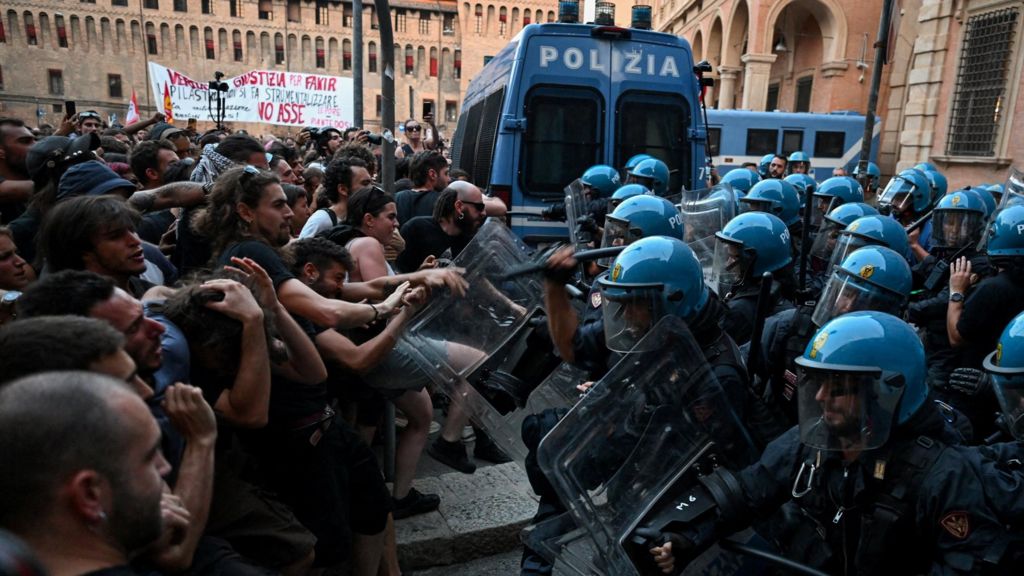
The death of Abderrahim Fakir, a Moroccan-born long-term Italian resident, while in police restraint in the northern Italian city of Bologna has triggered large-scale public protests and reopened heated national debates over police use of force, racial justice, and law enforcement accountability. The incident began on a Sunday morning, when a neighbor in the working-class Pilastro neighborhood called police to report that Fakir was acting erratically and kicking local garage doors. When officers arrived at the scene, they first attempted to de-escalate the situation before deploying pepper spray to subdue him.
Circulated widely across Italian media, a graphic video of the encounter captures the moments after Fakir was forced to the ground. The footage shows two uniformed police officers pinning Fakir to the pavement while he lies face down, repeatedly crying out for the officers to stop holding him. A third civilian bystander assisted officers by holding down Fakir’s legs, as emergency medical personnel stood by nearby. Roughly two minutes into the recording, Fakir ceases all movement. After binding his wrists and ankles, one officer noticed Fakir was unresponsive and slapped him twice on the cheek in an attempt to rouse him. By the time ambulance workers stepped in to assess him, Fakir was already fully unconscious and could not be revived.
In the wake of his death, Bologna prosecutors have opened a formal manslaughter investigation targeting both the responding police officers and the medical personnel present at the scene. Multiple eyewitnesses have told local media that while Fakir was clearly experiencing mental distress at the time of the encounter, he never threatened any bystanders and was completely unarmed. For Fakir’s family, the incident has been an unfathomable loss, and they are demanding full accountability for his death. “You can’t die like this,” his sister Khadija Fakir told reporters. “They killed him mercilessly, and I want the truth.” Speaking at a public demonstration Monday evening, his niece Yossra Fakir pushed back against efforts to reduce her uncle to a headline. “He wasn’t a number, he wasn’t a news line… he was loved,” she said. “He deserved to be helped and heard, and he deserved dignity.”
Bologna’s mayor Matteo Lepore joined widespread public outrage, noting that anyone who viewed the restraint video would be deeply shocked by what they saw. He organized a mass peaceful demonstration in central Bologna on Monday night to call for transparency, and invited members of Fakir’s family to speak alongside him on stage. The demonstration drew thousands of attendees who marched peacefully demanding justice for Abderrahim Fakir, but the event fractured late in the night when a group of roughly 100 protesters split off from the main crowd. Clashes broke out between this splinter faction and police, and two vehicles were set on fire before order was restored. Official reports confirm that 64 police officers were injured during the overnight unrest.
In the aftermath of the protests and violence, Italian political leaders have offered starkly different responses. Prime Minister Giorgia Meloni, head of the current right-wing government, emphasized that a full investigation into the circumstances of Fakir’s death was mandatory to uncover the full truth, but added that “nothing can justify violence against law enforcement.” She condemned the splinter group’s actions, saying “Those who chose to use this incident as a pretext to set the city ablaze, attack officers, and sow violence… were not seeking the truth: they were seeking confrontation.”
Domenico Pianese, secretary-general of Italy’s national police union, also criticized Lepore’s decision to call for a public demonstration the day after Fakir’s death, arguing that the timing opened the door for anti-police and pseudo-anarchist groups to exploit the tragedy for their own political gain. Defending the responding officers’ actions, Pianese claimed that the intervention shown in the video was carried out correctly. He argued that the fact officers needed to use pepper spray and request civilian assistance to restrain Fakir proved that the level of force used was not excessive, adding that officers had immediately turned over all body camera footage to prosecuting authorities as soon as the incident concluded.
Opposition political figures have pushed back against the government’s rhetoric and its show of solidarity with police, echoing public calls for full accountability. Ilaria Cucchi, a senator with the opposition Greens and Left Alliance whose own brother Stefano died in Italian police custody in 2009 — a case that became a national scandal — criticized the government’s positioning. Many protest signs carried at the Bologna demonstration explicitly referenced Stefano Cucchi’s case, linking Fakir’s death to a long history of controversial deaths in police custody in Italy. Center-left Democratic Party lawmaker Francesco Boccia also hit out at the government, accusing it of adopting heavy-handed U.S.-style immigration enforcement tactics that have led to unnecessary deaths.
Fakir, who was in his 50s, had been part of a Moroccan family that settled in Italy more than 30 years ago, and lived near Bologna for decades where he operated a small local logistics and delivery business. His immigration lawyer Barbara Spinelli remembered him as a kind, hardworking person, and wrote on social media: “[Fakir] was a hardworker, he was kind… Ask yourselves why he died in the hands of those who had an institutional duty to protect his life.” As the manslaughter investigation moves forward, Italy remains deeply divided over the incident and what it says about systemic issues in national law enforcement.