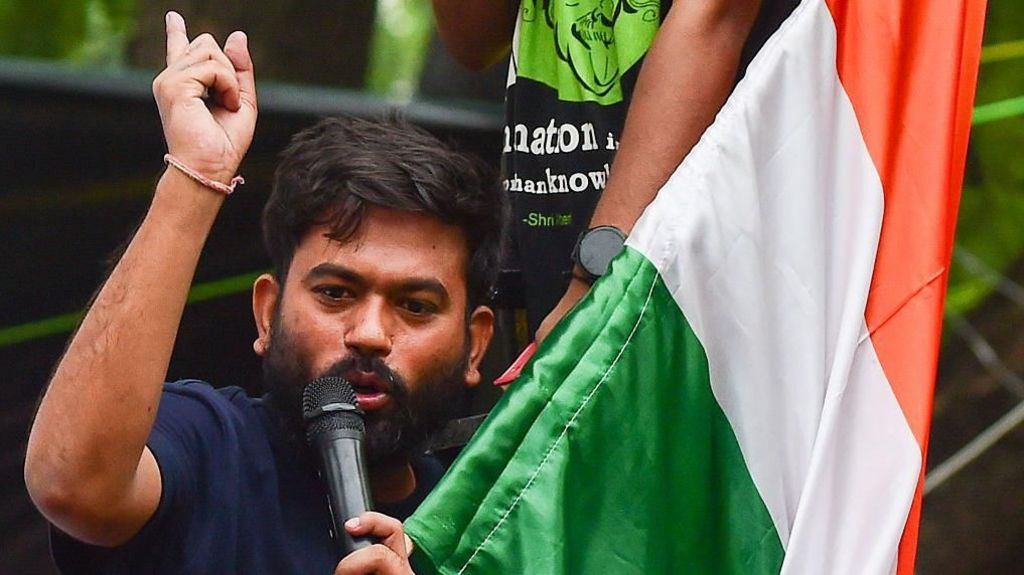
Fresh mass demonstrations have resumed in India’s capital New Delhi, just 24 hours after a violent police crackdown on supporters of the youth-led Cockroach Janta Party (CJP), a grassroots movement demanding sweeping national education reforms and the resignation of Union Education Minister Dharmendra Pradhan.
The unrest unfolded on Monday, when tens of thousands of young demonstrators from across the country defied a pre-existing police ban to march toward India’s Parliament during the opening of the monsoon legislative session. What began as a peaceful mass mobilization quickly escalated into widespread chaos in Central Delhi, when security forces deployed batons and tear gas to disperse the crowd. Official police accounts confirm that at least 60 protesters and 118 police personnel were injured during the operation, while 70 demonstrators remain in police custody. Officers also cleared the movement’s long-standing protest encampment at the historic Jantar Mantar observatory, tearing down the main stage and all makeshift shelters set up by participants.
Multiple on-the-ground accounts from protesters, shared with international media, confirm that even female demonstrators were not spared from the use of force. Social media footage, circulated once local internet access was restored after a full-day blackout, shows uniformed and plainclothes security officers beating fleeing protesters, with multiple people left unconscious on the ground. Eyewitness reports describe panicked crowds scrambling over police barricades to escape, with demonstrators suffering severe head wounds and broken bones that required emergency treatment from volunteer medics.
The CJP, an unregistered satirical political movement, traces its origins to a controversial comment made earlier this year by India’s Chief Justice, who infamously described unemployed young people entering journalism and activism as “cockroaches”. After the remark sparked national outrage, the justice clarified he was only referring to people holding what he called “fake and bogus degrees”, but the label was adopted reclaimed by young activists as a badge of protest against systemic failures in India’s education sector.
The movement had maintained a peaceful encampment at Jantar Mantar for more than a month, drawing global attention when prominent education activist Sonam Wangchuk joined the protest on June 28 and launched an indefinite hunger strike to back the CJP’s demands. Wangchuk was forcibly removed from the protest site by police just two days before Monday’s march and transported to a local hospital, where he has continued his fast. What began as a focused demand for education reform has since grown into one of the most significant displays of public dissent against Prime Minister Narendra Modi’s government in recent years.
In advance of Monday’s march, senior Bharatiya Janata Party (BJP) leader and Health Minister JP Nadda met with CJP representatives to discuss their demands. CJP spokesperson Saurav Das described the 10-minute meeting as unproductive, noting that while the government promised to review the group’s concerns, no concrete commitments were made. Other CJP leaders criticized the meeting as a hollow gesture, after being forced to wait four hours for the discussion that produced no results. Early indications suggested the movement might agree to stand down after the meeting, but organizers hardened their stance once internet access was restored and footage of the police crackdown spread widely online.
Shortly after the meeting, as protesters learned of the violence, security forces moved in to clear the entire Jantar Mantar site. Authorities used loudspeaker announcements to repeatedly order demonstrators to evacuate, claiming the protest was officially over. By Monday evening, however, CJP activists had reclaimed the protest site and issued a public call for renewed support, writing in a social media post: “Despite the police brutality, the brave protestors of CJP are back. Delhi, come out and join us at Jantar Mantar – this is now or never! Dharmendra Pradhan Must Resign!”
In an official statement following the crackdown, Delhi Police claimed the operation was justified because protesters had engaged in “unruly, aggressive and violent behaviour”, violated prohibitory orders, attacked officers with stones, breached barricades, and damaged public and government property. The CJP has forcefully rejected this account, accusing police of being the unprovoked aggressors. CJP founder Abhijeet Dipke issued a public apology to supporters, particularly women who were beaten by male officers, writing on X: “We could have done better. I could have done better to protect you from the inhumane actions of the Delhi police.” Dipke also confirmed one young female protester remained in critical condition in a Delhi hospital.
The CJP’s core demands center on a full overhaul of India’s education system, with a specific focus on increasing accountability for repeated high-stakes exam paper leaks. The call for Pradhan’s resignation gained momentum following the leak of the National Eligibility cum Entrance Test (NEET), the country’s mandatory entrance exam for medical school. Nearly 2.28 million candidates sat for the May 3 exam, which was canceled just days later after confirmed reports of widespread cheating and paper leaks. A re-test was held weeks later, but the scandal has already been linked to more than 20 student suicides, with families saying their children were left devastated by the disruption to their academic futures. Pradhan has rejected all calls for his resignation, dismissing the CJP and its supporters as a “B-team of disruptive elements” aligned with the political opposition.
Major opposition parties, farmer union leaders, prominent activists, and even Bollywood celebrities have publicly thrown their support behind the movement. Rahul Gandhi, leader of the main opposition Indian National Congress, has called the protesters’ demands “legitimate” and labeled Modi “the most anti-youth prime minister India has ever had”. As of Tuesday, thousands of demonstrators had returned to Jantar Mantar to renew their protest, ensuring the youth-led movement will remain a major political challenge for Modi’s government in the coming weeks.