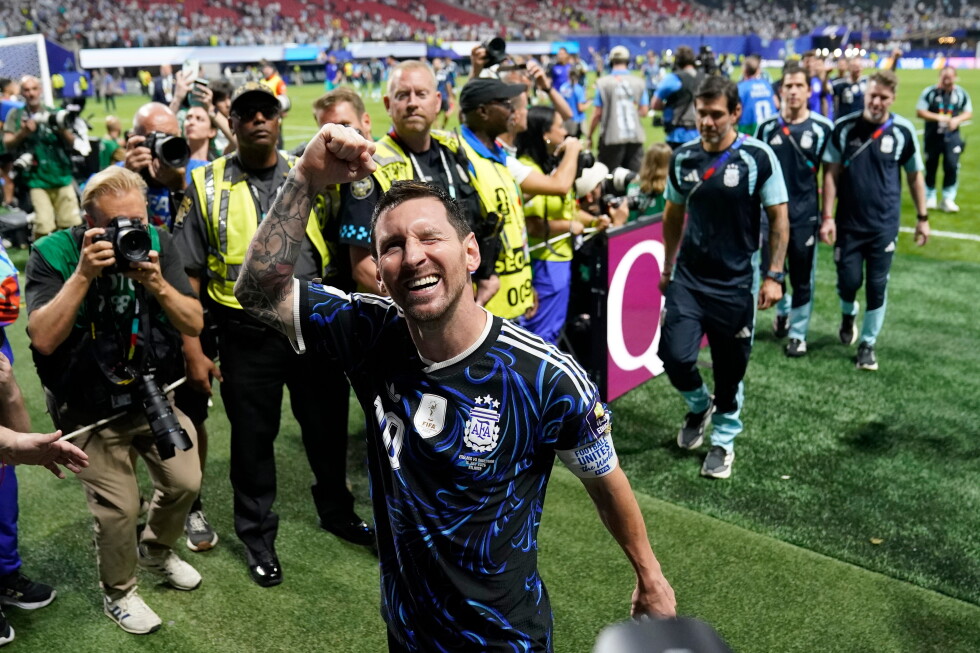
The 48-nation expanded World Cup co-hosted across the United States, Canada and Mexico is set to conclude Sunday with a historic championship clash that lives up to the sport’s highest billing, pitting arguably the greatest player to ever touch a ball against the most dominant international team of the current era. For years, the narrative around global men’s soccer has held that Lionel Messi rarely tastes defeat, and Spain has been unbeatable — a trend that will collide on one of the sport’s biggest ever stages at New Jersey’s MetLife Stadium.
Lionel Messi and defending champions Argentina enter the final against a Spanish side that has not lost a single match in 37 consecutive outings, a streak stretching back to the start of 2024. For Spain, a win would secure a second World Cup title 14 years after their 2010 triumph, and cement their status as the undisputed global powerhouse of men’s soccer. For Argentina, victory would make them the first men’s national team to win back-to-back World Cup titles since Pele led Brazil to back-to-back crowns in 1958 and 1962. For Messi himself, the match is a chance to cap off what he has signaled will be his final World Cup run with Argentina with the fairy-tale ending all fans of the sport are craving.
Spain head coach Luis de la Fuente, who has led the side to an undefeated 28-0-9 record across their current unbeaten streak, framed the matchup as a collision of two elite squads built for the big stage. “On Sunday, we will watch a great show,” he said. “Two great national teams — two superteams, in my opinion — very similar in some aspects in terms of attitude, footballers’ talent. I think that it’s going to be an amazing final.” While the matchup is often framed simply as the world’s best individual against the world’s best collective team, the storylines run far deeper than that surface-level narrative.
The rivalry between Messi and Spanish soccer carries decades of history. Though Messi was born in Argentina, he developed his game as a youth player and spent nearly all of his legendary club career in Spain. At multiple points, the Spanish national federation attempted to convince him to switch allegiances and represent La Roja, but Messi never wavered in his commitment to his home country. Sunday’s match will mark the first time Messi has taken the pitch against Spain since a 2010 friendly, when Argentina defeated the then-reigning world champions in a lopsided rout. When asked about the massive expectations around the match, Messi downplayed the hype, framing it as simply another chance to play the game he loves with his teammates — even with 80,000 fans in the stadium and an estimated 2 billion global viewers tuning in.
One of the most surreal subplots of the final is the meeting between Messi and Spanish teenage star Lamine Yamal. Nearly 20 years ago, a toddler-aged Yamal was photographed with Messi during the Barcelona star’s early days at the club. Now, the young prodigy will share the same World Cup final pitch with the player he once posed for a photo with as an infant.
Reflecting on the roots that brought him to this historic match, Messi spoke in his native Spanish about the joy that first drew him to the sport. “We grew up playing soccer with passion, eager to play,” he said. “We played everywhere. We played on the street. We played at school. We played with teams. We didn’t think about the pressure. It was just natural play.”
Make no mistake, however: the pressure on Sunday will be unprecedented. For Argentina, the match is widely understood to mark the end of the Messi era for the national team, regardless of the final result. Argentina head coach Lionel Scaloni summed up the magnitude of Messi’s legacy for his nation and the sport, calling him “The best footballer that the world has seen.”
This historic final run was almost derailed before it even began, after a high-profile retirement a decade ago. In 2016, a heartbroken Messi walked away from the national team after missing a decisive penalty in a Copa América final loss to Chile, leaving Argentina empty-handed in another major tournament. At 29, he had grown exhausted from falling short of the ultimate prize for his country, and his retirement only lasted a few weeks. In the years since, Argentina has claimed the 2021 Copa América, the 2022 World Cup, and a second Copa América title in 2024, cementing a dynastic run that no one could have predicted after that 2016 loss. What makes the moment even more poetic is that the 2016 final that prompted his retirement was held on the exact same pitch that will host Sunday’s World Cup final: MetLife Stadium.
Messi never truly left the game, of course. He continued to dominate at the club level, starring for Barcelona, Paris Saint-Germain, and now Major League Soccer’s Inter Miami, where he has claimed back-to-back MLS MVP awards and led the club to a league title. Even at this stage of his legendary career, he remains capable of producing match-winning moments in the biggest games with almost effortless ease. Scaloni summed up his legacy simply: “He is pure history. History. A legend.”
Spain is also chasing unprecedented history of its own at this World Cup. Entering Sunday’s match as pre-tournament favorites, La Roja have conceded only one single goal across their first seven matches of the tournament, and have not trailed for even one second of play across the entire tournament. By comparison, Argentina has spent more than 100 minutes of the tournament trailing, including stoppage time. Historic defensive performances of this caliber are almost unheard of at the World Cup. Only three previous World Cup-winning teams — the 1998 French squad, the 2006 Italian side, and Spain’s own 2010 champions — finished the tournament with just two goals conceded. This current Spanish squad is on track to beat that record by miles.
Spain captain Rodri emphasized that his side is not overlooking Argentina’s strength beyond Messi, noting that the two finalists are the most cohesive collective teams in the tournament. “Argentina is far more than Messi,” he said. “They’ve proven that they’re a very complete team with top players. … We are the best two teams playing in a collective manner as a group. Of course, we need to be mindful of Leo, but many other players.”
After a month of thrilling matches, the 104th and final match of the biggest World Cup in history comes down to this: the defending champions against the next generation of global soccer greats, the biggest star the sport has ever known against a squad of players who grew up idolizing him, now with a chance to end his reign on the biggest stage.
This 2026 iteration of the World Cup was not without its share of controversies and challenges, echoing the geopolitical tensions that define the modern era. The tournament faced widespread criticism over multiple high-profile issues, including onerous travel restrictions imposed on the Iranian team amid ongoing geopolitical conflict between Iran and the United States, backlash against FIFA after the governing body lifted a red-card suspension for U.S. star Folarin Balogun following public pressure from former U.S. President Donald Trump — who will be in attendance Sunday to present the championship trophy — and calls for an investigation into Argentina’s squad from the British government after players posed with a banner claiming sovereignty over the Falkland Islands following their semifinal win over England.
Regardless of off-field controversy, the World Cup will end as it always does: with one team lifting the trophy in celebration, and the other left to process heartbreak. Argentina goalkeeper Emiliano Martinez summed up the shared hope of players and fans alike ahead of kickoff: “They’ve got their strengths. So do we. I wish it will be a final that goes down in history.”
AP Sports Writer Stephen Whyno in New York contributed to this report.