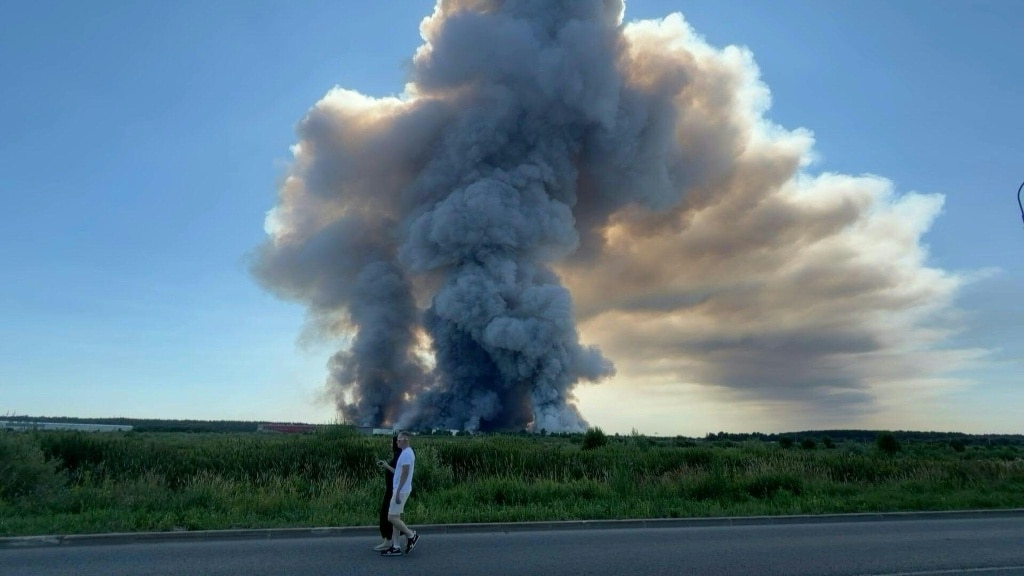
In an escalation of cross-border military action, waves of Ukrainian explosive-laden drones targeted logistics facilities operated by Russia’s largest e-commerce retailer Wildberries in two Russian regions on Saturday, leaving eight people dead and nearly 90 others hospitalized. Large-scale fires sparked by the attacks filled the sky with thick black smoke that lingered for hours, marking one of the deadliest Ukrainian strikes on Russian civilian-linked infrastructure in recent months.
The attack hit two separate Wildberries warehouses: one in the Tambov region, roughly 500 kilometers southeast of Moscow, and a second in Elektrostal, Moscow Oblast, where an oil depot and an empty kindergarten were also damaged. Seven night-shift workers were killed at the Tambov facility, regional governor Evgeny Pervyshov confirmed, while a eighth person died of injuries in a Moscow region hospital, according to Moscow Oblast governor Andrei Vorobyov. An empty kindergarten in Elektrostal was also struck, but no injuries were reported at that site. As of Saturday evening, firefighters were still working to fully contain the blaze at the Moscow Oblast warehouse, while the fire in Tambov had been fully extinguished.
Wildberries CEO Tatiana Kim called the incident an unfathomable tragedy for the company and the country. “A terrible night, terrible events for our company and for our country. It is a pain that cannot be put into words,” Kim said in a statement. An AFP correspondent on the scene observed thick black smoke billowing over the Moscow region from early Saturday morning through late afternoon.
The strike comes as part of Kyiv’s months-long intensification of long-range attacks on Russian territory, a campaign Ukrainian officials describe as “long-range sanctions” and retribution for more than four years of Russian bombardments on Ukrainian civilian and infrastructure targets. To date, this campaign has primarily targeted Russian oil infrastructure, contributing to widespread fuel shortages across nearly 90% of Russia’s regions since June — a disruption to daily life unprecedented since the full-scale invasion began. For Russian civilians, this has meant long daily lines at petrol stations, a sharp shift from years of abundant, low-cost fuel that remained cheaper than prices across Western Europe.
Ukrainian President Volodymyr Zelensky explicitly claimed responsibility for the attack in a post on the social platform X, confirming the targeting of the two logistics facilities. Zelensky alleged the warehouses were being used to store sanctioned components for Russian drone production and military navigation equipment, framing the strike as a direct response to ongoing Russian attacks on Ukrainian civilian infrastructure.
Concurrent with the strike on Russian territory, new Russian bombardments across southeastern Ukrainian regions killed five people and wounded nearly 20 others, according to local reports. The cross-border attacks come amid a broader stalemate on the main front line, where Ukraine has managed to slow Russia’s ongoing summer offensive but has not made significant territorial gains of its own.
The incident also unfolds against a backdrop of growing domestic unrest in Ukraine, where thousands of protesters have gathered for three consecutive days in major Ukrainian cities to oppose the surprise dismissal of popular Defense Minister Mykhailo Fedorov. Zelensky’s sudden government reshuffle, which removed the young, tech-savvy minister who led many of Ukraine’s key military innovation projects, has triggered rare public dissent during wartime. Diploatic efforts led by the United States to negotiate a end to the conflict remain stalled, as Washington has shifted its foreign policy focus to escalating tensions with Iran in recent weeks.
Russian officials have reported a sharp surge in drone attacks targeting Moscow in recent weeks. Moscow mayor Sergei Sobyanin confirmed that more than 370 drones were launched toward the Moscow region during Saturday’s overnight attack alone, adding that nearly 1,892 Ukrainian drones targeting the capital were intercepted between July 11 and July 18.