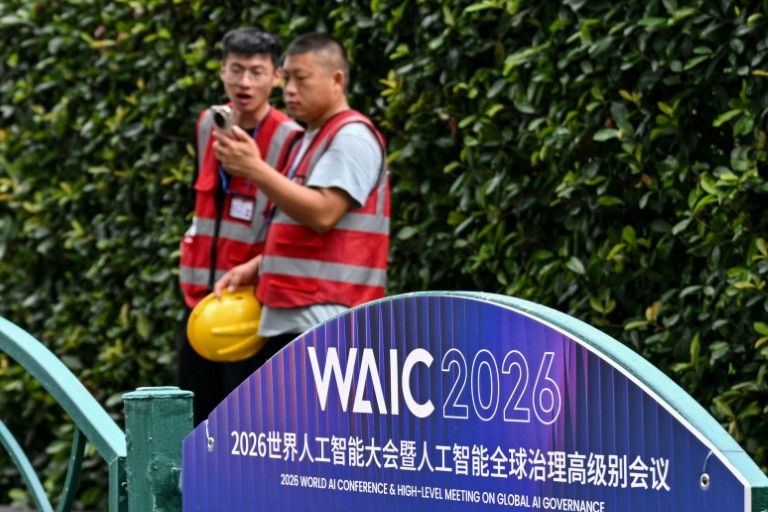
Against a backdrop of growing geopolitical friction over cutting-edge artificial intelligence development, Chinese President Xi Jinping delivered a landmark call for inclusive global collaboration Friday, opening the annual World Artificial Intelligence Conference (WAIC) in Shanghai with a clear rejection of one-nation dominance in the fast-growing sector.
In his opening address, Xi framed AI development as a global collective endeavor rather than a competition for unilateral supremacy. “AI development should not be a solo performance by a single country, but a symphony of international cooperation,” he stated. He also pushed back against growing unilateral restrictions on AI technology trade, noting: “We should jointly oppose overstretching the national security concept in the field of AI or placing one country’s security over that of others.”
The remarks come amid rising tensions: the U.S. and European Union have introduced sweeping restrictions on Chinese technology imports rooted in national security claims, while internal debates within the U.S. over government access to cutting-edge AI models have sparked new uncertainty about global technology governance. Beyond geopolitical disputes, the rapid expansion of AI capabilities has triggered widespread global concern over unregulated use, including potential deployment in military combat and exploitation by malicious actors such as hackers and terrorists. To address these risks, Xi called for a globally coordinated governance framework centered on human oversight, outlining a plan to establish unified laws, regulatory standards, technological monitoring, early warning systems, and emergency response mechanisms to “ensure AI is always under human control” through a “people-centric” approach.
One day ahead of the conference opening, Chinese Foreign Minister Wang Yi joined representatives from 29 countries including Russia, Pakistan, and Indonesia to sign an agreement launching a new intergovernmental AI cooperation body. Headquartered in Shanghai, the World Artificial Intelligence Cooperation Organization will facilitate cross-border consultation and collaboration to advance the “healthy and orderly” growth of global AI, according to Chinese state media. The four-day WAIC has drawn more than 1,000 Chinese technology firms alongside senior officials, leading researchers, and industry leaders from across the globe, with United Nations Secretary-General António Guterres among the high-profile international attendees. More than 3,000 AI-powered products are on display at the event, ranging from high-performance semiconductor systems designed for AI computing to consumer smartphones equipped with autonomous AI app operation capabilities.
Industry analysts describe WAIC as the most authoritative annual event for tracking the trajectory of China’s rapidly expanding AI industry. While the U.S. still holds a clear lead in advanced chip manufacturing, frontier computing infrastructure, and capital-intensive cutting-edge model development, China has emerged as its closest and most comprehensive global competitor, noted Poe Zhao, an analyst with independent technology publication Hello China Tech.
Chinese AI capabilities have advanced at a striking pace in recent years. On the opening day of WAIC, Beijing-based AI startup Moonshot AI unveiled its new flagship model Kimi K3, which industry reports indicate matches or nearly matches the performance of many top-tier U.S. AI models. Other major launches at this year’s conference include MiniMax’s new M3 generative model, the first mass-produced consumer smartphone integrated with a fully autonomous AI agent, and Huawei’s Atlas 950 “supernode,” a purpose-built AI architecture optimized for large-scale machine learning and complex reasoning.
Zhao explained that this year’s conference reflects a key industry shift in China: moving beyond developing standalone large language models to building fully integrated AI systems that can be deployed at scale across everyday consumer and industrial use cases. AI agents—autonomous tools that can hold natural conversations, manage third-party software, and complete complex multi-step tasks for users—have emerged as a central focus of the 2025 event.
AI has become a core strategic priority of Chinese industrial policy, backed by billions in state investment designed to build a fully self-sufficient domestic AI ecosystem spanning from raw chip production to end consumer applications. The scale of China’s AI growth is unprecedented: state media reports that daily domestic consumption of AI “tokens”—the standard industry unit for measuring AI compute usage—has increased 1,000-fold over the past two years. Official projections value China’s domestic AI market at 1.2 trillion yuan ($177 billion) in 2025, with forecast annual growth exceeding 30 percent. Data from the World Intellectual Property Organisation (WIPO) shows China now leads the world in generative AI patent filings, with more than 43,000 new filings recorded between 2024 and 2025, more than any other nation.
A growing number of global corporations are also turning to Chinese AI models, drawn to their competitive performance, lower licensing costs, and flexible open-source customization options that stand in contrast to the closed, proprietary systems offered by leading U.S. AI developers such as OpenAI and Anthropic. Global industrial giant Siemens became one of the highest-profile international adopters of Chinese open-source AI in 2025, signaling growing global demand for alternative AI development pathways outside of U.S. control.