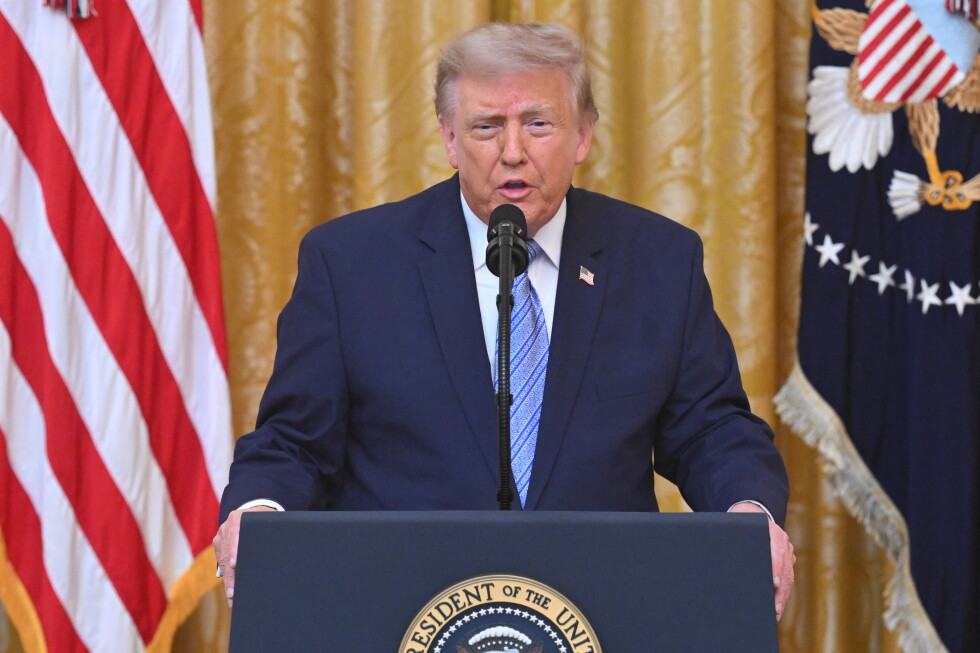
In a primetime national address delivered Thursday from Washington, former and current President Donald Trump centered his remarks on long-debunked claims of widespread election fraud, reviving his years-long campaign to deny his 2020 loss to Democratic opponent Joe Biden while offering no verifiable evidence to back his allegations.
Trump opened the speech by touting what he framed as key policy wins of his second term, before shifting to a stark warning about purported systemic flaws in U.S. electoral infrastructure. He announced he would declassify a set of previously sealed documents related to the 2020 presidential election and 2018 midterm contests — elections in which he lost the White House and his Republican party suffered significant congressional defeats. Concurrent with the address, the White House launched a public website hosting the declassified materials, which were released without broader contextual framing and consist of snippets from investigation files, intelligence memos, and internal correspondence.
Multiple independent and partisan reviews, including probes led by Republican officials and Trump’s own first-term attorney general, have repeatedly confirmed no widespread fraud or vote manipulation altered the 2020 election outcome. No credible intelligence has ever corroborated claims that foreign actors changed the final vote count in that contest. Notably, Trump declined to question the validity of his own 2016 and 2024 election victories.
Trump argued that current U.S. electoral systems fail to meet a standard of fairness and honesty, framing his push for strict federal voter ID legislation as an urgent response to the vulnerabilities he outlined. “America is back and doing really well, but we still have a major challenge that must be urgently addressed, because no country can be great without fair and honest elections,” he said. “Unfortunately, the system we have today falls catastrophically short of that standard.”
Experts and former intelligence officials have pushed back hard on Trump’s framing. Sue Gordon, who served as principal deputy director of national intelligence during Trump’s first term, described the address as “a dangerous speech about an incredibly important topic.” She told CNN that the intelligence community repeatedly warned Trump of foreign election interference during his first term, only to be dismissed and criticized by the president amid the investigation into his 2016 campaign’s ties to Russia. “He had an entire term to deal with it and I don’t know how you can believe how the same community that told him about it, that was excoriated about it wouldn’t warn him in 2020,” Gordon said.
Observers also highlighted a striking omission in Trump’s remarks: while he centered China as a primary foreign threat to U.S. elections, he made no mention of Russia, which U.S. intelligence agencies have repeatedly confirmed launched wide-ranging influence campaigns to support Trump in both the 2016 and 2020 presidential contests. He also declined to issue any criticism or warning to Chinese President Xi Jinping, a leader he has repeatedly praised throughout his political career.
Primetime presidential addresses to the nation are traditionally reserved for major national events or urgent national milestones, but Trump has increasingly used the platform for overtly political messaging in his second term. His April 2025 primetime address focused on the ongoing Iran war, where he claimed U.S. objectives would be completed “very shortly” — a prediction that has not held, as strikes between U.S. and Iranian forces have intensified in recent weeks.
Not all major broadcast networks chose to air the address live. ABC, NBC, and CNN declined to carry the live speech on their linear channels, opting instead to stream it in full on their digital platforms and cut into regular programming only if developments warranted it. CBS and MSNBC cut away from the address before Trump concluded his remarks, while Fox News aired the entire speech live. Trump hit back at the non-airing outlets, accusing them of participating in “a plot” to suppress his message.
White House press secretary Karoline Leavitt had pushed networks in advance to carry the address live, arguing “the mainstream media should air the president’s speech and allow the American people to draw their own conclusions from it.” Network decisions to decline live coverage are not unprecedented: in 2022, then-President Joe Biden’s primetime address warning of Trump’s extreme ideology was not carried live by major networks, and in 2014 major outlets opted to stick to scheduled entertainment programming rather than air then-President Barack Obama’s address on immigration reform.
Democratic lawmakers have warned that Trump’s revival of false 2020 election claims is a deliberate tactic to sow public distrust in electoral systems ahead of the 2026 midterm elections, where Republicans face challenging political headwinds. Sen. Mark Warner of Virginia called Trump’s claims “totally bogus,” noting in a social media statement that “our intelligence agencies unanimously agreed that China did not even try to change a single vote in the 2020 election.” Rep. Joseph Morelle of New York, ranking Democrat on the House committee overseeing federal elections, said Trump is laying groundwork to discredit the 2026 results. “This is a pretext for the president, I think, calling into dispute the 2026 elections,” Morelle told C-SPAN, adding “we have secure elections.” Democratic Sen. Chris Coons of Delaware noted that “I heard no concrete allegations that foreign actors actually changed the results of an American election.”
When asked Thursday whether Trump would commit to accepting the results of the 2026 midterms, Leavitt declined to answer. Vice President JD Vance told reporters a day earlier that “of course we’re gonna support the results of the midterm elections,” but pushed back on questions about why Trump was prioritizing relitigating past contests rather than focusing on upcoming elections. The Associated Press contributed additional reporting from correspondents across Washington and New York.