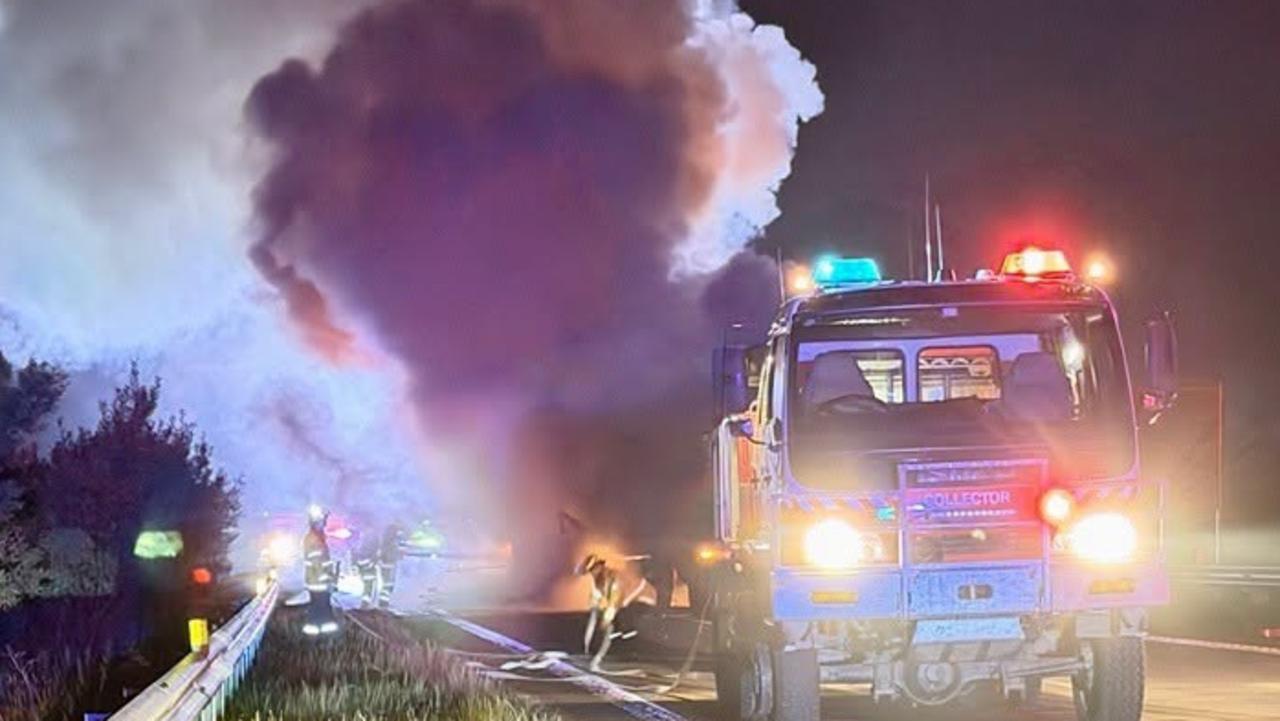
A catastrophic early-morning collision between two heavy goods vehicles has shut down a critical intercity highway connecting Australia’s two largest urban centers, leaving one driver missing and emergency crews scrambling to contain a large vehicle fire.
The crash unfolded at approximately 4:10 a.m. Friday on the Hume Highway near the small town of Breadalbane, when a road train collided head-on with a B-double truck. Moments after impact, one of the two vehicles erupted into an intense inferno that sent a thick, dark blanket of smoke billowing across the entire roadway, disrupting visibility and complicating initial emergency response efforts.
Emergency responders quickly arrived at the isolated crash site to extract trapped drivers and bring the blaze under control. The 31-year-old operator of the road train was pulled from the wreckage with only minor head trauma, and was immediately transported to Yass Hospital for observation and further medical care. But despite extensive search efforts amid the active fire, the driver of the B-double truck has not yet been located, and remains officially listed as unaccounted for as of Friday morning.
Firefighters from the New South Wales Rural Fire Service remain on scene hours after the crash, working to fully extinguish the deep-seated blaze and mitigate environmental risks from leaking fuel and other vehicle fluids, including containing any hazardous run-off that could seep into nearby land or water systems.
The Hume Highway, the primary arterial route connecting Sydney in New South Wales and Melbourne in Victoria, was closed to traffic in both directions immediately following the collision. While southbound lanes have been cleared and reopened to motorists after initial cleanup work, northbound lanes will remain closed for an extended period as emergency crews complete their work and infrastructure assessments begin.
Transport authorities have diverted all northbound traffic through Canberra via the Barton and Federal Highways, urging long-distance drivers to plan for significant delays and consider alternate routes where possible.