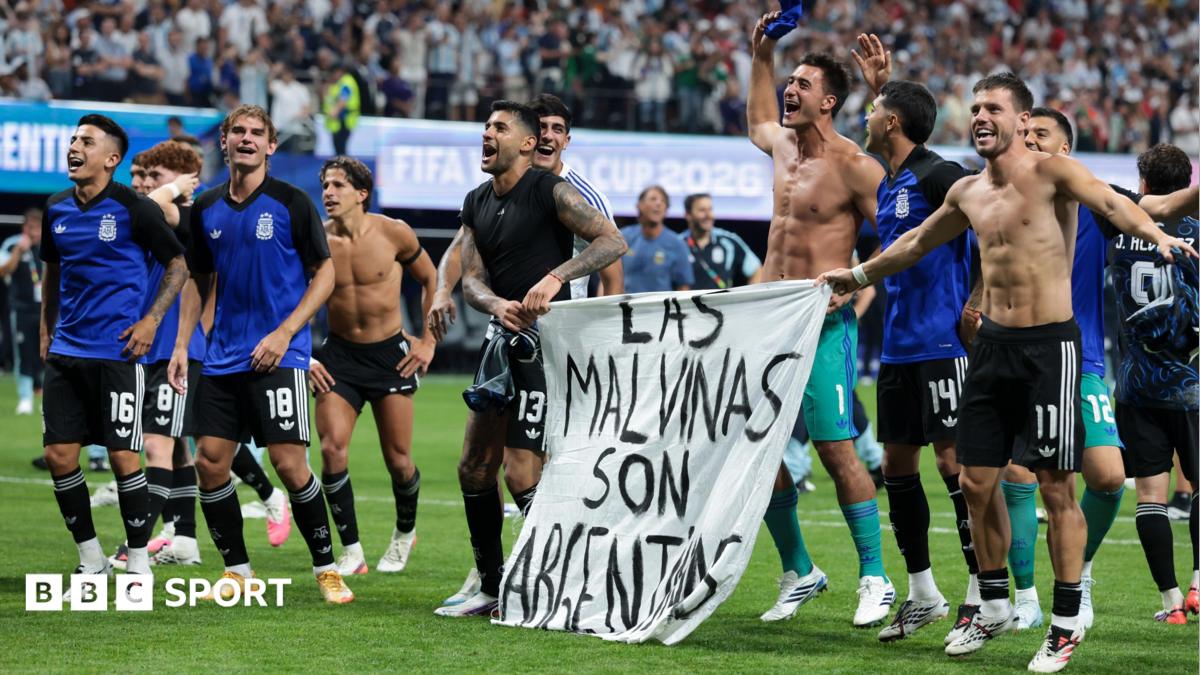
A stunning late comeback victory for defending champions Argentina over England in the 2026 World Cup semi-final has been overshadowed by a provocative political gesture that now puts the South American side at risk of formal disciplinary action from global football governing body Fifa. Playing in Atlanta, Argentina overturned a 1-0 deficit to score two late goals, securing a 2-1 win over Thomas Tuchel’s England side and booking their place in Sunday’s tournament final against Spain.
What should have been a moment purely of sporting celebration quickly turned controversial, when members of the Argentina squad unfurled a banner emblazoned with the phrase “Las Malvinas son Argentinas” — translated as “The Falklands are Argentine” — a reference to the long-running sovereignty dispute over the South Atlantic territory. The Falkland Islands, a self-governing British Overseas Territory located around 300 miles off Argentina’s eastern coast, has been contested by Buenos Aires and London for decades. The disagreement erupted into open armed conflict in 1982, when Argentine forces invaded the islands, leading to a 74-day war that claimed the lives of 655 Argentine servicemen, 255 British military personnel, and three civilian residents of the islands.
This is not the first time Argentine football authorities have faced sanction from Fifa over this exact gesture. Back in 2014, the Argentine Football Association was fined £20,000 after players displayed the same slogan on a banner ahead of a friendly match against Slovenia. Fifa ruled at the time that the action violated its regulations banning political statements and player misconduct.
In the wake of Wednesday’s semi-final win, senior Argentine political figures have publicly backed the team’s gesture. Argentina’s vice-president Victoria Villarruel took to social media platform X to write that the match “wasn’t just another match”, pairing her post with a video appearing to show Argentine service members. “The Falklands are Argentine,” she added. “They banned bringing them to the stadium and forgot that we carry them in our blood and our hearts.” In pre-match comments, Villarruel had already framed the fixture as an opportunity “to put the invaders in their place”, stoking political tensions ahead of kickoff.
This is not the first incident of its kind during Argentina’s 2026 World Cup run: following the team’s dramatic 3-2 round of 16 victory over Egypt, players sang chants referencing the Falkland Islands alongside tributes to Argentine legends Diego Maradona and Lionel Messi.
Notably, Argentina manager Lionel Scaloni had explicitly stated ahead of the semi-final that he refused to conflate football and politics. “The reality is that this is a football match. I can’t mix things up, especially out of respect for what happened so many years ago,” Scaloni told reporters ahead of the game. “It was a very sad period in our history, and there isn’t much we can do about it, that’s the reality. Things are happening elsewhere in the world, and we criticise the existence of war. We certainly remember those people, of course. But it is a football match – we shouldn’t confuse the two.”
Due to longstanding historical tensions between the two nations, the semi-final was already held under heightened security measures, with organizers preparing for potential unrest surrounding the high-stakes fixture. The match was ultimately decided by late goals from Enzo Fernandez and Lautaro Martinez, who turned the game on its head to send Argentina through to the final, leaving England eliminated from the tournament at the semi-final stage. Fifa has yet to announce the timeline or details of any disciplinary proceedings against Argentina following the banner protest.