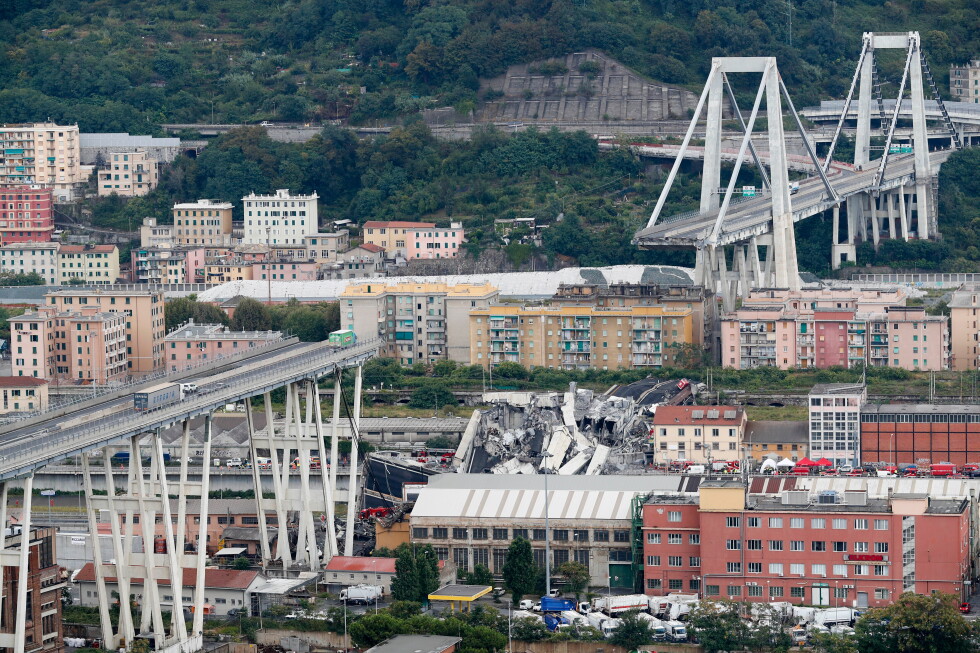
GENOA, Italy – Nearly eight years after one of Italy’s deadliest infrastructure disasters killed 43 people, a Genoese courtroom is set to deliver long-awaited verdicts Thursday in the trial of 57 defendants charged over the collapse of Genoa’s Morandi highway bridge. The disaster, which exposed systemic failures in Italy’s national infrastructure upkeep, has remained a raw wound for victims’ families and a national reckoning over public safety standards for years.
The defendants facing judgement are a broad group that includes former senior executives from Autostrade per L’Italia, Italy’s major highway concession operator, lead engineering experts from the firm’s subsidiary SPEA, and ex-officials from Italy’s national Infrastructure Ministry. Nearly all defendants stand accused of negligent conduct leading to widespread disaster and multiple counts of manslaughter, stemming from allegations that they deliberately neglected mandatory upkeep and safety inspections for the aging bridge, a critical transit link connecting northern Italy to the French Riviera.
The collapse unfolded on the morning of August 14, 2018, when a 200-meter section of the concrete bridge crumbled during a heavy rainstorm. Dozens of cars and heavy trucks fell more than 40 meters to the ground below, killing all occupants. Graphic footage of the destroyed span spread globally, sending shockwaves across Italy: the collapse occurred on the eve of Ferragosto, Italy’s iconic mid-summer public holiday, when millions of Italians were already traveling for summer vacation, making the disaster a national conversation overnight.
Lead prosecuting attorneys have argued that decades of deferred maintenance and ignored safety warnings directly caused the structural failure, and have collectively called for nearly 400 years of combined prison sentences for the 57 defendants. All defendants have consistently denied any criminal wrongdoing, asserting that an inherent, unforeseen construction defect from the bridge’s original design was the root cause of the collapse.
Thursday’s verdicts will bring a close to a sprawling trial that has stretched over four years and included more than 280 separate court hearings, as legal teams sifted through thousands of pages of engineering reports, maintenance records and witness testimony.
For victims’ legal representatives, the core demand is not just harsh sentences, but formal recognition that the disaster was preventable. “Our expectation is to feel our pain recognized … and to have it acknowledged that this did not happen by chance, but because of serious failures in maintenance,” explained Raffaele Caruso, one of the lead attorneys representing multiple victims’ families.
When the Morandi Bridge opened to traffic in 1967, it was hailed as a groundbreaking engineering marvel, defined by its three distinctive A-shaped concrete pylons and unique concrete-encased stay cable design. Caruso noted that the trial has already confirmed that warning signs of structural degradation in the pylon that ultimately collapsed were documented as early as the 1990s. Maintenance work to address the same corrosion defect was completed on the bridge’s two other pylons starting in 1993, but work was never scheduled or carried out on the third failed pylon.
“From 1993 onward, the problem was known. We had three identical pylons. Two had already shown the same defect, and no one seriously asked whether the third one had it as well,” Caruso told reporters ahead of the verdict.
Ahead of Thursday’s ruling, current Autostrade chief executive Arrigo Giana, who took over the role last year, issued a formal public apology in an open letter published in all major Italian national newspapers Thursday morning. “The actions and decisions of some people left indelible scars,” Giana wrote. “Offering today the apology that was not made then is, for us, a moral imperative that goes beyond establishing legal responsibility and the course of justice toward the truth.”
Earlier in the legal process, Autostrade and its engineering subsidiary SPEA reached a separate corporate liability settlement with prosecutors. The firms agreed to pay roughly 30 million euros ($34 million) in administrative fines, and implemented sweeping new corporate compliance protocols designed to prevent similar safety failures in the future. All victims and their families have already received full financial compensation through the agreement. In exchange, the companies avoided standing trial as corporate defendants, and escaped far harsher potential penalties that would have included a ban on bidding for future public infrastructure contracts across Italy.
A replacement span, designed by world-renowned Genoa-born architect Renzo Piano, opened to traffic in 2020. The new bridge was built alongside a permanent public memorial honoring the 43 people killed in the 2018 collapse.