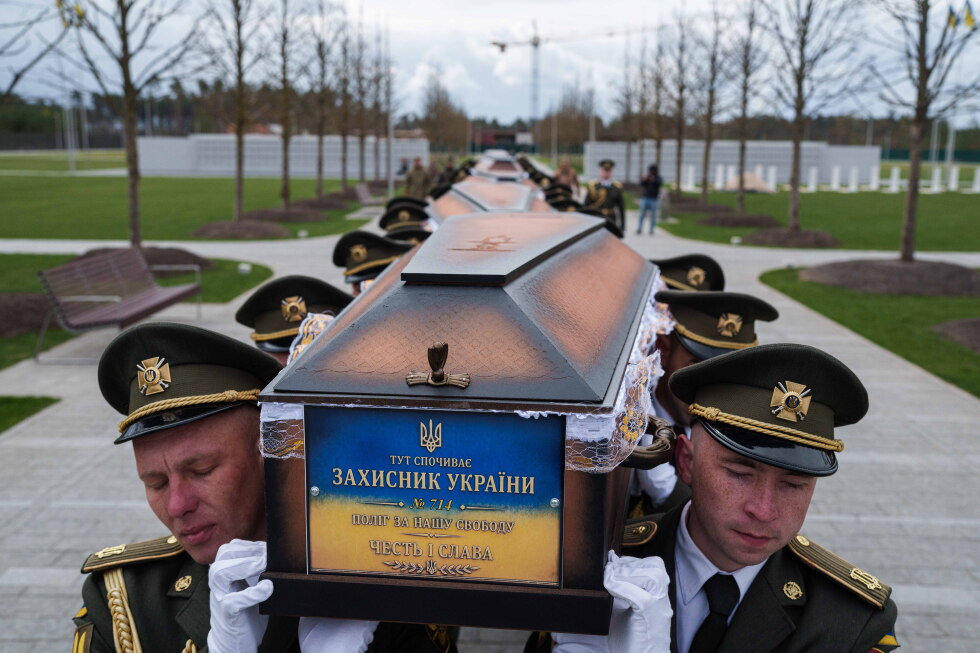
On a quiet, somber day at Kyiv’s main military cemetery, siblings Stanislav and Oleksandra Yalynych walked slowly between rows of plain wooden crosses, clutching a bouquet of deep red carnations. Every cross in this section of the burial ground shares the same heartbreaking inscription: “unknown defender of Ukraine”, etched above a unique identification number and a small note stating that efforts to confirm the soldier’s identity are still ongoing. One grave, however, now stands apart from the rest: beneath the generic wording, a photograph has been taped to the cross — that of Ihor Yalynych, a Ukrainian soldier who was last seen alive in the Kharkiv region in early 2022. After four long years of relentless searching, the two siblings finally found their father.
The painstaking work of identifying Ukraine’s fallen troops has emerged as one of the longest, most raw open wounds left by Russia’s full-scale invasion, a national reckoning that experts and officials agree will stretch on for decades after the final shots are fired. Hundreds of unidentified troops already rest in the Kyiv cemetery, with new grave sites dug every week to accommodate more remains, and many more may never be named, leaving their families in perpetual limbo.
For much of the war, Ukraine lacked a dedicated resting place for unidentified fallen soldiers. Bodies were stored in refrigerated facilities across the country while the national military cemetery was under construction. Even before the site was formally completed in January 2024, the first group of unknown troops was laid to rest there in August 2023, and more than 300 now lie under numbered crosses.
“I was a daddy’s girl, and I took the loss very hard,” said 21-year-old Oleksandra Yalynych. “All these four years, all I wanted was to come and sit with him, to talk. … Now I’m glad we found him. Now I have somewhere to go.”
Ihor Yalynych’s story mirrors that of thousands of Ukrainian service members who have fallen since the full-scale invasion began. He had served in Ukraine’s military since 2015, just one year after armed conflict broke out in eastern Ukraine and Russia illegally annexed the Crimean Peninsula. When Moscow launched its full-scale invasion in February 2022, Ihor was deployed with a brigade in eastern Ukraine. He returned safely from his first combat mission, even sending photos of himself to his son Stanislav, but he never came back from his second.
After weeks of no contact, Stanislav took to social media to post that his father was missing. An acquaintance reached out, saying he had recognized Ihor in a photo circulating on a Russian Telegram channel: the image showed nine Ukrainian soldiers, shot and killed, lying in a line. When Stanislav saw the photo, he knew immediately his father was among the dead.
Ukraine’s National Police in the Kharkiv region confirmed to the Associated Press that an investigation into the deaths of this group of service members, whose bodies were recovered in the region in April 2022, remains ongoing, along with efforts to identify all of the men.
Ihor’s body remained in Russian-occupied territory for five months, and it was only recovered after Ukrainian forces reclaimed the area in September 2022. What followed was a four-year slog through bureaucratic red tape, including mandatory DNA testing, before the family could finally claim his remains. According to Stanislav, the process could have been completed much faster if Mykolaiv regional police — where Ihor was registered as a resident — had not lost the case file, which sat unprocessed for more than two years.
In response to a written inquiry from the AP, Mykolaiv police did not address the family’s claims of a lost file or excessive delay, only stating that no criminal proceedings had been filed in connection with Ihor’s identification process. Because of the missing file, Stanislav was only able to provide his DNA sample for matching roughly six months ago, and the match was confirmed just two months after that.
Under Ukraine’s current system for honoring fallen troops, when a soldier is buried as unknown and no family is present to accept the folded national flag from the coffin, the Ukrainian state steps in to receive the flag on the soldier’s behalf, holding it until an identification is made, Veterans Affairs Minister Natalia Kalmykova explained.
“Honoring a person who gives their life for their country is, first of all, truly needed by those who remain,” she said. “So we understand the price being paid for independence — in our case, our country’s — for our right to choose our own path and democracy in this country.” So far, three of the first unknown soldiers buried in the Kyiv cemetery have been formally identified, she added.
Kalmykova noted that the backlog of unknown dead traces back to the chaotic early weeks of the 2022 invasion. Most troops who joined in the first year of the full-scale war were not required to submit DNA samples, leaving no pre-existing database to cross-reference with remains. A national database has since been established, and around half of all active Ukrainian troops have now submitted their DNA, according to a senior military official who spoke on condition of anonymity.
In cases where no troop DNA is available in the database, identification relies on close relatives coming forward to provide their own samples for matching. That process is often derailed: many relatives live in Russian-occupied territory, have fled abroad, are estranged from the soldier, do not know their loved one is missing, or have themselves been killed in the war.
As of the latest data, more than 40,000 DNA samples from unidentified remains have been registered in Ukraine’s system, said Ruslan Abbasov, deputy director of the State Scientific Research Forensic Center of the Ministry of Internal Affairs. Most of these have already been cross-referenced with roughly 170,000 samples submitted by relatives of missing service members. When no match is found through the existing database, investigators often go to extra lengths, searching soldiers’ abandoned apartments or retrieving personal belongings to collect viable DNA, Abbasov added.
To streamline future identification efforts, every unidentified coffin is marked with a unique ID number inside and out, and the number is inscribed on the grave marker. A centralized public registry logs every number to the corresponding set of remains, so a confirmed match can quickly be traced to its burial site.
Ukraine receives remains of fallen troops directly from frontline recovery teams, and through the repatriation process with Russia. Since the full-scale invasion began, Ukraine has recovered 24,805 bodies of fallen troops through repatriation alone, according to the Coordination Headquarters for the Treatment of Prisoners of War.
While some remains are found with identity documents in pockets, DNA testing is still required to confirm matches: there is no guarantee the documents found with a body actually belong to that soldier. Maksym Paziura, a forensic medical examiner working in the Kyiv region, explained that the process is often far more complicated. In many cases, remains of multiple soldiers are mixed together in a single collection bag, making it difficult just to extract a usable DNA sample. Most remains also are in advanced stages of decomposition by the time they are recovered.
Paziura’s team processes 15 to 20 bodies every day, holding them in refrigerated storage until they can be identified or buried. The team’s workload is roughly five times what it was before the full-scale invasion, he said. “Even if the war ends, we’ll still have a great deal of work,” Paziura said. “Identification is a hard, long process, and it won’t stop when the fighting does.”
For families of missing troops, identification is about far more than emotional closure. Until a death is formally confirmed, relatives cannot settle inheritance claims, legally remarry, or access the state compensation that is owed to families of fallen soldiers. Abbasov pointed to the Western Balkans, where identification of war dead continues decades after the Yugoslav Wars ended, and said Ukraine will face the same long, slow process.
For Stanislav Yalynych, placing his father’s photo on the grave brought a long-awaited sense of peace. “Now it won’t only be us who know our father lies there,” he said. Since the photo was added, strangers visiting the cemetery have stopped to ask about Ihor. To Stanislav, that means his father’s sacrifice will not be forgotten, and his memory will live on long after he is laid to rest.