Escalating military conflict between the United States and Iran, combined with a broad sell-off in artificial intelligence-linked tech stocks, dragged most Asian equity markets lower on Thursday, even as oil prices pulled back slightly from multi-week highs. Geopolitical uncertainty and shifting central bank policy created a volatile trading environment across the region, with only a handful of benchmarks bucking the downward trend.
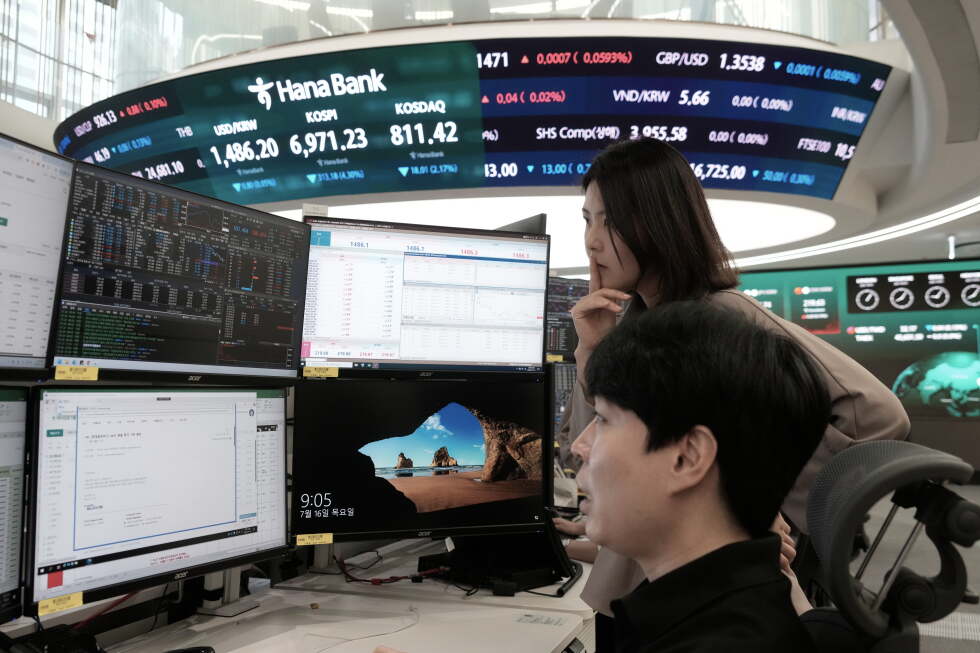
The selling pressure was most acute in South Korea, where the benchmark Kospi index plummeted 6.6% to close at 6,816.70. Two factors drove the steep decline: first, a broad pullback in AI and semiconductor shares that form the core of the country’s equity market, and second, an unexpected interest rate hike from the Bank of Korea (BOK), the first such increase the central bank has implemented since 2023. The rate move was crafted to tamp down resurgent inflationary pressures stoked by rising energy costs tied to the Iran conflict. Leading the losses, major memory chip manufacturer SK Hynix dropped 11.2%, while tech giant Samsung Electronics fell 8.2% by market close.
Japan’s benchmark Nikkei 225 also suffered heavy losses, sliding 2.9% to end the session at 66,767.64, weighed down by the same AI-related sell-off that hit South Korea. Japanese chip industry firms led the declines: memory chipmaker Kioxia plummeted 13.5%, chip equipment producer Tokyo Electron fell 5.2%, and semiconductor testing specialist Advantest gave up 5.6%. Conglomerate SoftBank Group, which holds large stakes in global AI ventures, also shed 6.4% on the day.
Taiwan’s Taiex index recorded a more modest 0.3% loss, as investors adopted a cautious stance ahead of highly anticipated quarterly earnings from Taiwan Semiconductor Manufacturing Company (TSMC). TSMC is widely viewed as a key barometer for both the global semiconductor sector and the ongoing AI boom, making its earnings report a closely watched event for markets across the region.
Against the broader regional downturn, Hong Kong’s Hang Seng Index emerged as a clear outlier, gaining 1.7% to close at 25,111.22. The gains were led by e-commerce and tech giant Alibaba, whose Hong Kong-traded shares climbed 4.4% following a key regulatory announcement from Chinese authorities. On Wednesday, China’s cyberspace regulator announced it had approved Apple’s Apple Intelligence AI tool for use in mainland China, and Alibaba subsequently confirmed that its in-house Qwen large language model will be integrated into the Apple Intelligence system. Mainland China’s Shanghai Composite Index bucked the Hong Kong trend, however, falling 0.9% to 3,921.20. Australia’s S&P/ASX 200 edged 0.2% lower to 8,820.50, while India’s Sensex bucked the regional trend to climb 0.3% by close of trading. U.S. stock futures ticked slightly higher in early Asian trading hours, building on gains seen on Wall Street in the previous session.
In energy markets, crude oil prices slipped slightly early Thursday but remained at sharply elevated levels amid ongoing military escalation between the U.S. and Iran. Brent crude, the global benchmark for oil pricing, dropped 0.4% to $84.55 per barrel; before the outbreak of the Iran conflict in late February, Brent traded at roughly $72 per barrel. U.S. benchmark crude fell 0.2% to $79.34 per barrel. In a Thursday research note, ING commodities strategists Warren Patterson and Ewa Manthey noted that oil prices had notched three consecutive days of gains as diplomatic efforts to de-escalate tensions between Washington and Tehran failed to make progress. The ongoing conflict has disrupted global energy logistics, the pair explained, with rising tensions creating meaningful disruptions to vessel traffic through the Persian Gulf, specifically the Strait of Hormuz — a strategic chokepoint that accounts for roughly a fifth of global oil shipments.
Overnight on Wednesday, U.S. equities closed higher: the benchmark S&P 500 gained 0.4% to reach 7,572.40, the Dow Jones Industrial Average climbed 0.3% to 52,658.64, and the tech-heavy Nasdaq Composite added 0.6% to 26,269.23. Gains were supported by a June inflation report showing U.S. price growth slowed more than expected, as well as strong quarterly earnings from major Wall Street firms including asset management giant BlackRock, whose shares rose 6.6% after posting revenue and profit that far outperformed analyst expectations. SpaceX, Elon Musk’s private space launch firm that began trading publicly this week, briefly dipped below its $135 per share IPO price before recovering a portion of its losses in midday trading.
In currency markets, the U.S. dollar edged lower against the Japanese yen, slipping to 162.09 yen from 162.19 yen in the previous session. The euro also ticked slightly lower, falling to $1.1467 from $1.1464 against the U.S. dollar.