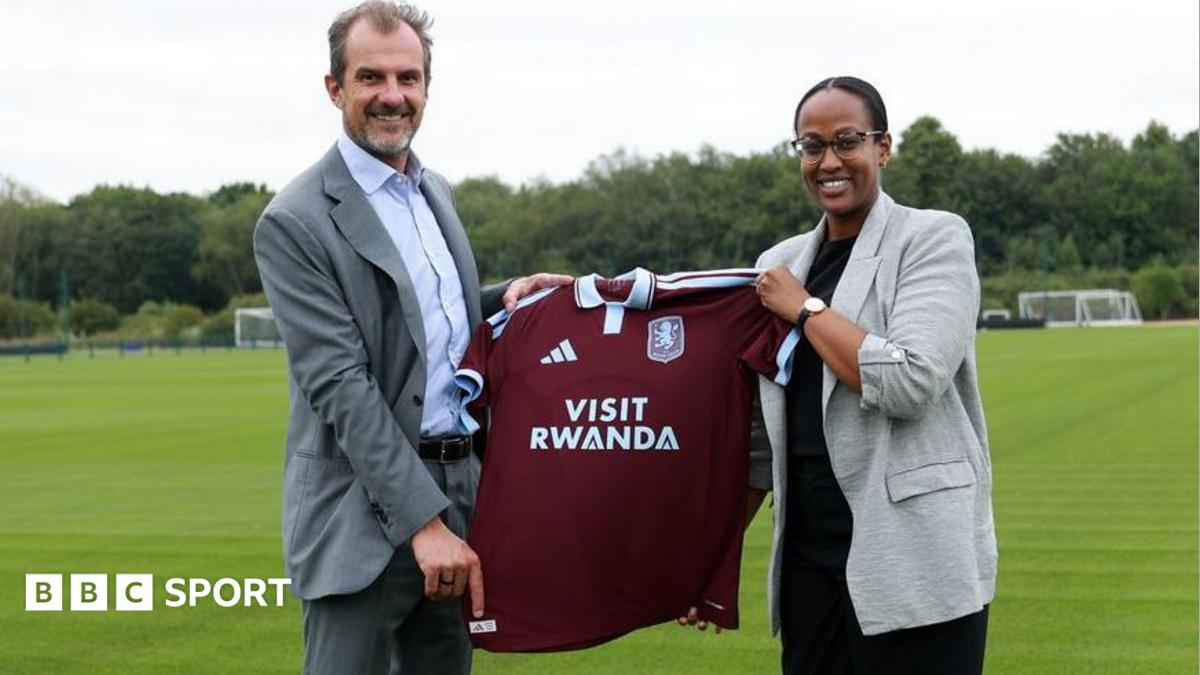
English Premier League side Aston Villa has landed the largest sponsorship agreement in its century-long history, a multi-year £20 million-per-year deal with Rwandan tourism board Visit Rwanda that has quickly reignited global debate over alleged “sportswashing” of Rwanda’s alleged human rights abuses and military interference in the Democratic Republic of Congo (DRC).
The deal will see Visit Rwanda replace betting brand Betano on the front of matchday kits for Aston Villa’s men’s senior team, women’s senior team, and youth academy squads. The partnership marks the first major major commercial agreement negotiated by Francesco Calvo, who took over as the club’s president of business operations last year following the departure of Chris Heck. In a formal statement announcing the partnership, Calvo framed the deal as a milestone in the club’s global growth strategy, saying it unlocks cross-sector opportunities across tourism, foreign investment, and grassroots sports development.
“This is a very exciting partnership for Aston Villa and a symbol of the club’s continuing expansion and growth into international markets,” Calvo said. “There is a great range and depth of opportunities for collaboration, learning and innovation and we are looking forward to working with Visit Rwanda to deliver meaningful activations through tourism, investment and sporting development.”
But the agreement has drawn immediate condemnation from human rights advocates and political leaders, who accuse Rwanda of using high-profile football partnerships to distract the global public from systemic human rights violations at home and its role in fueling ongoing deadly conflict in eastern DRC. Felix Jakens, head of campaigns for Amnesty International UK, said the pattern of Rwanda leveraging elite football sponsorships for positive public relations is nothing new, and that Aston Villa and the Premier League have a responsibility to address the allegations.
“It’s not new that Rwanda is using sportswashing to deflect attention from its terrible human rights record,” Jakens said in a statement to BBC Sport. “Aston Villa should be well aware that Rwanda is seeking to leverage this partnership to create positive PR. The country is prolific in arbitrary detention, torture and the repression of free speech – these are abuses at home. We are seeing bloodshed right before our eyes in the Democratic Republic of Congo, and Rwanda is playing a significant role in fuelling that conflict – both through its support to the M23 rebels and the direct actions of its military in Eastern Congo. Rwanda’s sportswashing needs to be called out, and we’d like Aston Villa and the Premier League to play their part in this.”
The criticisms come amid a long-running international dispute between DRC and Rwanda. Just last month, DRC formally filed a case against Rwanda at the International Court of Justice (ICJ), accusing the neighboring country of violating multiple international treaties by deploying military forces and arming rebel groups to carry out illegal operations on DRC territory. The allegations stretch back decades, rooted in regional instability that followed the 1994 Rwandan genocide. Rwanda has repeatedly denied all claims that it supports armed groups in eastern DRC, but independent United Nations experts and several Western governments have verified that Rwanda provides backing for the M23, one of the most active and violent insurgent groups in the region.
Aston Villa’s deal marks the latest high-profile Rwandan tourism sponsorship in global football that has faced public scrutiny. Visit Rwanda already holds partnerships with clubs across Europe’s top leagues, including Paris Saint-Germain (PSG), Atletico Madrid, and previously Arsenal and Bayern Munich, and each of these deals has sparked protests and campaigns from fans and human rights groups.
Last year, amid a worsening humanitarian crisis in eastern DRC tied to the M23 insurgency, DRC Foreign Minister Therese Kayikwamba Wagner openly called on Arsenal, Bayern, and PSG to end what she labeled “blood-stained” sponsorship deals, questioning the moral standing of accepting revenue from a nation she accuses of military aggression. “It is time Arsenal ended its blood-stained sponsorship deals with this oppressor nation. If not for your own consciences, then the clubs should do it for the victims of Rwandan aggression,” Wagner wrote in open letters to the clubs’ leadership.
Fan campaigns have also pressured clubs to cut ties: PSG supporters launched a national petition demanding an end to the partnership in 2024, while Arsenal’s fan-led group Gunners for Peace ran a public campaign urging the club not to renew its Visit Rwanda sleeve sponsorship, even suggesting rival Tottenham Hotspur would be a more ethical alternative.
In response to past criticisms, the Rwanda Development Board has repeatedly rejected the accusations as misinformation, saying the Visit Rwanda initiative is designed to showcase the country’s progress toward peace, stability, and inclusive economic growth, and that DRC has attempted to undermine the partnerships through unfair political pressure.
In recent months, a handful of high-profile clubs have moved to end their commercial sponsorship deals with Visit Rwanda. Arsenal announced last November that its eight-year sleeve sponsorship agreement would conclude at the end of the 2025-26 season, a deal that was reportedly worth more than £10 million annually at its peak. Bayern Munich announced last August that it would transition away from commercial branding to focus solely on expanding its existing youth academy partnership in Kigali with Rwanda’s Ministry of Sports. However, other clubs have expanded their ties: just two months ago in April 2025, PSG extended its Visit Rwanda sponsorship until 2028, while La Liga side Atletico Madrid signed a new three-year deal to feature the Visit Rwanda logo on both its men’s and women’s senior team kits.
Aston Villa’s need for a new front-of-shirt sponsor arose after all Premier League clubs agreed to remove all gambling industry sponsorship from the front of matchday kits by the end of the 2024-25 season, requiring the club to find a replacement for outgoing sponsor Betano. The BBC has reached out to Aston Villa for additional comment on the new sponsorship following the human rights criticisms, and the club has not yet issued a further response.