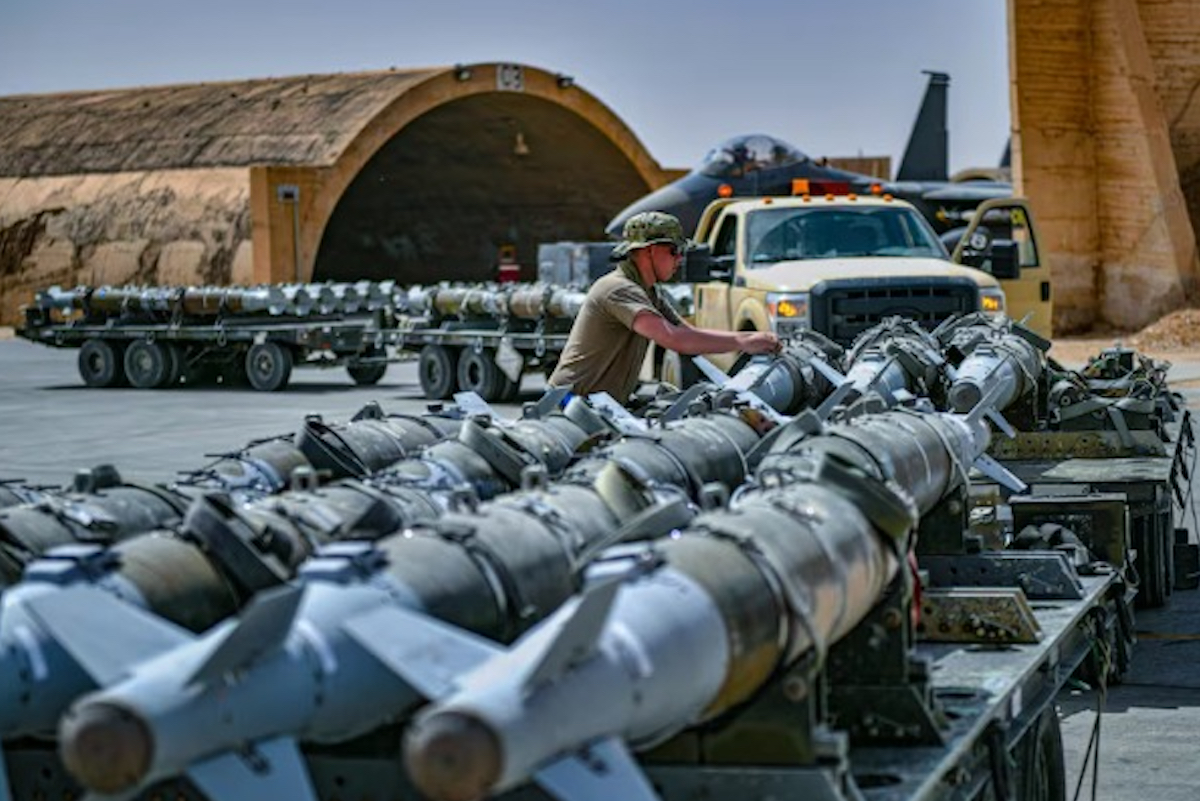
As the United States accelerates its efforts to rebuild a wartime-capable defense industrial base, a growing body of independent defense research warns that the initiative faces a make-or-break test: can new weapons be produced, transported, and sustained fast enough to meet the demands of high-intensity, simultaneous conflicts across the Indo-Pacific?
A July 2026 analysis draws on multiple recent reports from leading U.S. think tanks to unpack both the progress the Pentagon has made and the lingering structural vulnerabilities that could undermine its preparedness. This month, the Center for Strategic and International Studies (CSIS) released an assessment noting that while Washington has made notable strides in reorienting its defense industrial base for potential great power conflict, critical gaps in munition stockpiles and supply chain resilience still persist.
To date, the U.S. Department of Defense (DoD) has deployed large pools of combined public and private investment to counter strategic competition, particularly from China. In fiscal year 2025 alone, the DoD expanded its defense vendor ecosystem by adding 5,000 new suppliers, pushing total contract obligations for non-traditional defense contractors past $120 billion. To replenish stockpiles drawn down by recent engagements, the department has secured landmark multi-year contracts to ramp up production of defensive interceptors, and shifted its procurement strategy to a “high-low mix” that targets low-cost munitions making up 70% of all requested units by fiscal year 2031. Additionally, Washington has allocated $7.6 billion across 2025 and 2026 to build a secure, China-independent rare earth supply chain spanning from mining to final magnet production.
Despite these sweeping acquisition reforms and a proposed fiscal year 2027 defense budget equivalent to 4.6% of U.S. GDP, multiple reports caution that fully institutionalizing wartime readiness will take years. Lead times for production of critical weapon systems still stretch to more than three years, meaning many current investments will not translate to usable stockpiles for the near term. While the DoD currently frames industrial mobilization progress around total funding committed and planned capacity expansions, the ultimate decisive metric will be whether the U.S. can outproduce China, deploy military materiel across the vast Pacific, and replace combat losses faster than a conflict consumes them. It remains unproven whether projected U.S. production can meet the demands of high-intensity conflict across multiple simultaneous theaters, including the Korean Peninsula and Taiwan.
Recent war gaming and scenario planning highlights just how stark the demand for munitions would be in a regional conflict. In a 2025 article for the Texas National Security Review, analysts Nicholas Anderson and Daryl Press calculated that even a limited pre-emptive strike on North Korean targets would require 24 long-range B-1 and B-52 bombers carrying 528 air-launched cruise missiles, plus 120 sea-launched Tomahawk missiles from naval vessels, alongside 48 M270A1 precision multiple launch rocket systems from U.S. ground forces based on the Korean Peninsula. That level of expenditure is negligible compared to the projected munition use in a U.S.-China conflict over Taiwan, according to a May 2026 CSIS report from Seth Jones. Jones estimates that in the first seven days of conflict alone, U.S. forces would fire between 3,000 and 5,000 baseline Joint Air-to-Surface Standoff Missiles (JASSMs), 3,500 to 4,000 extended-range JASSM-ERs, and 400 to 1,000 Tomahawk missiles — a rate of expenditure that would severely deplete or entirely exhaust key U.S. stockpiles almost immediately.
If conflicts broke out simultaneously on the Korean Peninsula and over Taiwan, scarce U.S. missiles, bombers, and logistics capacity would be split between the two fronts, forcing the Pentagon to prioritize support for one theater at the direct expense of the other. These projections have amplified core questions about whether U.S. munitions production can offset China’s established industrial advantage and replace wartime losses fast enough to shift the regional military balance.
A January 2026 TIDALWAVE report from The Heritage Foundation compared U.S. and Chinese munitions production ecosystems, finding that the U.S. Indo-Pacific munitions network suffers from significant structural fragility, while China’s system is a large, highly integrated enterprise purpose-built for high-intensity regional conflict. The report warns that the U.S. model, which relies on finite pre-positioned stockpiles, could face a catastrophic “Triple Bind” supply failure within 25 to 120 days of a conflict starting. This risk stems from a two-year lag in production scaling, critical bottlenecks in rocket motor manufacturing, and heavy U.S. reliance on imported TNT from Poland. In contrast, China’s state-owned defense conglomerates, such as NORINCO, operate automated, robotic smart factories that maintain resilient peacetime production with the capacity to surge output by 150% to 250% during wartime, allowing China to sustain prolonged combat operations.
The report does note that both powers face critical chokepoint vulnerabilities: the U.S. remains heavily dependent on Chinese processing and production of rare earth minerals, while China’s highly centralized, rail-reliant distribution network is uniquely vulnerable to targeted cyberattacks and international restrictions on advanced semiconductor exports. Overall, the analysis finds China holds a clear advantage in sustained regional munitions production, though both sides are susceptible to targeted disruption of key industrial and logistical bottlenecks.
Even if the U.S. successfully consolidates supply chains and expands domestic munitions production, those gains will not translate to usable combat power if forward bases, ports, transport networks, storage sites, and maintenance hubs cannot survive Chinese missile attacks and keep weapons flowing to frontline forces. A January 2025 report from the Hudson Institute by Thomas Shugart III and Timothy Walton warns that decades of underinvestment in Indo-Pacific combat logistics have left U.S. forward bases unhardened and extremely vulnerable to precision strikes. The authors note that Chinese precision strikes could disable interconnected fuel lines, above-ground storage tanks, and pre-positioned munition stocks that are essential for sustained air operations. These vulnerabilities also prevent the rapid dispersal of aircraft to alternate bases, as most lack pre-positioned munitions, redundant fuel supplies, and sufficient passive defensive infrastructure.
A December 2024 report from the Stimson Center, led by Kelly Grieco, reached a nearly identical conclusion. Grieco and her co-authors warn that Chinese missile attacks on forward base runways could cut critical logistics and refueling links. Prolonged runway closures would ground aerial refueling tankers, severely limiting operations for short-range fighter jets that depend on in-flight refueling to reach combat zones. Damaged airfields would also block deliveries of spare parts and fresh munitions, while exposed fuel and weapon stocks could be entirely depleted within days without secure, reliable resupply routes.
In short, U.S. munitions expansion will only deliver limited wartime value unless forward bases and logistics networks can survive attack and keep aircraft fueled, armed, and operational. Beyond these logistical challenges, many experts argue that current Pentagon contract announcements and investment targets overstate actual wartime capacity, as much of the reported progress has yet to result in delivered weapons, qualified suppliers, skilled manufacturing labor, or sustained industrial output.
A May 2026 CSIS report from Mark Cancian and Chris Park argues that even with major funding increases and ambitious industrial framework agreements, the U.S. still faces a prolonged “window of vulnerability.” Billions of dollars in planned procurement have not yet materialized into battlefield-ready weapons. Cancian and Park note that while the DoD emphasizes its aggressive contract activity, critical interceptors and missiles face severe manufacturing backlogs, requiring three or more years from initial funding allocation to arrival in U.S. military stockpiles. They stress that funding alone cannot instantly resolve long-standing supply chain bottlenecks or expand actual factory output, and that most projected maximum surge capacities remain theoretical, rather than proven, sustained industrial output.
Looking ahead, the next phase of the U.S. defense industrial buildup will be measured not by announcements of new capacity, but by proven results: can the U.S. sustain steady production, demonstrate through realistic contested-theater exercises that weapons can be replenished and delivered faster than China can disrupt their flow. Unless Washington aligns factory expansion with hardened logistics infrastructure, coordinated allied production, and realistic multi-theater war planning, new industrial capacity may arrive too late to strengthen deterrence before the next major regional crisis.