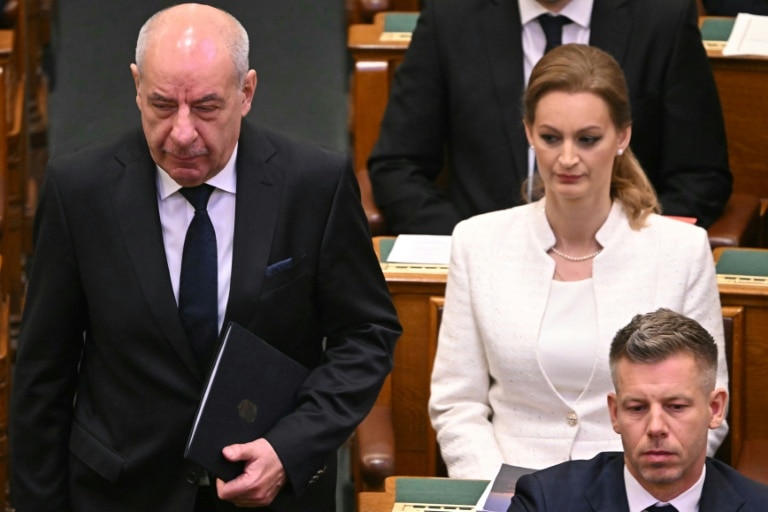
In a major shakeup of Hungary’s post-Orban political landscape, the country’s national parliament passed a constitutional amendment Monday that clears the way for the removal of President Tamas Sulyok, a close ally of long-serving nationalist former Prime Minister Viktor Orban. The vote comes as new Prime Minister Peter Magyar, who took office after a landslide electoral victory in April, follows through on his core campaign pledge to dismantle the power structure Orban built over 16 years of what he called ‘illiberal’ rule.
Magyar, who leads the pro-European conservative Tisza party, has repeatedly framed Sulyok as one of Orban’s unelected ‘puppets’ holding onto power from the previous regime, arguing the 70-year-old president is unfit to serve in the new government. Tisza holds a two-thirds supermajority in parliament, giving the party enough votes to unilaterally amend the constitution without support from opposition factions. The final vote saw 139 lawmakers back the amendment and only six vote against it, after which Tisza legislators held a brief 30-second standing ovation to mark the moment.
Following the vote, Magyar declared that his administration had completed the first major step of dismantling the constitutional framework put in place by the Orban regime. Now, all attention turns to Sulyok, who has five days to either resign voluntarily or sign the amendment into force. Magyar has made clear there is no middle ground: if Sulyok fails to act within the deadline, impeachment proceedings will immediately be launched in parliament. Legal experts note that while the Hungarian presidency carries largely ceremonial duties, Sulyok holds the power to veto legislation and refer bills to the constitutional court — though he cannot block a constitutional amendment. Still, political analysts warn a refusal to step down could trigger a unprecedented constitutional crisis in the central European nation.
Sulyok has pushed back against the move, accusing Magyar of spreading false information to manipulate public opinion. Orban’s Fidesz party, the long-ruling opposition faction, boycotted the entire parliamentary session to protest the amendment, labeling the 12-point reform package ‘autocratic’ — an accusation that was frequently leveled against Orban during his time in office. In a Facebook post published Monday, Orban, who was out of the country attending the FIFA World Cup in the United States ahead of the vote, warned that setting this precedent puts every public figure at risk: ‘Today they’re targeting the president, but tomorrow they could do the same to anyone.’
The measure has also drawn criticism from international human rights watchdogs. Amnesty International has argued that Sulyok is guaranteed the right to due process, while Human Rights Watch said the rushed constitutional amendment is eerily reminiscent of the power-grabbing tactics Fidesz employed during its time in government. Yet the move enjoys broad popular support: a May 2025 poll conducted by the 21 Research Center found that 67 percent of Hungarian voters support Sulyok’s removal from office.
Some domestic legal figures have defended Magyar’s approach, even as they acknowledge the extraordinary nature of the measure. Andras Baka, a former chief justice of Hungary’s Supreme Court, whose own term was cut short by similar legislative action in 2011 after he spoke out against Fidesz’s judicial reforms, told reporters that the tactics are justified if they lead to the establishment of a new, rights-respecting constitutional order. ‘In a country properly governed by the rule of law, such extraordinary measures cannot be used, but Hungary became a captured state under Orban,’ Baka explained.
Beyond removing Sulyok, the constitutional amendment includes several other sweeping changes. It introduces a 12-year cumulative term limit, capped at three terms, for all members of parliament, a change that will bar multiple high-profile opposition politicians — including senior Fidesz lawmaker Gergely Gulyas, who resigned his post as parliamentary party leader in protest this week, from running for re-election in 2030. The amendment also establishes a new National Asset Recovery and Protection Office, which will be granted broad investigative and enforcement powers to root out the systemic corruption that human rights groups and international observers have described as endemic during Orban’s tenure.
Magyar reaffirmed his long-term plan after the amendment passed: the government will launch a nationwide public consultation process to draft an entirely new national constitution, one that he says will be built with input from as broad a cross-section of Hungarian society as possible, fulfilling another core campaign promise to break fully with the Orban era.