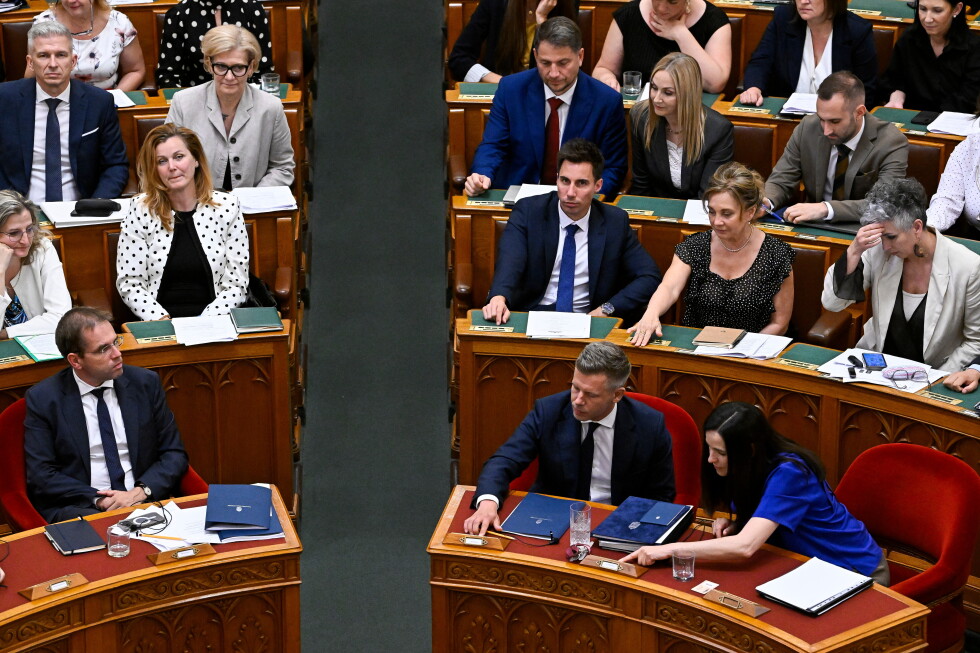
In a historic parliamentary vote that marks the most significant shift in Hungarian politics in nearly two decades, Hungary’s 199-member national legislature approved a sweeping constitutional amendment on Monday to remove incumbent President Tamás Sulyok from office and advance a slate of political reforms designed to unwind the autocratic political system built by longtime former Prime Minister Viktor Orbán.
The measure passed with overwhelming support, tallying 139 votes in favor and just six opposed. The outcome was all but guaranteed after current Prime Minister Péter Magyar’s pro-European center-right Tisza party secured a two-thirds parliamentary supermajority in an April landslide election, a mandate that gives the party full power to rewrite the country’s constitution and roll back 16 years of Orbán-era policy. Following the vote announcement, Tisza lawmakers erupted in a standing ovation, while all members of Orbán’s far-right Fidesz party boycotted the entire legislative session in protest.
Under Hungarian legislative rules, Sulyok — an appointee of the previous Orbán administration — has five days to sign the amendment into law. He has not yet publicly stated whether he will comply with the parliament’s decision, but Tisza leadership has already vowed to initiate impeachment proceedings against the sitting president if he refuses to sign. Magyar has long argued that Sulyok failed to uphold his constitutional duty as head of state by refusing to check Orbán government’s antidemocratic overreach during his tenure. Removing Sulyok was a central campaign promise for Magyar, and the prime minister has framed his party’s landslide election win as a clear voter mandate to follow through on that pledge. Sulyok has repeatedly rejected calls to resign voluntarily.
In a post-vote press conference, Magyar framed the amendment’s passage as a pivotal turning point for Hungarian democracy. “With this vote today, we have closed an era,” he said, confirming that the new government had formally “started the transformation of the Orbán legal system.” Beyond removing Sulyok — which clears the way for parliament to elect a new head of state aligned with the current government’s agenda — the amendment includes a package of structural reforms: it introduces new judicial oversight, establishes a special anti-corruption body tasked with investigating financial misconduct during the Orbán administration, and imposes a 12-year cumulative term limit for members of parliament.
Fidesz has decried the amendment as an “unprecedented” attack on Hungary’s democratic foundations. Last week, the party organized a public protest against the changes that drew roughly 3,000 attendees, though Orbán himself did not make an appearance at the rally. On the day of the vote, Orbán shared a provocative post to his Facebook page featuring a photo of Magyar with the ominous subtitle “Democratic Hungary: 1990-2026,” referencing the timeline of Hungary’s post-communist transition. The former prime minister was traveling to the United States on Monday to attend the final three matches of the World Cup, and has made limited public comments on the legislative push since the election.
While Hungary’s presidency is largely a ceremonial role, the position holds key constitutional powers: the president is responsible for signing all parliamentary legislation into law and can send passed bills to the Constitutional Court for judicial review. Tisza supporters have long raised concerns that Sulyok could use these powers to systematically block the new government’s reform agenda, making his removal a critical early priority for the administration.
Since taking office in May, Magyar’s government has moved rapidly to dismantle what the prime minister has labeled Orbán’s “mafia state,” removing dozens of political appointees and institutional leaders tied to the previous autocratic regime. The administration has already suspended the news division of Hungary’s public television and radio outlets, which Magyar argues operated as a state-run “propaganda factory” for Fidesz, and permanently closed the country’s controversial Sovereignty Protection Office — a body widely criticized by Orbán’s opponents as a tool to harass government critics and censor independent media.
Ahead of Monday’s vote, Fidesz caucus leader Gergely Gulyás claimed the amendment “breaks up the legal system, undermines the rule of law and restricts democracy.” Gulyás also announced he would step down from his position as caucus leader, as the new 12-year term limit would bar him from running for re-election in the next national parliamentary vote. Following the vote, Fidesz supporters organized a candlelight vigil outside the parliament building in Budapest to protest what they described as the “tyranny” of Magyar’s incoming reform government.