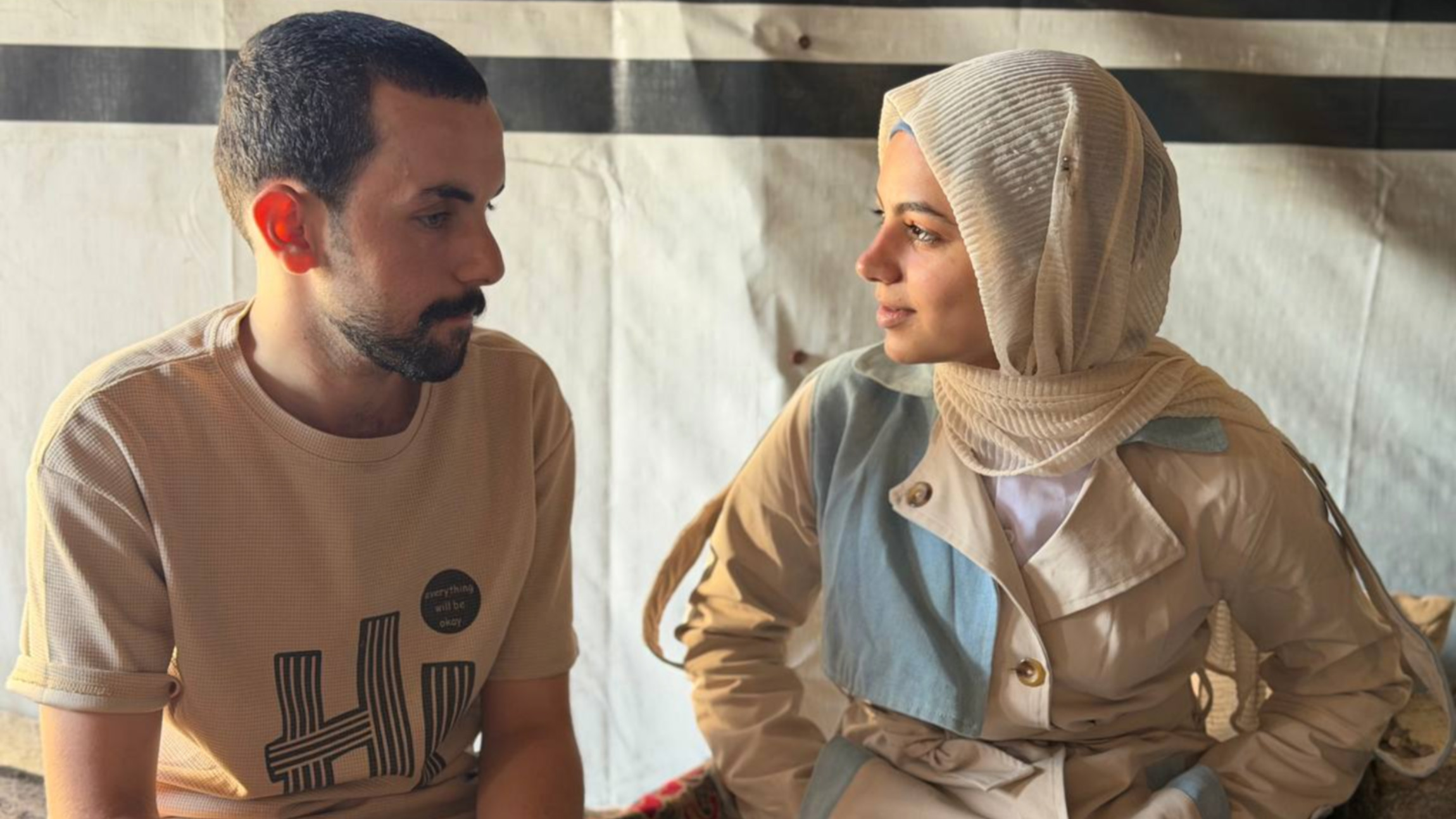
It has been nearly a year since 23-year-old Hamada al-Banna stepped toward Israeli aid convoys near Zikim in northern Gaza, chasing a single sack of wheat flour to feed his family amid widespread starvation. What followed was a nightmare of forced disappearance, torture, and a long, agonizing separation that tested the unbreakable resolve of his 18-year-old fiancee, Reem Jadallah. Today, after months of false news and abandoned searches, their bittersweet reunion has cast a harsh light on the growing crisis of forcibly disappeared Palestinians in Israel’s ongoing campaign in Gaza.
On August 9, 2025, Banna set out for Zikim alongside his brother Adham, joining thousands of desperate Gazans who risk their lives to access limited humanitarian aid amid crippling food shortages. After securing his sack of flour, Banna learned Adham had been killed by Israeli forces. Dropping his flour to search for his brother, he unknowingly wandered close to an Israeli military outpost. Troops opened fire, a shell exploded, hurling him 10 meters through the air, and he woke with severe leg and chest wounds, with no memory of who he was or how he had arrived.
In an account shared exclusively with Middle East Eye, Banna described waking from a six-month coma in Israel’s Soroka Hospital, suffering from profound amnesia. As his memory slowly returned, a soldier entered his room and began verbally abusing Banna’s mother. Enraged, Banna threw his IV bag at the soldier, triggering a violent assault that ended with his transfer to Sde Teiman, the notoriously abusive Israeli prison widely condemned for the mistreatment of Palestinian detainees.
For four months, Banna was held in solitary confinement, where he endured systematic torture at the hands of Israeli prison guards. “They would suddenly enter my cell and beat me brutally for no reason. They sprayed me with pepper spray, beat my genitals, and threw stun grenades into my cell,” he recalled. On one occasion, he was held for six straight days in what Palestinian detainees call a “disco room”: a purpose-built space where prisoners are subjected to constant, deafening noise designed to break mental and physical resilience through extreme sleep deprivation and psychological torture.
While Banna was held incommunicado, his family in Gaza held out little hope of finding him alive. After months of no contact, Israeli authorities incorrectly notified the family that Banna had been killed while in custody, a death officially attributed to torture. For most of the family, the search ended there. But Jadallah refused to accept the news.
The couple had met after both their families were displaced from northern Gaza to a shared shelter in Gaza City, as Israeli attacks intensified across the enclave. Banna had proposed to Jadallah shortly before he disappeared, and the pair had been preparing for their wedding, lost when their planned home was destroyed in the conflict. When Banna failed to return from his trip for flour, Jadallah began what would become a months-long search against all odds.
Across the Gaza Strip, Banna’s case is far from unique. According to the Palestinian Centre for the Missing and the Forcibly Disappeared (PCMFD), roughly 8,000 Palestinians have been registered as missing since Israel launched its military campaign in Gaza in October 2023, including nearly 2,900 children. While most are believed killed and buried under rubble from Israeli airstrikes and ground operations, hundreds are suspected of being secretly detained by Israeli forces during incursions, at checkpoints, or while seeking aid near Israeli military zones. Israeli authorities have routinely blocked access to information about detained Palestinians, even refusing requests from the International Committee of the Red Cross (ICRC) to confirm their whereabouts or conditions.
Jadallah held onto the one clue that Banna might still be alive: Israeli legal aid group HaMoked confirmed he was in Israeli custody, but refused to share additional details without a privately hired lawyer. Unable to afford legal fees, Jadallah made the painful decision to sell all of her gold, the only valuable asset she owned, to secure legal representation. Months later, her lawyer returned with the devastating false confirmation that Banna was dead, listed on an official registry of prisoners killed in custody in February 2025.
While the rest of Banna’s family abandoned their search, Jadallah pressed on alone. “Everyone kept telling me to give up hope, but I never did. Deep inside, I always felt that he was still alive,” she told Middle East Eye. For months, she visited every hospital in Gaza, checking newly arrived bodies to confirm it was not Banna. Every time a group of Palestinian detainees was released by Israel, she brought Banna’s photo to the release site, asking every freed prisoner if they had seen him. Because Banna had spent most of his detention in a hospital and then solitary confinement, no one had seen him – but still, she did not stop.
Her unwavering hope finally paid off on July 7, when the ICRC called Banna’s family with an unexpected message: Banna was alive, and had just been released from Israeli custody. He was calling from an ICRC phone to confirm he was coming home. “When his family called to tell me, I was in complete shock. I started laughing. I said, ‘I don’t understand. What do you mean?’” Jadallah said. “I couldn’t believe it. I was afraid to believe it because I thought it might be another false piece of news. I didn’t truly believe it until I saw his photograph with the released prisoners.”
When Jadallah rushed to meet her fiance, she found he had already been asking everyone around him to bring his fiancee to him. But the reunion, while joyful, quickly revealed the deep scars left by a year of abuse. “The Hamada who came out of prison was not the same person I had been waiting for all this time,” Jadallah said. “I noticed how much he had changed. Sometimes, in the middle of a conversation, he suddenly stares into space and begins reliving memories of his detention. He has become irritable, and even the slightest sound bothers him.”
The trauma of his detention shapes every part of Banna’s daily life even after release. He cannot sleep lying down, as most people do; he only sleeps sitting upright, a habit forced on him by his prison conditions. He eats barely any food, his body accustomed to the tiny rations provided to him in detention. The couple’s planned wedding, scheduled just before Banna’s disappearance, has been postponed indefinitely: all of their savings, their furnished home, and the wedding preparations were destroyed in the conflict. For Jadallah, however, none of that loss matters compared to getting Banna back alive. “We lost everything, but I got him back. That is what matters most,” she said.