As Russia’s full-scale invasion of Ukraine enters its third year, Ukrainian President Volodymyr Zelenskyy touched down in Paris on Monday for high-stakes talks with two dozen European leaders from the pro-Ukraine Coalition of the Willing, a gathering that signals unified Western resolve to back Kyiv’s fight against Russian aggression. The summit comes amid a sharp intensification of cross-border drone attacks, shifting battlefield momentum, and urgent negotiations to ramp up Ukraine’s defensive capabilities against relentless Russian aerial assaults.
Parallel to the Paris talks, European Union foreign ministers gathered separately in Brussels to deliberate on Ukraine’s pressing military and humanitarian needs, as well as the growing threat Russia poses to European continental security. Both Kyiv and its European backers are moving to capitalize on Ukraine’s recent battlefield gains to push Russian President Vladimir Putin toward meaningful peace negotiations—though Moscow has refused any compromise, even after a year of peace efforts led by the U.S. Trump administration.
Military analysts and Western officials attribute Ukraine’s recent advances to major breakthroughs in domestic drone development, which has given Kyiv a critical edge on the battlefield. Targeted strikes on Russian supply routes behind front lines have drained the Russian military’s operational momentum, forcing Moscow to slow its advances and accept extremely high personnel and equipment losses. Most notably, Ukraine’s sustained campaign targeting Russian supply lines into Russian-annexed Crimea has triggered the worst fuel shortage on the Black Sea peninsula since 2014, dealing a major blow to the Kremlin’s official narrative that it is winning the war.
A top priority for Zelenskyy at the Paris summit is accelerating plans for joint European-Ukrainian development of anti-ballistic air defense systems, a critical capability to block Russia’s devastating attacks on Ukraine’s civilian energy infrastructure. In remarks posted to social media Monday following another round of overnight Russian airstrikes across Ukraine, Zelenskyy emphasized, “Everyone in the world sees that Ukraine needs more air defense, more protection of life.” A recent pledge from U.S. President Donald Trump to grant Ukraine a license to domestically produce Patriot air defense systems has been hailed as a potential breakthrough, though experts and Ukrainian officials caution it will likely take years for this policy to translate into operational weapons in Ukraine’s arsenal.
The Paris Coalition of the Willing gathering, which officially includes more than 30 pro-Ukraine nations, brought roughly 25 heads of state and government to the French capital. The high turnout is widely interpreted as a public demonstration of long-term European commitment to Ukraine, and a unified warning to Moscow amid ongoing Russian efforts to test European resilience against escalation. In a separate development Monday, French Foreign Minister Jean-Noël Barrot announced that France would summon the Russian ambassador to Paris and impose new sanctions on Russian hackers, in response to what Barrot described as “a vast cyber campaign aimed at sabotage and espionage, carried out by Russia in about 10 European countries.”
The spillover impact of the war is already being felt by Ukraine’s neighboring countries. On Monday, Moldova’s Ministry of Foreign Affairs confirmed that a drone launched during Russian overnight attacks on Ukraine’s Odesa region crashed and detonated on Moldovan territory, calling the incident “serious and unacceptable.”
Zelenskyy’s trip to Paris also comes against a backdrop of major domestic and political shifts in Kyiv and Washington. The visit follows the recent passing of U.S. Senator Lindsey Graham, one of Kyiv’s most steadfast supporters in Washington, whose death has raised Ukrainian concerns over future U.S. support. It also comes amid an ongoing major government reshuffle in Kyiv, which saw Prime Minister Yulia Svyrydenko step down from her post on Sunday.
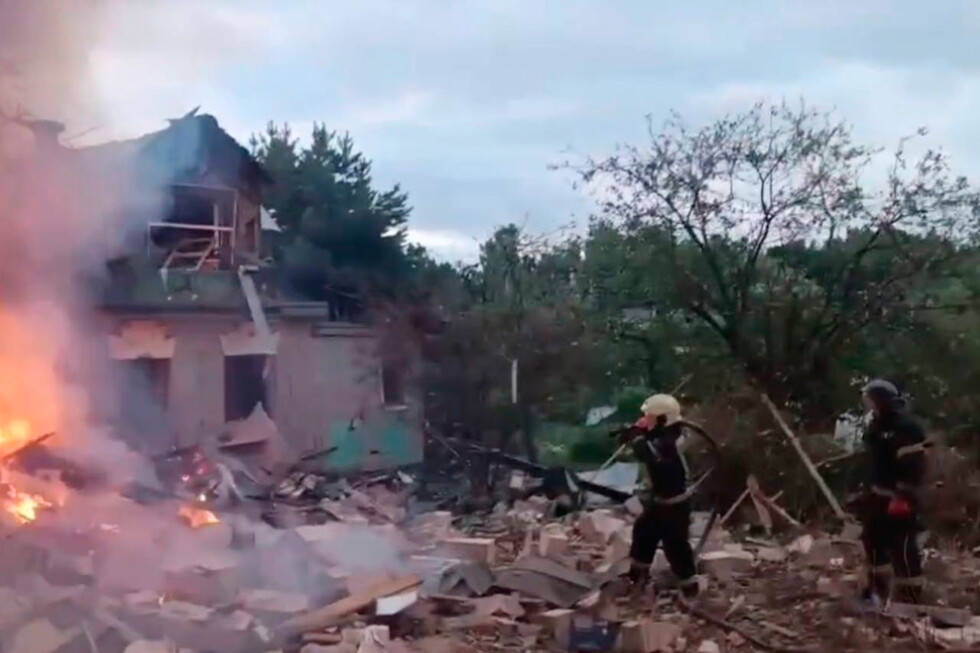
Over the past 48 hours, drone activity between the two warring sides has reached new levels of intensity. Ukraine launched a massive wave of domestically developed long-range drones and missiles targeting deep inside Russian territory, matching and even exceeding the scale of relentless Russian aerial assaults on Ukraine. Moscow Mayor Sergei Sobyanin announced that Russian air defenses shot down 350 Ukrainian drones headed toward the capital since late Sunday, including 50 in the immediate Moscow area. Andrei Vorobyov, governor of the Moscow region, reported that 81 drones were downed overnight, with three civilian deaths and three injuries recorded in a strike on the Pionersky settlement outside Istra, where five private homes were destroyed by fire.
In a parallel wave of Russian attacks on Ukraine, the Ukrainian Air Force reported that Russia launched 134 long-range strike drones and three guided aviation missiles across Ukrainian territory. Ukrainian air defenses shot down or jammed all three missiles and 123 of the drones, though six remaining drones caused damage at five locations across the country. In the southern Ukrainian city of Zaporizhzhia, regional military administration head Ivan Fedorov reported that over 70 residents have been hospitalized after recent Russian strikes damaged 11 residential apartment blocks.
Russian security officials also announced Monday that they had thwarted a large-scale Ukrainian drone plot targeting two key Russian air bases: the Ukrainka air base in the far eastern Amur region, and the Shagol air base in the southern Ural region of Chelyabinsk. According to Russia’s Federal Security Service, the domestic intelligence agency, small drones were smuggled into Russia’s western Bryansk region via air balloons and larger transport drones, then transported by car to the vicinity of the targets by Ukrainian agents. The FSB said it had arrested the Ukrainian agents and their accomplices, and seized 24 drones, calling the alleged plot “unprecedented in its scale and the level of threat” to Russian military infrastructure. The foiled plot comes just over a year after Ukraine’s Operation Spiderweb, a covert strike that destroyed or damaged nearly a third of Russia’s strategic bomber fleet after drones were smuggled into Russian territory, per Ukrainian official accounts.