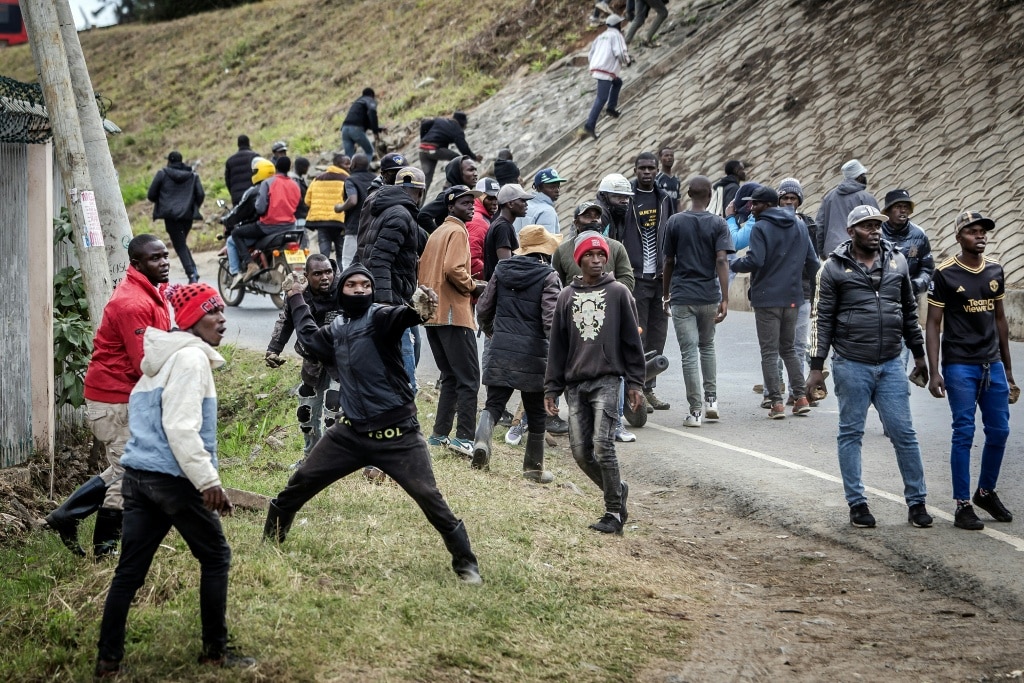
As Kenya approaches its 2027 general election, a disturbing trend has taken root in the country’s political landscape: widespread hiring of low-paid armed thugs — locally referred to as “goons” — by political operatives to disrupt opposition rallies, attack anti-government demonstrators, and intimidate civil rights activists. Fueled by crippling systemic poverty and cutthroat political competition, this entrenched culture of violence is raising urgent alarm that the upcoming poll could descend into uncontrolled chaos.
A recent investigation by Nairobi-based independent research firm Odipo Dev has documented a clear “rate card” for these hired enforcers: local councilors pay as little as 500 Kenyan shillings (approximately $4) per day for their services, while members of parliament pay up to 1,000 shillings ($8) daily. For thousands of unemployed and underprivileged young Kenyans, this meager pay is often the only accessible source of income in an economy starved of formal work opportunities.
AFP spoke with five current goons on condition of anonymity, and their accounts lay bare the cycle of desperation that traps young people in this violent trade. Twenty-seven-year-old Marius, who has worked as a goon since he was 17, grew up in Korogocho, one of Nairobi’s most impoverished informal settlements, raised by a single mother who could not afford secondary school fees. His childhood dream of becoming a surgeon was quickly quashed, leaving him functionally illiterate with few other options to support himself. “You end up being a goon to at least earn something,” he explained. Though he initially projected confidence in his work, he later admitted he hides his dangerous trade from his young son, saying “I don’t want to expose him to the bad things I do. I don’t want him to follow in my shoes.” Marius already lost five teeth in a political brawl, when he was paid to disrupt the opening of a hospital by a rival politician.
Widespread official collusion enables this goon culture, even as both politicians and police publicly claim to be working to eradicate it. During large-scale anti-government protests in 2023, AFP correspondents witnessed hundreds of goons operating directly alongside uniformed police to attack demonstrators, before the goons looted and vandalized businesses in central Nairobi. Just last month, CCTV footage obtained by AFP shows uniformed officers marching alongside an armed gang that stormed Nairobi’s iconic All Saints Church to violently break up a planned civil society meeting. Earlier this month, an opposition rally in southwest Kenya was overrun by armed men, leaving one attendee dead and several others wounded — video footage from the scene shows police standing by passively, making no attempt to intervene.
National Police Service spokesperson Michael Muchiri dismissed allegations of institutional collaboration with goons as “preposterous,” telling AFP that any complicit officers are rogue actors currently under investigation. “The National Police Service is determined to ensure the ‘goon culture’ does not gain a foothold in this country,” Muchiri said. But analysts note that politicians from every major political faction rely on goons, filling a perceived gap in state security that leaves politicians unable to count on police protection for their events and operations. “There is a policing gap… and politicians feel the need to have this machinery either to defend themselves or to intimidate their opponents,” explained Odipo Dev researcher Darius Okolla.
Goonism in Kenya is not a new phenomenon; it has deep, poisonous roots that stretch back decades to the authoritarian rule of former president Daniel arap Moi. In the 1992 election cycle, Moi’s ruling party Kanu formed the group Youth for Kanu ’92 (YK’92), a youth movement organized to rally support for the incumbent regime, and it was widely accused of vote-buying and orchestrating political violence against opposition groups. A key organizer of YK’92 was current Kenyan President William Ruto, who was later charged with crimes against humanity by the International Criminal Court for his alleged role in the widespread 2007-2008 post-election violence that killed more than 1,000 people. The case ultimately collapsed after witnesses reported widespread intimidation.
Interviewees told AFP that since Ruto took office in 2022, following a divisive general election, the use of goons has reached a new peak. The Ruto administration has faced massive youth-led protests sparked by skyrocketing living costs, widespread economic hardship, and public anger over systemic corruption, and goons have been systematically deployed to crush these demonstrations. “The goons were used to put them down,” Marius said. “The goon rate has increased highly because (Ruto) likes operations like that.” The Ruto administration did not respond to multiple requests for comment from AFP for this report.
Rights advocates warn that if the current trend of escalating political violence through hired goons continues, Kenya has little chance of holding free, fair, and peaceful elections in August 2027. “If this trend continues, it is evident that Kenya will not have free, fair, and peaceful elections” said Hussein Khalid of Kenyan human rights organization Vocal Africa.
At its core, the rise of goon culture is driven by systemic economic desperation. World Bank data shows that roughly 800,000 young Kenyans enter the labor market every year, but the formal sector only creates around 100,000 new jobs annually, leaving seven out of eight new jobseekers locked out of formal work. Even educated young people struggle to find stable work: 28-year-old Daniel, a former altar boy who grew up in one of Nairobi’s slums as one of seven children, saw his parents scrape together enough money to put him through university where he studied criminology. But in Kenya, landing a formal job often requires political connections and cash to “buy” the position — resources his family did not have.
“They say education is the key, but honestly speaking we never find the padlock open,” Daniel told AFP. He has now worked as a goon for seven years, and he speaks openly of the deep regret he feels for the violence he has committed. “You find that you have even hit a woman… that woman is like my mother. But you had no option,” he said. Political handlers typically supply goons with alcohol and drugs to numb the self-loathing that comes with the job. “In a sober mind, it’s not easy,” he added.
Daniel alternates between shame and grim pragmatism about his role. He knows politicians use him “like tissue paper” to do their dirty work and will discard him once he is no longer useful, but he still welcomes the cash the work provides. He and other goons are already looking forward to the 2027 election campaign, when they expect a surge in demand for their services. “We are counting ourselves rich in the coming months because the election campaigns will be open,” he said. “At least we can benefit: we can get phones, come back with cash we are promised by these leaders.” Goons also gain a form of gang-like social status in their low-income neighborhoods, where many young people see them as local heroes. “We are heroes to these kids,” Daniel said.
The trade is deliberately structured to avoid leaving a digital trail: goons are hired through offline neighborhood networks, with no text messages or digital payments that could be traced. Recruits are instructed to gather at a prearranged location, dress all in black, and bring face coverings to hide their identities. All payments are made in cash, often in new, unmarked banknotes, according to interviewees.
Goons operate in cells of 20 to 50 people, led by a senior local handler. The most violent and ruthless enforcers — referred to as “person in the top gear” — have a small chance to climb the ranks, eventually becoming middlemen who connect politicians to low-level goons, and even potentially gaining access to mainstream political society. Multiple interviewees pointed to Calvince “Gaucho” Okoth, a controversial youth organizer who has been repeatedly linked to violent political mobilization despite denying he is a goon. Last month, Nairobi Governor Jonathan Sakaja appointed Okoth to the board of a local public hospital. “Someone like Gaucho was once a big fish. Now he’s a shark,” Daniel said.
Most goons care little for the political causes they are paid to advance, and many openly oppose the politicians they work for. “In Kibera, what you usually say: your money is not you,” explained 23-year-old David. The policy concerns of rights groups and middle-class anti-government protesters also feel distant and abstract to most goons, who face immediate survival pressures. “If we side with them, we will not be employed,” Marius explained. Having watched politicians profit from corruption and violence, many young goons see joining the system as the only way to get a share of the country’s wealth. “Each and every youth is interested in that activity because if you can’t beat them, then join them,” Daniel said.