When our vehicle wound up the steep, curved mountain road leading to Bédar, a small Andalusian town in Spain’s southeastern Almeria province, we stepped out into a scene of utter devastation. Twisted, molten fragments of burned cars littered the roadside, and every hillside stretching toward the horizon was blanketed in a thick, ashy black coating of charred vegetation. This is the aftermath of Thursday’s catastrophic wildfire, already ranked as one of the deadliest wildfire events in modern Spanish history.
As of Sunday, the official death toll has climbed to 13, with five of the victims believed to be British citizens. The latest fatality was a 93-year-old British woman who succumbed to her burn injuries in a hospital over the weekend. Official confirmation of all victims’ identities is still pending, while emergency teams have now fully contained the blaze after it consumed roughly 7,000 hectares (17,300 acres) of forest and residential land. Fanned by gusty winds reaching 50 km/h, the flames spread with a speed and ferocity that caught many local residents off guard.
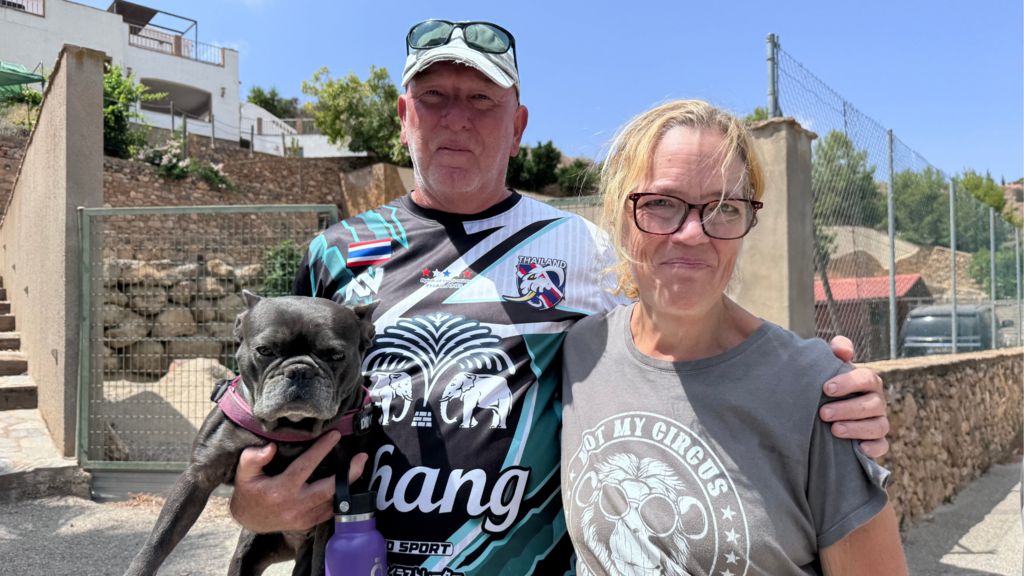
Yet amid the widespread destruction, pockets of survival offered small, bittersweet moments of relief. Driving deeper into Bédar’s residential neighborhoods, it became clear that dozens of the region’s distinctive bright white stucco homes escaped the blaze unscathed. For British expats Emma and Simon Mitchell, who moved to the town three years ago, that escape felt nothing short of a miracle. “This is our house and it survived,” Emma told reporters, breathing a heavy sigh of relief. When the couple returned to their property Sunday as part of the first wave of evacuees allowed back into the zone, they found all 15 of their chickens alive, and power and water still running, despite the inferno that burned right up to their property line.
That relief quickly gave way to grief and anger, however, as Emma looked across the valley to the homes of friends that were reduced to ash. The Mitchells are among 600 of the nearly 1,500 evacuated residents permitted to return to their properties to assess damage, and their experience has laid bare critical gaps in the region’s emergency alert system. The couple told reporters they received no formal advance notice of the spreading fire, despite living just a quarter kilometer from the blaze’s path. “We get an alert for earthquakes that are 50 miles away but we don’t get an alert for a fire that is a quarter of a kilometre away,” Simon Mitchell explained. “Next time it would be good to get an alert on our phones.”
Emma Mitchell has also pushed back against claims from some local officials that victims, including the British citizens killed, failed to follow official evacuation instructions. She lashed out at authorities for engaging in victim-blaming, noting that many victims never received any instructions at all. “You need to get your act sorted and please don’t try and victim-blame afterwards,” she said. “These people that died, they had no instructions to follow, they did the best they could in the circumstances they could and they paid the price.”
Local officials have defended their response, explaining they chose not to issue a broad phone alert Thursday night out of concern that it would reach residents outside the danger zone and create unnecessary congestion that would complicate evacuation efforts. They added that police instead relied on door-to-door notifications and phone calls to warn at-risk residents. As of Sunday night, neither the Andalusian regional government nor Spain’s national Civil Guard had responded to requests for additional comment on the response criticism.
The disaster has had a disproportionate impact on the region’s large community of foreign expats, who have settled in the Los Gallardos area surrounding Bédar for its warm climate and scenic landscapes. Among the injured are a British couple who were out hiking when the fire spread rapidly Thursday. Local media reports say the pair was found badly burned and semi-conscious in a ravine, and they remain in intensive care after being evacuated to a major hospital.
Spanish Prime Minister Pedro Sánchez has scheduled a visit to the devastated fire zone on Monday to meet with first responders and affected residents. This wildfire already ranks among the deadliest in recorded Spanish history: only two other major wildfires have recorded higher death tolls, a 1979 blaze near Lloret de Mar that killed 21 people, including nine children, and a 1984 fire on the Canary Island of La Gomera that killed 20.
Climate scientists have repeatedly warned that rising global temperatures driven by anthropogenic climate change are increasing the frequency and intensity of summer heatwaves across Southern Europe, creating ideal dry, warm conditions for extreme, fast-spreading wildfires like the Almeria blaze. First responders and local leaders across the Mediterranean have called for updated emergency infrastructure and more robust alert systems to adapt to the growing risk of catastrophic wildfire events.