The 20XX World Cup has become defined not just by on-pitch brilliance and historic underdog runs, but by a string of controversial officiating decisions enabled by new rules and video technology that have directly altered the outcome of knockout-stage matches, leaving ousted teams furious and sparking widespread debate about the role of technology in soccer.
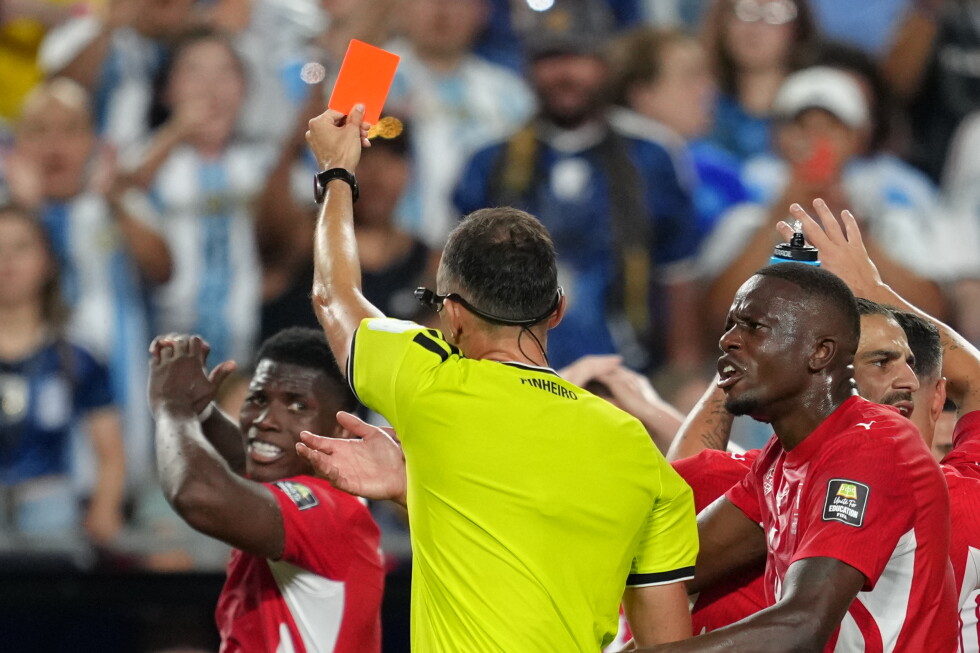
The latest flashpoint came in Saturday’s quarterfinal clash between Argentina and Switzerland, where Swiss forward Breel Embolo was sent off just five minutes after his side had leveled the score at 1-1. The incident, which swung the momentum firmly in Argentina’s favor, has centered on a newly implemented regulation often called the “mistaken identity” rule – a name that has added to widespread confusion among fans and teams alike.
In the moment of the challenge, on-field referee Joao Pinheiro did not catch Embolo’s simulation of a foul by Argentina’s Leandro Paredes, and initially issued a yellow card to Paredes instead. Under existing FIFA protocols, when a card is issued to the wrong player for an offense, the Video Assistant Referee (VAR) is permitted to intervene and ask the on-field official to review the play on the sideline monitor. After reviewing the replay, Pinheiro ruled Embolo had committed clear simulation, issued him a second yellow card, and dismissed him from the match. Argentina went on to secure a 3-1 victory in extra time, advancing to the semifinal.
Switzerland’s head coach Murat Yakin did not mince words after the elimination, saying, “The referee made the wrong decision. I know they will protect their referee but this rule destroyed our game today, and it’s very painful, and to be eliminated in that way hurts a lot.”
This incident is far from an isolated case at this tournament. Multiple high-profile exits have been tied to strict applications of new regulations and VAR checks, leaving eliminated sides and their fans questioning consistency and fairness.
Germany became one of the first major teams to exit under controversial circumstances, ousted in the round of 32 following a disallowed game-winning goal. Jonathan Tah’s late extra-time strike against Paraguay was chalked off after VAR ruled a foul by German defender Waldemar Anton on Paraguay goalkeeper Orlando Gill. Replays showed only minimal contact between the two players, drawing sharp criticism of the decision. FIFA’s referees chief Pierluigi Collina defended the call, noting that officials had been instructed to penalize any contact where players block opponents without making an attempt to play the ball, particularly when goalkeepers are involved. Germany ultimately lost the match in a penalty shootout, with Tah missing the decisive spot kick. The early exit has already triggered major upheaval in German soccer: head coach Julian Nagelsmann has resigned, with former Liverpool manager Jurgen Klopp widely tipped to take over the role.
Elsewhere, cutting-edge connected ball technology – fitted with advanced sensors that capture ball movement data 500 times per second – has already changed the course of one nation’s tournament. The high-tech system cost Croatia a dramatic late equalizer against Portugal in the round of 32, when Josko Gvardiol’s 90th-minute strike to level the score at 2-2 was ruled out for offside. The sensors detected the slightest touch from Croatia’s Igor Mantanovic in the build-up to the goal – a contact too subtle to be seen by the naked eye or even standard video replays. FIFA has defended the technology, saying it provides officials with an unprecedented level of accurate data to make faster, more precise calls. But Croatia head coach Zlatko Dalić, who stepped down from his role after the tournament exit, pushed back on the change, saying “All these decisions take the joy out of football.”
A similar VAR-related controversy saw Egypt fall short of a historic upset against defending champion Argentina in the round of 16. The African side held a 1-0 lead in the second half and looked set to extend their advantage when Mostafa Zico finished off a sweeping counter-attack to score. Wild celebrations were cut short when VAR confirmed a foul on Argentina’s Lisandro Martinez earlier in the build-up – deep in Egypt’s own half, hundreds of yards from the goal – and disallowed the strike. Argentina went on to stage a stunning late comeback, winning 3-2 and eliminating Egypt. Egyptian head coach Hossam Hassan launched a fierce attack on the officiating, saying “We have suffered injustice.” The Egyptian Football Association released a formal statement echoing that anger, noting “Several key incidents raised serious concerns and left profound questions about the consistency and fairness of decisions that directly influenced the course of the game.” Collina responded to the criticism by confirming that FIFA does not set any limit on how far back an incident can be reviewed to overturn a goal, and defended the integrity of match officials at the tournament.
The high-tech in-ball sensor was called into question again during England’s 2-1 quarterfinal victory over Norway. Norwegian players and staff insisted that Jude Bellingham’s first-half equalizer came after the ball hit an overhead camera suspension cable, which would have resulted in a stopped play and disallowed goal. But FIFA released a statement saying the sensor showed no change in the ball’s trajectory that would indicate contact, leaving Norway’s claim unaddressed. The side also had a late equalizer ruled out after VAR spotted a foul by Erling Haaland on England’s Elliot Anderson before a corner was taken. Under new rules designed to curb pre-corner fouls by attacking teams, VAR is permitted to intervene on incidents that occur before the ball is even put into play, a regulation that Norway’s camp has criticized as overly harsh.
As the tournament advances to the semifinal stage, the debate over how technology and new rules shape the outcome of matches is only expected to intensify, with fans and stakeholders divided on whether the changes improve officiating accuracy or erode the spontaneous, human element that has defined soccer for more than a century.