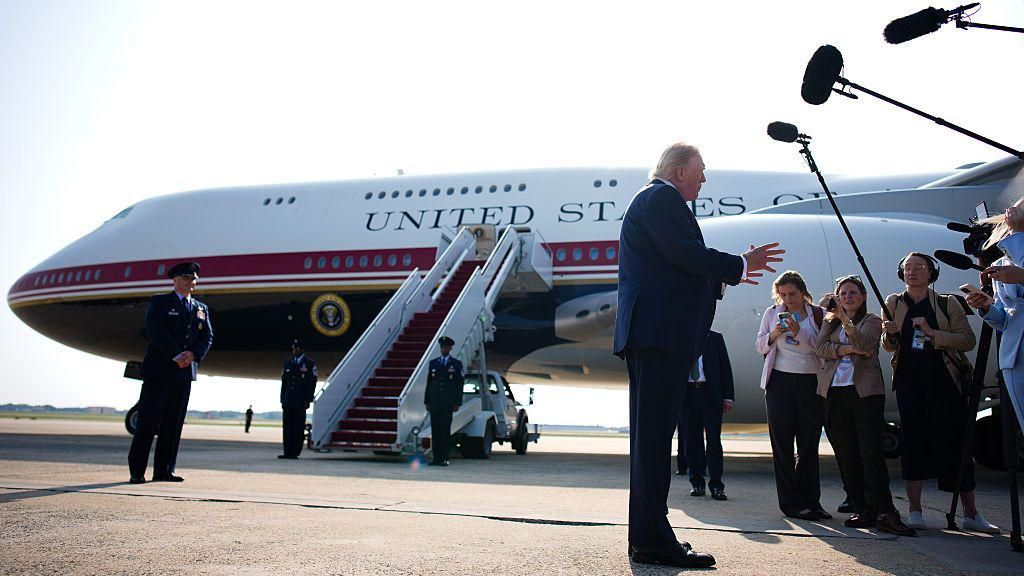
A dramatic collision between press freedom and federal law enforcement has erupted in the United States after The New York Times confirmed multiple of its reporters have been subpoenaed to give sworn testimony before a federal grand jury, stemming from the outlet’s reporting on alleged national security flaws linked to former President Donald Trump’s newly gifted Qatari Air Force One plane.
Federal agents personally delivered the court orders to the reporters’ private residences, requiring their appearance before the panel in Manhattan this coming Wednesday. The investigation, launched by the Department of Justice (DOJ), centers on alleged illegal leaks of classified national security information connected to the reporting. The subpoenas make clear that testimony is sought to probe a suspected violation of federal criminal law, the Times confirmed.
The controversy traces back to last year, when the Qatari government gifted the U.S. a pre-owned Boeing 747-8 jumbo jet, valued at roughly $400 million, as an unconditional donation to join the Air Force One fleet. Trump formally unveiled the aircraft in a public event last month, with the U.S. Air Force asserting at the time that the luxury jet had already undergone modifications to meet presidential transport requirements, including upgrades to security systems, mission communications, logistics infrastructure and advanced technology. The service also added that any potential security risks carried over from the jet’s previous use had been fully neutralized.
But in July 2026, amid rising tensions with Iran that included ongoing U.S. military strikes, the Times published a pair of explosive reports citing anonymous government sources. The outlet claimed that during Trump’s return trip from a NATO summit held in Turkey, U.S. Secret Service officials pressured Trump to abandon the new Qatari-gifted jet and switch to an older, proven Air Force One aircraft due to unaddressed security gaps. Reporters later elaborated that security officials warned the newer aircraft lacked critical defensive features, including advanced anti-missile capabilities needed to protect the sitting president. Multiple other major U.S. news outlets, including CBS News—partner outlet of the BBC in the U.S.—published matching reporting, with a former senior U.S. government official telling CBS that there had not been sufficient time or funding to retrofit the jet to meet all mandatory Air Force One security standards.
When asked about the security concerns during a press appearance this week, Trump downplayed the risks, telling reporters: ‘I have a threat all the time. I’m No. 1 on their list.’
The DOJ has defended its investigation in an official statement to the BBC, acknowledging the vital constitutional role of a free press in American democracy but arguing the department has a core responsibility to enforce rules governing classified information. ‘We value and appreciate the important role that the press plays in this country, but DOJ also plays an important role to make sure that the people entrusted with our nation’s secrets do what they’re supposed to do with that information, which means not sharing classified information,’ the statement read.
For its part, The New York Time’s chief newsroom legal counsel David McCraw has decried the subpoenas as an unprecedented attack on press freedom. In sharp remarks, McCraw called the move a ‘brazen act’ that amounts to nothing less than a deliberate attempt to chill investigative journalism, saying it is designed to intimidate reporters and block the American public from learning information that is clearly in the public interest. ‘Our journalists report the facts and advance the American public’s right to know how their government is operating and their taxpayer dollars are being used,’ McCraw added.
Under U.S. law, the unauthorized disclosure of classified information by government insiders is classified as a federal criminal offense. At the same time, the First Amendment to the U.S. Constitution provides strong protections for press freedom, shielding journalists who publish information that serves the public good from prosecution in most cases. Grand juries, which are composed of ordinary citizens convened by the federal government, are tasked with reviewing evidence collected by prosecutors to determine whether there is sufficient probable cause to bring criminal charges against a suspect or suspects.