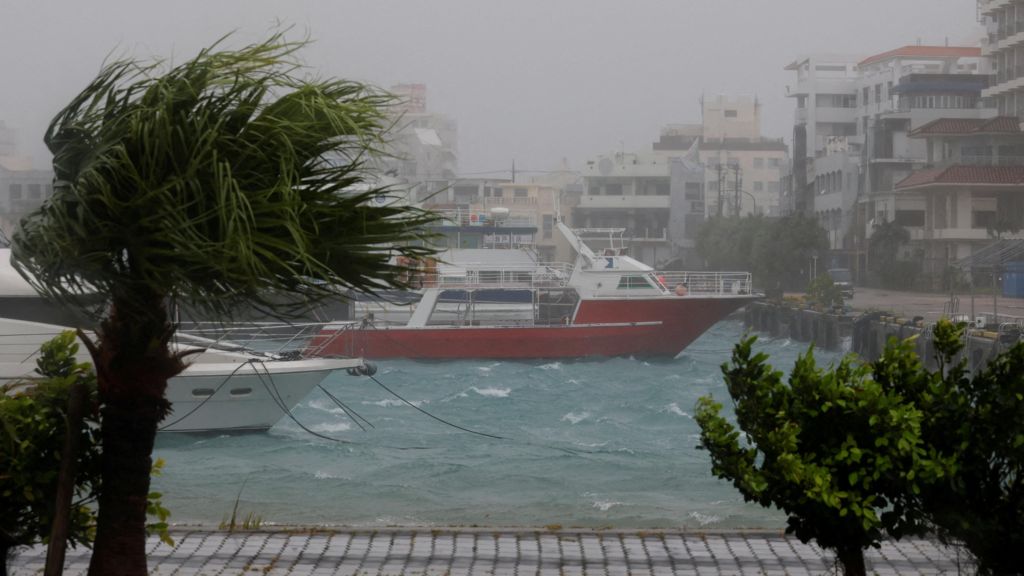
A massive late-season Pacific storm, Typhoon Bavi, is moving toward the eastern coast of China after carving a destructive path across the western Pacific that has already claimed lives and forced tens of thousands of people from their homes. This marks the second powerful typhoon to strike East Asia in just seven days, arriving as communities in southern China still recover from the deadly impact of an earlier storm system.
Originating as a powerful super typhoon, Bavi first battered Guam and the Northern Mariana Islands last Monday, packing sustained wind speeds of up to 290 kilometers per hour. As the storm moved northwest across the Pacific, it gradually weakened, but retained enormous size that stretches 1,000 kilometers at its widest point, a span roughly equal to the entire width of mainland France. By the time it reached Japan’s remote Sakishima Islands, part of the Ryukyu chain between Japan’s main islands and Taiwan, sustained winds had dropped to 144 kilometers per hour, still strong enough to cause widespread disruption. Southern Japanese islands including Ishigaki bore the brunt of the storm’s impact, leaving at least five people injured and thousands of households without electrical power.
After passing Japan’s southern island chain, Bavi brushed the northern tip of Taiwan, dumping extremely heavy rainfall across the island’s northern regions. While Taiwan avoided a catastrophic direct landfall, the storm’s intense downpours triggered widespread landslide warnings that forced thousands of residents to evacuate high-risk areas. Local authorities warned total rainfall could reach as much as one meter across worst-affected parts of the island, leading to widespread disruptions: dozens of commercial flights have been canceled, schools across multiple regions suspended classes, and residents rushed to stock up on emergency supplies, leaving supermarket shelves emptied of staple goods.
Tragically, Bavi has already claimed lives before approaching East Asia’s major population centers. Earlier landslides triggered by the storm’s outer rain bands killed 17 people across the Philippines. No fatalities have been recorded in Japan or Taiwan to date.
Currently, Bavi has weakened to a Category 1 typhoon, but meteorological and emergency authorities emphasize it remains an extreme hazard due to the enormous volume of moisture trapped in its extensive rain bands. Forecasters expect the storm to make landfall near the major eastern Chinese city of Wenzhou on Sunday morning. Wenzhou, a coastal metropolis with a population of roughly 10 million people, lies directly in the forecast path of the storm. Chinese officials have warned Bavi will bring “exceptionally heavy rains” to eastern Zhejiang province and neighboring northeastern Fujian province, and have ordered the mass evacuation of hundreds of thousands of residents from high-risk coastal and low-lying areas. Authorities note the preemptive evacuation order was implemented to prepare for the worst possible outcome, prioritizing public safety even if the storm’s impact ends up less severe than forecast.
The arrival of Bavi comes as parts of southern China are still reeling from the widespread devastation left by Typhoon Maysak earlier this week. Maysak left at least 39 people dead, killed massive numbers of livestock, caused hundreds of millions of dollars in agricultural losses, and even spawned two rare tornadoes in central China’s Hubei province, compounding the damage to communities already strained by extreme weather.