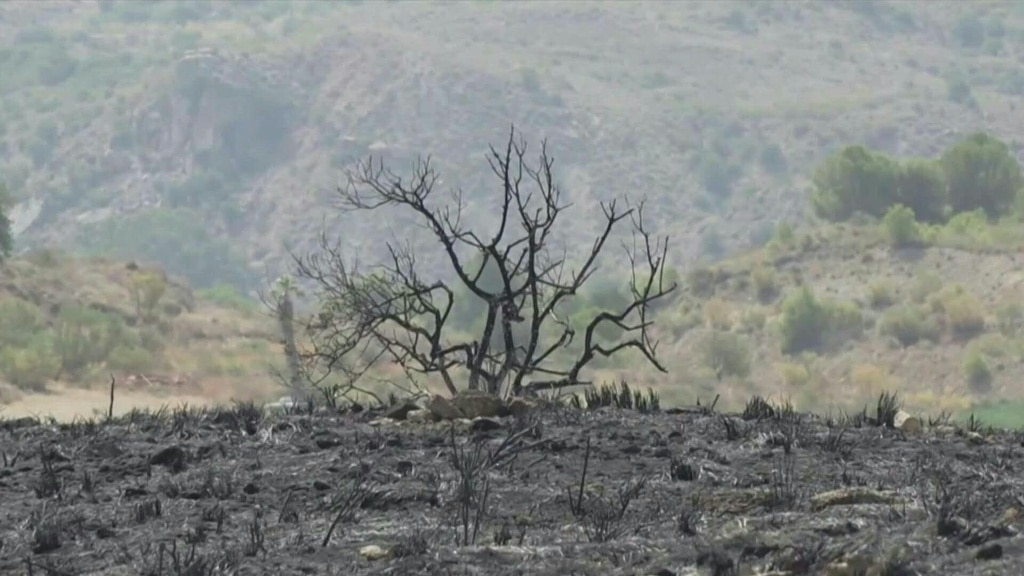
Sixteen months after one of the deadliest wildfires in modern Spanish history erupted in southern Spain’s Andalusia region, emergency crews have finally turned a corner in their battle against the blaze, thanks to a sudden shift in favorable weather conditions.
The fast-moving inferno first ignited on Thursday in the hilly Gallardos area, a scenic stretch of Andalusia that hosts a large community of foreign residents and seasonal tourists. By Saturday, improved atmospheric conditions — including dropping temperatures, receding high winds that had previously stoked the flames, and rising humidity — gave firefighters the opening they needed to launch a direct offensive against the blaze, a tactic that had been impossible for the first 48 hours of the emergency.
Twelve people from multiple nationalities have been confirmed killed in the fire, with most of the victims discovered in or near the small whitewashed village of Bedar. Many of the deceased were trapped while attempting to flee the advancing flames, either in their vehicles or on foot, regional officials confirmed. Authorities have also noted that a number of the victims failed to comply with mandatory evacuation orders or instructions to shelter in place as the fire approached their communities.
Survivors who escaped the blaze have described harrowing, nightmare-like scenes that they say will stay with them forever. “We were absolutely terrified. We could see the flames. It was horrific,” Manoli Ramos, 72, a local councillor in Bedar, told reporters. Ramos, who lived through a major 2012 wildfire in the same region, compared this event to something out of a nightmare: “This time it was like hell.”
Austin Crilly, an 87-year-old British resident who was evacuated by police from the high-risk zone, recalled the sudden speed with which the fire advanced. “I was watching television when I saw a huge black cloud, well I thought it was a cloud,” Crilly said. “I thought, ‘My God, I will shut the door’. Then, five minutes later, there was banging at the door. They said, ‘Take your money, take your cards and get out’.”
Martin Smith, a 63-year-old British tourist who was evacuated from a local campsite alongside his 65-year-old wife Elizabeth, called the scene unprecedented. “It wasn’t good. Not good at all. I’d never seen anything like it. You see things like that in films, but never in real life,” Smith said.
Antonio Sanz, chief of emergency management for the Andalusian regional government, announced Saturday that no new fatalities had been recorded overnight, a development he called “the best news we could have”. Spain’s Civil Guard has completed an initial sweep of burned areas, and while search operations continue, no additional bodies have been discovered so far.
Sanz also clarified public confusion around reports of 23 missing people, explaining that the count refers to individuals whose families have been unable to reach them, many of whom have already reached safe evacuation centers. Only seven formal missing persons reports have been filed with authorities to date. Officials caution that a final confirmed death toll will not be released until all recovered remains undergo autopsies and formal identification, which is still underway.
As of Saturday, the blaze has scorched approximately 6,600 hectares (16,300 acres) of rugged terrain, marked by steep ravines that make it nearly impossible for ground fire vehicles to access. Around 500 firefighting personnel, supported by more than 20 water-bombing aircraft, have been deployed to contain the spread of the fire.
Investigators currently believe the wildfire was sparked when a power line snapped amid weeks of extreme heat that has gripped Spain, with temperatures regularly exceeding 40°C. Those sustained high temperatures turned the region’s vegetation into dry, tinder-like fuel ready to ignite at the smallest spark.
Climate scientists around the world have repeatedly warned that human-caused climate change is increasing both the frequency and severity of extreme weather events, including the record-breaking heatwaves and large-scale wildfires that have become increasingly common across southern Europe in recent years.