As the United States pushes forward with aggressive plans to build out a new deterrence architecture targeting China in the Indo-Pacific, growing systemic gaps between its grand strategic ambitions and its core industrial, logistical, and political capabilities threaten to leave this framework dangerously incomplete at the exact moment it is needed. This emerging rift has been laid bare by stark warnings from top US military leaders and independent defense analysts, who highlight cascading constraints that could undermine Washington’s regional posture before a crisis even unfolds.
Last month, The Washington Times brought public details of a closed-door 221-page assessment compiled in April 2026, in which the commander of US Indo-Pacific Command, Admiral Sam Paparo, warned Congress that the risk of armed conflict with China is on the rise. Paparo urged Congress to allocate a minimum of $122 billion in fiscal 2027 funding to shore up deterrence across the Indo-Pacific region, framing the request around what he describes as accelerating Chinese military expansion, growing pressure on Taiwan, long-term territorial claims, and deepening strategic alignment between Beijing, Moscow, and Pyongyang. In his view, the $122 billion represents the bare minimum required to maintain a credible deterrent and secure victory if open conflict breaks out.
Breaking down the request, Paparo has earmarked $67.4 billion for expanded missile procurement, $18 billion for development of capabilities to disrupt Chinese command-and-control systems, $15 billion for space-based early warning and surveillance infrastructure, and $2.3 billion for the acquisition of drones and other autonomous weapons systems. The broader plan also calls for expanding both defensive and potential offensive missile capabilities on Guam, upgrading critical military infrastructure in Hawaii and smaller Pacific island nations, strengthening access to allied military bases and expanding joint exercises, and fielding a range of lower-cost advanced systems including the Blackbeard hypersonic missile, Quicksink anti-ship bomb, and next-generation advanced naval mines.
Paparo’s assessment explicitly notes that China is on track to complete preparations for a potential military operation targeting Taiwan by 2027, while continuing to leverage legal, economic, and information-based pressure that falls below the formal threshold of open war. The unclassified summary of his assessment, which is required under the existing Pacific Deterrence Initiative, is being released to shape congressional deliberations over the 2027 fiscal year defense appropriations bill. Beyond the public spending request, defense analysts note that Paparo’s appeal is less a routine procurement wish list and more a candid admission that the United States’ existing force posture in Asia is growing increasingly vulnerable to Chinese military advances.
The core challenge to US deterrence stems from China’s rapidly maturing anti-access/area denial (A2/AD) network, which is specifically designed to neutralize the traditional aircraft carrier strike groups that have long been the backbone of US power projection in the Pacific. As Jordan Spector outlined in a March 2026 article for the U.S. Naval Institute’s *Proceedings* journal, this system centers on advanced ballistic missiles that can saturate and disable large naval targets. It includes the already operational DF-21D “carrier killer,” a medium-range missile with a maneuverable warhead built to strike large naval vessels at extended ranges, alongside the DF-26B, which has a 3,862-kilometer range and is capable of targeting both regional US bases and deployed naval forces. Spector estimates that China currently deploys roughly 500 short-range ballistic missiles and 450 medium-range ballistic missiles, all supported by a robust, multi-layered surveillance network.
This integrated surveillance architecture combines naval and air reconnaissance assets, military satellites, coastal and sea-based over-the-horizon radars, and a large maritime militia made up of thousands of civilian vessels. This combination gives China the ability to detect, track, and target US military assets across nearly the entire breadth of the western Pacific, creating major risks for concentrated US force deployments.
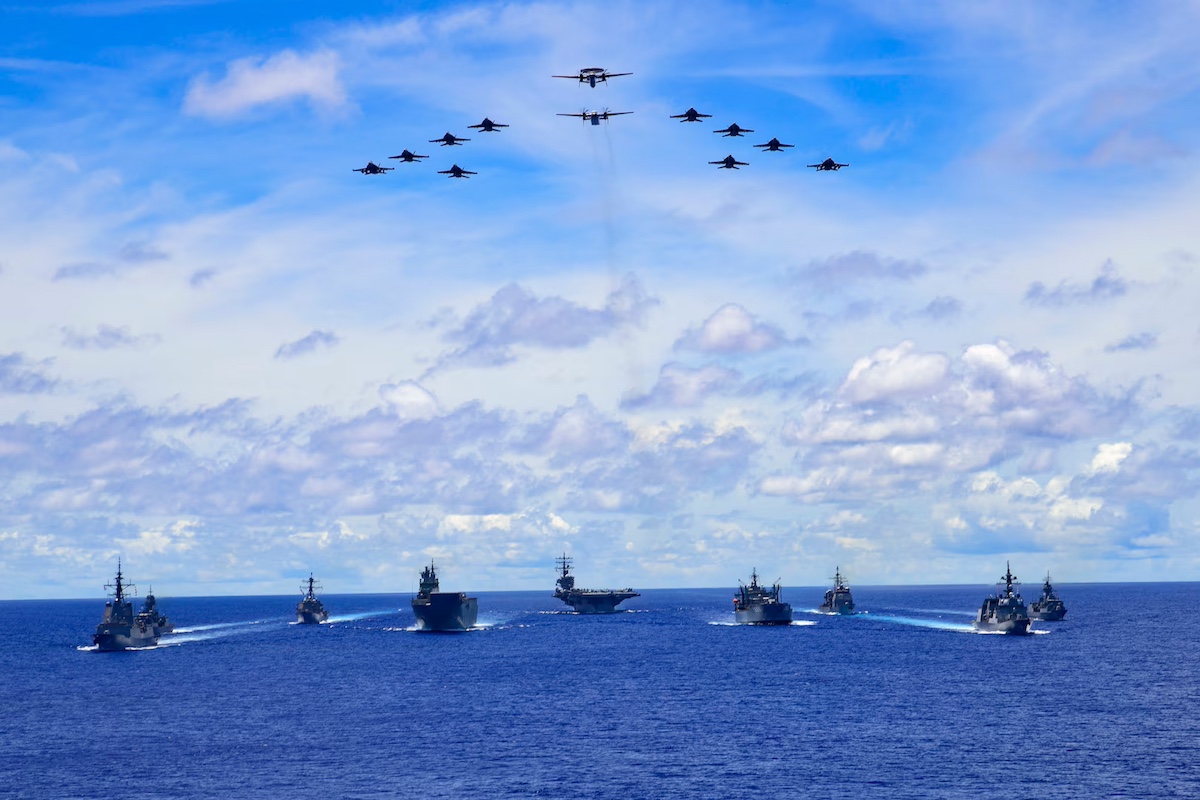
To counter these vulnerabilities, US defense planners have developed a series of operational overhauls to reshape the country’s Pacific posture. The US Navy is shifting away from its reliance on large, high-value capital ships and fixed large bases toward a hybrid fleet model and far more dispersed operational deployments. Writing for the Center for International Maritime Security (CIMSEC) in February 2026, George Galdorisi laid out a proposal for a 500-ship future fleet that combines 350 crewed vessels with 150 large uncrewed maritime platforms. This model would add critical operational mass to the US fleet at a far lower per-unit cost than traditional crewed vessels. Under Galdorisi’s framework, large uncrewed surface vessels would act as modular mobile bases for smaller autonomous craft operating in heavily contested coastal waters. These uncrewed systems can carry out intelligence, surveillance, reconnaissance, and mine-countermeasure missions in high-risk littoral zones, while keeping expensive crewed capital ships outside the most lethal range of China’s A2/AD envelope. Operating up to 926 kilometers from shore, this combined human-autonomy team can generate the operational mass needed to maintain presence while dramatically improving force survivability without putting additional US personnel at risk.
Beyond naval restructuring, the US is also moving away from its decades-long model of large, permanent regional garrisons in favor of a far more flexible, distributed operational posture. In a January 2026 report from the Asan Institute, analysts Peter Lee and Esther Dunay explain that new concepts including Agile Combat Employment (ACE) and Dynamic Force Employment call for dispersing aircraft and other critical assets across a network of temporary, austere airfields, secured through pre-negotiated access agreements with regional allies. Similarly, Expeditionary Advanced Base Operations (EABO) calls for deploying small, highly mobile teams across a network of small “lily pad” forward outposts. This structure forces Chinese military planners to contend with far more potential targets, complicating their strike planning while supporting US sea control efforts and reducing the vulnerability of concentrated US force deployments.
Despite these ambitious strategic and operational overhauls, whether the US can actually address the gaps identified by Admiral Paparo remains an open question, given the significant practical and political barriers that stand in the way of implementation. A May 2026 report from Seth Jones of the Center for Strategic and International Studies (CSIS) identified severe gaps in US wartime readiness, including three to four year production lead times for critical munitions, and severely depleted stockpiles left over from decades of conflict in the Middle East. Jones also noted that US logistics infrastructure is already under severe strain, with sustained operational demands causing significant structural wear on more than 40 percent of the Navy’s deployed surface vessels. He added that key forward bases in Japan, the Philippines, and Guam remain fully exposed to Chinese precision missiles and drone strikes, with most installations lacking sufficient hardened aircraft shelters and modern active defense systems to repel attacks. Most critically, consistent access to allied facilities and sustained military support from key regional partners including Japan and Australia is not always legally or operationally guaranteed, creating additional uncertainty for US deployments.
These military and industrial constraints are compounded by growing domestic political uncertainty in Washington. Following the May 2026 US-China summit, Anton Troianovski and David Sanger wrote in The New York Times that US President Donald Trump has moved away from the more confrontational approach to China that defined the Biden administration and Trump’s own first term in office. Trump has replaced tariff escalation and rhetoric of economic decoupling with diplomatic outreach, renewed business engagement, and public praise for Chinese President Xi Jinping. This policy shift suggests that the long-standing bipartisan consensus in Washington behind sustained strategic competition with China may be weakening, even as US military planners are calling for a larger, more urgent military buildup in the Indo-Pacific. Troianovski and Sanger note that while this shift toward accommodation may reduce immediate bilateral tensions, it also risks eroding the domestic political commitment needed to fund, deploy, and sustain the full deterrence architecture that military planners say is urgently required.
In the end, whether the US can turn Admiral Paparo’s warning into a fully operational, credible deterrent will depend far less on the headline $122 billion spending figure than on how quickly Washington can expand domestic munitions production, harden vulnerable regional bases, and secure consistent long-term access to allied infrastructure before a crisis erupts. If implementation of the plan stalls while political accommodation with China deepens, Chinese leadership could reasonably conclude that the growing gap between US strategic plans and its actual ability to execute them creates a narrowing, but increasingly attractive window for coercive action or open military force.