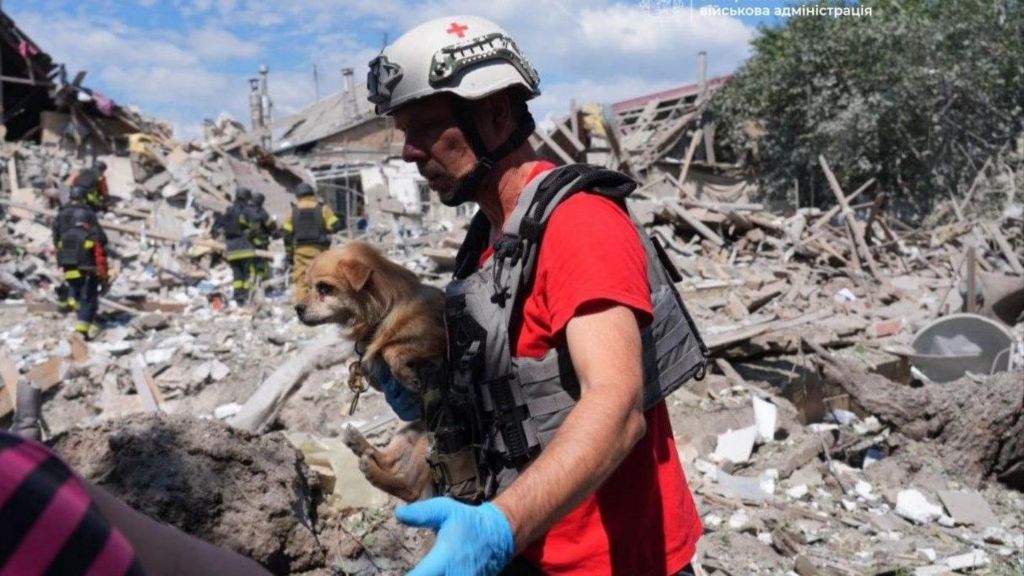
Nearly four and a half years into Russia’s full-scale invasion of Ukraine, the southeastern city of Zaporizhzhia, a hub home to roughly 750,000 civilians just 24 kilometers from active front lines, has entered a new phase of unrelenting danger. June 2026 saw a dramatic surge in Russian strikes that have upended daily routines and turned ordinary mornings into life-or-death moments for residents.
For IT specialist Anna Holovchenko, this new reality is personal. She was jolted awake at 5 a.m. one day last month by the impact of Russian glide bombs striking Zaporizhzhia’s suburbs. Barely an hour passed before a second wave of drone attacks echoed across the city, as Ukrainian air defense teams scrambled to intercept incoming unmanned aerial vehicles. “I realized I’m not getting any more sleep and started getting ready for work,” Holovchenko told reporters. A short time later, a Shahed drone crashed blocks from her office, shaking the building with a massive explosion, while another strike took out critical communications infrastructure and cut off internet access for hours. “That’s just another ordinary day in Zaporizhzhia,” she said.
Strikes in recent weeks have targeted a wide range of civilian infrastructure, including public transit buses, private vehicles, fuel stations, schools, government administrative buildings, and residential neighborhoods. In one deadly attack on a civilian bus, three people lost their lives, according to local emergency services.
Regina Kharchenko, Zaporizhzhia’s acting mayor, described the relentless pressure of the surge in attacks. Even in the middle of government work, she says the threat is unavoidable: during one particularly intense barrage, “I did not go to the shelter initially, but when it got too loud I took cover in the toilet.” Like most residents, Kharchenko lives an ordinary life without the protection of dedicated bomb shelters or security details: “I live in an ordinary high-rise, on the seventh floor. I’ve got no personal bunker with 10 bodyguards. Personally, I’m very afraid. At night she sometimes sleeps on the floor of her home corridor to reduce her risk of injury from falling shrapnel or broken glass.
City leaders were forced to hold an emergency legislative meeting in an underground bomb shelter to address the rapidly deteriorating security situation, where Kharchenko condemned what she called “stepped up terror against civilians” that has even put children at direct risk. In response, local authorities have rolled out emergency mitigation plans: construction of new public bomb shelters across the city is already underway, anti-drone netting is being installed at high-traffic, vulnerable locations, and anti-shatter safety film is being applied to windows at all schools, hospitals, and public government buildings.
Zaporizhzhia city holds unique strategic and symbolic weight in the ongoing conflict: it is the administrative capital of the Zaporizhzhia region, one of four Ukrainian regions that Russia unilaterally annexed in 2022 in a move that has not been recognized by the vast majority of the international community. Roughly 50 kilometers southwest of the city, in the portion of the region still under Russian occupation, sits Europe’s largest nuclear power facility, the Zaporizhzhia Nuclear Power Plant, whose safety has been a constant source of global concern since the invasion began.
What makes the recent surge in attacks particularly notable, analysts say, is that it comes even after Ukrainian forces pushed Russian ground troops back several kilometers from the outskirts of Zaporizhzhia city. The intensification of strikes is not driven by a shift in frontline positions, but by new Russian drone tactics and technology that allow strikes to reach deeper into the city than before.
Sam Cranny-Evans, a security analyst at the Royal United Services Institute, a leading London-based defense think tank, outlined three key factors behind the jump in successful attacks. First, Russian forces now regularly use longer-range “mothership” drones that deploy swarms of smaller, lethal first-person-view (FPV) drones. These smaller FPV drones were previously unable to reach Zaporizhzhia city, but when deployed from motherships launched closer to the front, they can scatter and hit targets that would otherwise be out of range. Second, Russia has started using mesh networking technology for its drone operations, which makes the signals far harder for Ukrainian electronic warfare systems to jam, and allows drones to relay signals between each other to extend their effective range. Third, Cranny-Evans notes that Ukraine’s electronic warfare capabilities, which have long been one of its most effective defenses against Russian drones, have been stretched thin: “reduced Ukrainian electronic warfare activity, because of a focus elsewhere and an equally increased focus from Russian units” on Zaporizhzhia has created openings for more Russian strikes to get through.
Local defense authorities confirmed the scale of the assault: in just the last week of June, Ukrainian air defense and electronic warfare teams intercepted 884 Russian drones targeting the city. While Russian forces have been pushed back south of Zaporizhzhia, they have continued incremental advances in other sectors of the front, though their progress has slowed significantly in recent months. Analysts add that Russian operational momentum has been hampered by a sustained Ukrainian campaign targeting Russian energy and logistics infrastructure, including strikes on oil refineries, fuel storage depots, and supply routes in occupied Ukrainian territory.
Despite the constant threat of attack, hundreds of thousands of Zaporizhzhia residents have chosen to remain in the city, rather than evacuate to safer regions of western Ukraine or abroad. For Holovchenko, the decision to stay is rooted in both pragmatism and defiance. “We’ve got food and fuel, why would I leave? Maybe I’m not the easily scared type,” she said. While she admits she has considered leaving, she refuses to let Russia drive her from her home: she does not want Zaporizhzhia to become another Ukrainian city emptied and destroyed by Russian occupation. “We’re just trying to stay safe and we’re doing all we can to survive until our victory,” she said.