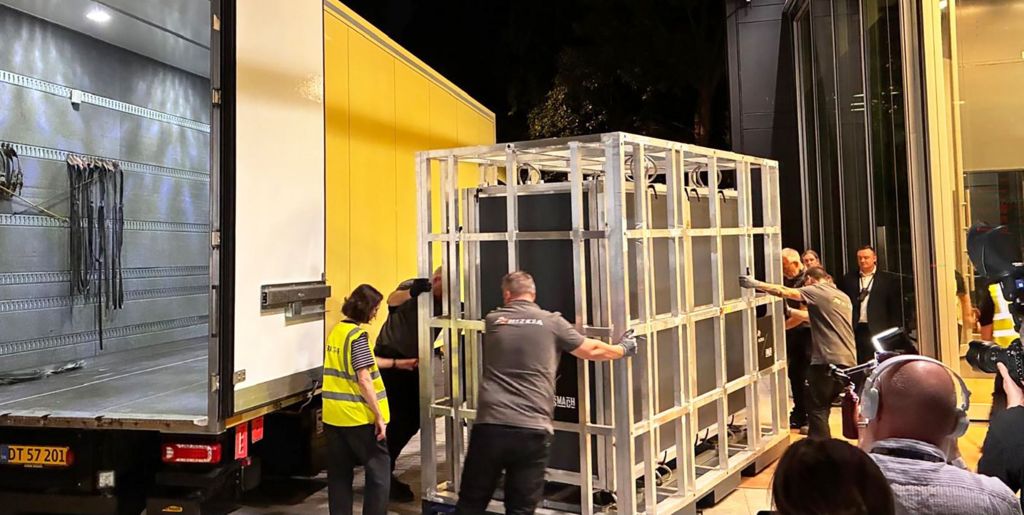
In the pre-dawn stillness of 2:50 a.m., a reinforced, temperature-controlled crate wrapped in an aluminum frame rolled through the loading bay doors of London’s British Museum. Inside, wrapped in centuries of history, lay the Bayeux Tapestry — making its first return to British soil in nearly 1,000 years, since historians believe it was originally crafted here shortly after the 1066 Norman Conquest.
Escorted by French police from an undisclosed northern French holding location and transported across the Channel via Eurotunnel, the 70-meter 11th-century embroidery completed its 300-plus-mile journey under cover of night to minimize risk to the fragile artifact. The arrival was witnessed by a small group of stakeholders including the French ambassador to the UK and British Museum leadership, with BBC News on hand to document the landmark moment.
The iconic work of medieval textile art weaves 58 vivid scenes detailing the chain of events that led to William of Normandy’s invasion of England and the defeat of Anglo-Saxon King Harold II — a turning point that redefined the course of British history, politics, language and culture. Despite its name, the Bayeux Tapestry is technically an embroidery: stitched onto linen with colored wool yarn, it includes 626 figures, 202 horses, and detailed depictions of 11th-century architecture, warfare, seafaring and daily life that no surviving written source can match. Historians credit its survival for nearly a millennium, through threats of moths, fire, flooding and war, as nothing short of a miracle.
The nine-month loan is a landmark cultural agreement between the French and UK governments, finalized last year between French President Emmanuel Macron and UK Prime Minister Sir Keir Starmer. The arrangement comes as Bayeux Museum, where the tapestry has been on permanent display since 1983, undergoes major renovation work. In exchange for the temporary loan, the British Museum is sending two of its most iconic British treasures to Normandy: the famed Sutton Hoo ship burial hoard and the 12th-century Lewis chessmen, carved from walrus ivory.
British Museum director Nick Cullinan called the tapestry’s return a once-in-a-lifetime historic event. “We’ve just witnessed something rather extraordinary… it feels like a really remarkable thing not just to witness but to be part of, and we’re so excited to share it with as many people as possible,” he said. Millie Horton-Insch, the exhibition’s project curator, acknowledged that the quiet unloading of a crate might seem unremarkable to an outside observer, but for her and her team, the moment carried profound weight. “When you consider the object within it, how old it was, how close to the events it depicts it was made, by people who lived through those events, it’s really profound,” she said, adding that she teared up as the crate was unloaded. Macron signaled the warm diplomatic spirit of the loan earlier, when he shared an image of the tapestry projected onto the White Cliffs of Dover, captioned with a simple “merci beaucoup.”
The historic loan has not been without controversy, however. Since the agreement was announced, French critics have raised urgent concerns about the risk of damage to the fragile textile, which has not left Bayeux in decades. A public petition opposing the move labeled it a “heritage crime,” and even famed late British artist David Hockney publicly opposed the transport, arguing that “some things are too precious to take a risk with.”
Museum and government officials on both sides have emphasized that every possible precaution was taken to protect the artifact during transit. After the tapestry was removed from its display stand in Bayeux last year, it was kept on its custom folding mount, placed inside a climate-controlled inner crate, then fitted into an outer aluminum-framed crate fitted with metal spring shock absorbers to buffer against road vibrations. Curators and transport teams completed two full test runs of the route using an identical textile replica to measure vibration levels and refine safety protocols, before the original artwork made its journey.
Cullinan stressed that the loan would never have moved forward if any stakeholder had deemed it too risky. “If anybody had said on the other side, especially on the French side as the lenders, ‘I think this is too risky to do’, it wouldn’t be arriving now. That’s the reality. A museum would never do something that imperilled the objects in its care,” he said. Peter Ricketts, the UK’s special envoy for the tapestry loan, added that all meticulous preparations had paid off, with the artifact arriving in perfect condition. “everything possible had been done to avoid damage,” he said. “No one would want to bring the tapestry to the UK if they thought there was any damage or danger to this extraordinary object. I’m not worried, I’m relieved.” Ricketts framed the loan as a meaningful act of cultural diplomacy, calling it “two old nations coming together to look at their shared history and that is very special.”
Public excitement for the September opening has already reached historic levels: the British Museum sold a record 100,000 tickets on the first day of sales alone. Unlike its permanent display in Bayeux, the tapestry will be exhibited flat in London, per the terms of the loan, with a custom mezzanine viewing platform that will allow visitors to see the entire 70-meter work in one view — an experience that has never been possible before in the tapestry’s history. Over the coming weeks, conservation teams will conduct a painstaking pre-display examination of the embroidery to document its condition ahead of the opening, marking the final step in a journey nearly 1,000 years in the making.