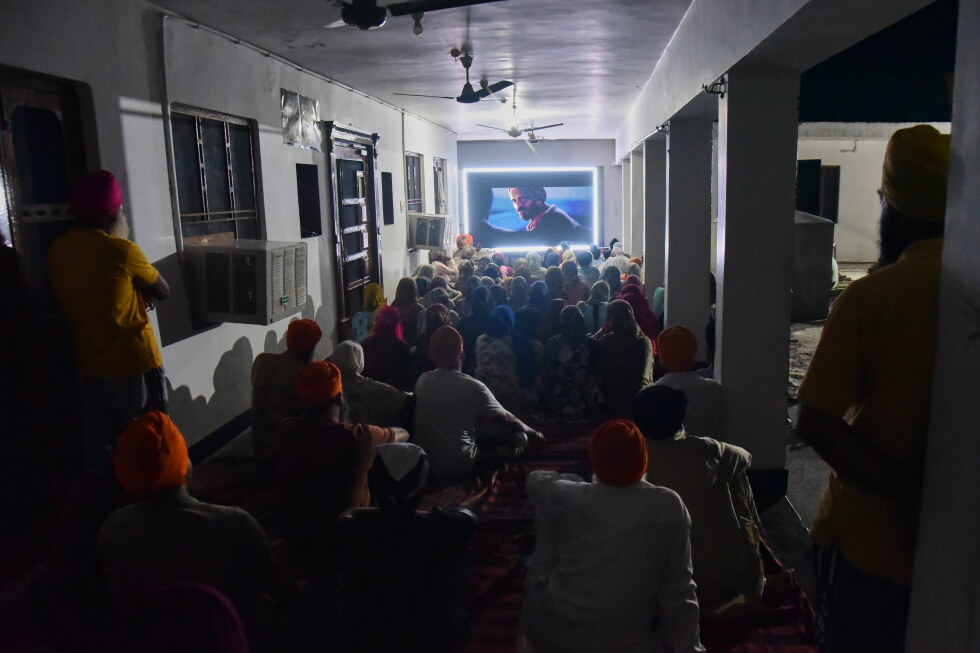
As twilight falls over the golden farmlands of India’s Punjab state, villagers in Gurdaspur have gathered in the open courtyard of a local Sikh temple for an act of quiet defiance: a community screening of *Satluj*, a feature film blocked from official distribution by Indian authorities.
The film traces the real-life story of Jaswant Singh Khalra, a fearless human rights activist who uncovered evidence of mass enforced disappearances and extrajudicial killings during the Indian government’s 1980s to early 1990s crackdown on a Sikh separatist insurgency seeking an independent state of Khalistan. The decades-old conflict, one of the bloodiest internal conflicts in modern Indian history, claimed the lives of thousands of civilians, militants, and security force personnel.
Rights groups have long documented widespread allegations of custodial deaths, secret cremations, and unrecorded disappearances from the insurgency era. It was Khalra who blew the lid off these abuses, revealing that police had secretly cremated thousands of disappeared people without notifying their next of kin or keeping any official records of the deaths. In 1995, Khalra was abducted by unknown assailants and later killed; multiple police officers have since been convicted in connection with his murder.
Originally titled *Punjab 95*, the film faced three years of bureaucratic delays after India’s central censor board demanded more than 120 edits to the content. After failing to secure permission for a wide theatrical release, the film premiered last week on Indian streaming platform ZEE5 — only to be pulled from the service within 48 hours following unspecified government pressure. New Delhi has not issued a public explanation for the takedown, but unnamed officials told local media the order was issued on national security grounds, as the government still views any open discussion of separatist sentiment as a threat to domestic stability.
But the ban has backfired spectacularly. The removal of the film from official platforms spurred leaked copies to spread rapidly across social media and private online channels, and grassroots groups across Punjab have mobilized to organize hundreds of unauthorized community screenings. Sikh temple compounds, village community halls, and open fields have been converted into makeshift open-air cinemas, with local residents pooling resources to rent projectors, speakers, and backup power generators. Volunteers spread word of screenings door-to-door, drawing crowds that mix elderly survivors of the insurgency and teenagers born decades after the conflict ended.
Inderjeet Singh Bains, a local organizer coordinating screenings in Gurdaspur district, explained that the grassroots movement is intended to create a shared space for communities to confront a painful chapter of Punjab’s history that still shapes intergenerational memory. “When we screen the film, we see our elders and mothers, many of them 60 or 70 years old, crying because they have lost their sons. Our people have endured immense suffering,” Bains said.
Gurmukh Singh, an audience member at a recent Gurdaspur screening, noted that the film finally gives full voice to stories that young Punjabis have only ever heard as fragmented family anecdotes. For most Punjab villages, the insurgency is not distant history — it is a lived trauma that touches nearly every family. “After watching the movie, there is a feeling of the grief our earlier generations had to bear,” Singh said.
The takedown of *Satluj* has reignited a long-simmering national debate over artistic freedom and censorship under Prime Minister Narendra Modi’s Hindu nationalist government. Critics argue that censorship cases against dissenting artistic works have grown increasingly frequent under Modi’s administration, which actively promotes films that align with its right-wing nationalist ideological narrative.
Balwinder Singh, a prominent Sikh religious leader, challenged the government’s justification for the ban: “Everything happened right before our eyes, so what is there to oppose? The truth is coming to light, and people should be allowed to see it.”
The Indian government maintains that film certification and censorship decisions are made independently by regulatory bodies under existing law. ZEE5, for its part, said in a statement that it pulled the film from its Indian platform “in light of current developments,” and added that it would explore “every appropriate avenue through due process” to restore the film to its service.
Even without official distribution, *Satluj*’s lead actor Diljit Dosanjh, one of India’s biggest entertainment stars, says the film’s message can no longer be suppressed. “Once audiences have seen it, it cannot be erased,” he said.
That reality is on full display in Gurdaspur’s temple courtyards. After the credits roll on screen, many audience members linger long into the night, comparing the film’s portrayal of the insurgency to the personal memories they have carried for decades. Pawan Deep Kaur, a young audience member, described the film as a devastating, honest portrait of the suffering endured by Punjab’s older generation. “It made us cry endlessly,” she said.