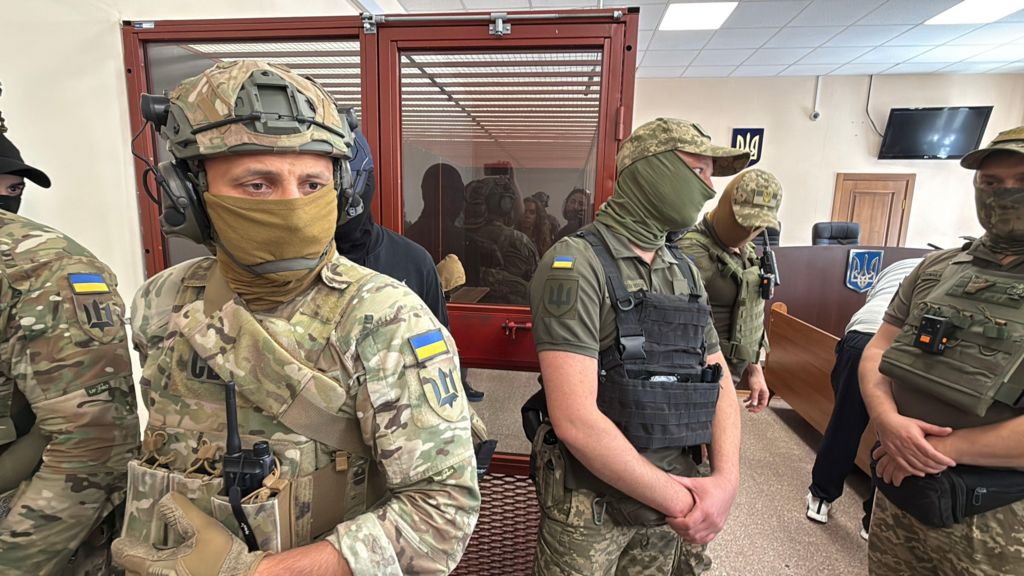
### High Security Court Appearance in Kyiv Holds Unprecedented Revelations
On Thursday, a heavily fortified Kyiv courtroom played host to a custody hearing that has sent shockwaves through Ukraine’s national security establishment, centered on a tangled cross-border case that connects a foiled assassination attempt in Monaco to the mysterious killing of the suspected would-be assassin on Ukrainian soil.
The defendant at the heart of the drama, 34-year-old Vladyslav Reut, is an active, decorated officer with Ukraine’s GUR military intelligence agency. Just days earlier, he had admitted to fatally shooting Anastasiia Berezovska, the 39-year-old woman identified as the prime suspect in last week’s bombing targeting sanctioned Ukrainian-born oligarch Vadim Yermolayev in Monaco. Reut even guided investigators to Berezovska’s hidden woodland grave west of Kyiv, concealed under a pile of tree branches. But in a dramatic reversal during Thursday’s hearing, Reut categorically denied pulling the trigger, shifting all blame to his co-defendant, 50-year-old Vitalii Zhykovych, a former officer with Ukraine’s SBU domestic security service.
Reut told the court he had only helped Zhykovych pick up Berezovska after she crossed into Ukraine from Poland by bus, just two days after the Monaco explosion and before her name was linked to the attack. According to Reut’s revised testimony, the pair drove Reut’s BMW to meet Berezovska on the Kyiv highway, with Zhykovych claiming they needed to hide her amid an unspecified criminal matter. Reut said Zhykovych produced a modified Makarov pistol from his backpack during the drive, and when Reut questioned the weapon, Zhykovych dismissed it as a precaution against panic. When the three reached a forest path near the village of Yuriv, Reut claimed Zhykovych ordered him to shoot Berezovska, threatening “it’s either her or us.” In Reut’s account, Zhykovych ultimately fired four fatal shots himself, after which the pair dug a grave and disposed of the gun and Berezovska’s belongings in a nearby lake.
Addressing why he initially confessed to the killing, Reut told the court he had acted out of fear: Zhykovych had threatened to harm his family if Reut did not take the blame, he claimed. “I have fought enemy combatants defending my country,” Reut emphasized to the court. “I would never intentionally murder an innocent civilian woman.”
The co-defendant’s legal team immediately rejected Reut’s new narrative. Anatoliy Ivanov, Zhykovych’s lawyer, described his client as a decorated patriot who fought against Russian-backed forces in eastern Ukraine in 2014 and participated in the defense of the Kyiv region following Russia’s 2022 full-scale invasion. Ivanov dismissed Reut’s claim that a low-ranking former SBU officer could force a serving GUR officer to participate in a murder, arguing Reut was only lying to avoid imprisonment. “He does not want to be imprisoned. I understand,” Ivanov said, while insisting his client “did not kill” Berezovska. Ivanov also raised the unsubstantiated possibility of Russian involvement, noting that Moscow has recruited Ukrainian intelligence agents in the past, saying “We’ve had a lot of such rats, unfortunately.”
Both suspects appeared in court heavily obscured: their hands were cuffed, they kept hoods pulled up over their heads and large masks covering most of their faces, leaving only their eyes visible. For the majority of the separate hearings, the pair sat hunched inside the courtroom’s fortified glass cage, their backs turned to assembled press cameras.
Prosecutors confirmed that investigators tracked Reut and Zhykovych quickly after identifying Berezovska as a suspect, using the dead woman’s phone records to zero in on the two men, before uncovering cash and cryptocurrency transfers they had made to Berezovska’s accounts. Prosecutor Dmytro Tkachuk told reporters the two men are accused of acting “jointly and in a coordinated fashion” and have both been formally charged with premeditated murder. While one suspect has disclosed information about a potential motive, Tkachuk said releasing that detail publicly would damage the ongoing investigation, adding “all versions are being considered” — including theories ranging from Russian interference to organized crime and corruption.
Yermolayev, the target of the Monaco bombing, made his fortune in the cognac and real estate industries, renounced his Ukrainian citizenship years ago, and was sanctioned by Kyiv for continuing business operations in Crimea after Russia’s 2014 annexation of the peninsula. To date, the full motive for the failed assassination attempt against him remains unconfirmed.
Ukrainian President Volodymyr Zelensky acknowledged the high-profile case Thursday evening, saying he would release “additional relevant reports” in the coming days as the investigation progresses. The judge rejected bail requests for both defendants, remanding them into custody to await further progress in the probe. For now, the case remains tangled in contradictory testimony and unanswered questions, creating a sensitive political and institutional challenge for Kyiv’s wartime government.
Ukrainian agent accused of murdering Monaco bomb suspect changes story