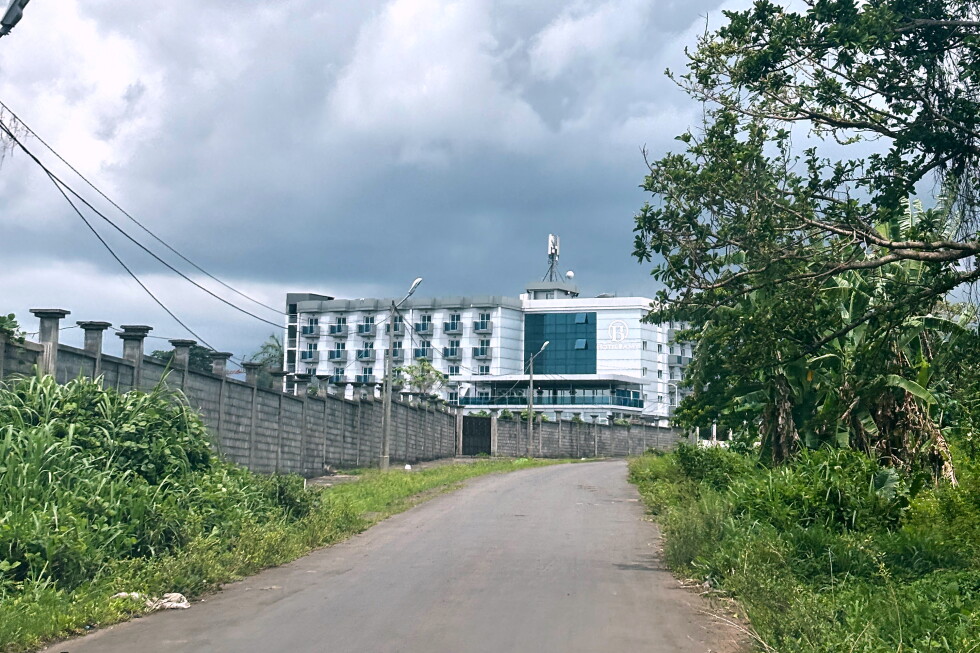
DAKAR, Senegal – Migrants deported from the United States and detained in an Equatorial Guinean hotel are sounding an urgent alarm: authorities have placed at least one suspected Ebola patient under quarantine in the same facility, according to statements from the detainees and the legal team representing them, released publicly Thursday.
The isolated facility, a hotel located on a lush tropical island off Equatorial Guinea’s mainland coast, is owned by the country’s long-ruling, powerful president Teodoro Obiang Nguema Mbasogo. It currently holds 17 migrants originating from a range of African nations including Angola, Mauritania and Ethiopia, placed there under a little-known, non-transparent third-country deportation agreement struck with the former Trump administration.
Details of the dangerous co-location emerged from both a formal statement released by an international coalition of human rights lawyers and on-the-record interviews with two of the detained migrants, who spoke only on condition of anonymity over fears of violent retaliation from Equatorial Guinean authorities. According to their accounts, last week medical personnel wearing full hazmat suits brought a man suspected of carrying the Ebola virus to the hotel and quarantined him on a floor directly below the section where migrants are being held.
An ongoing rare Ebola outbreak is currently ravaging the central African nation of the Democratic Republic of Congo, where the outbreak was first declared in May and has already claimed more than 600 lives to date. While a small number of confirmed cases have been recorded in neighboring Uganda, Equatorial Guinea – which shares no border with Congo and sits roughly 1,885 kilometers away from the outbreak’s epicenter – has not reported any confirmed or even suspected Ebola cases of its own until this reported incident.
Despite that lack of prior risk, the two deportees told the Associated Press that an English-speaking doctor explicitly informed them the man being brought into the hotel was a suspected Ebola case and that they should take precautions. No further information about the patient’s status or risk mitigation steps for detainees was provided after that initial warning.
The legal coalition’s statement echoed the detainees’ accounts, confirming that the group had received “disturbing reports from multiple detained individuals that a person with a suspected case of Ebola was recently brought under quarantine into the same hotel complex where they are being held.” One detainee added that a second suspected Ebola patient, a woman, was transported to the same quarantine floor of the hotel this past Sunday, also identified by arriving medical staff as a potential Ebola case.
The Associated Press has reviewed video footage that appears to show medical workers clad in full protective biohazard gear transporting individuals into the hotel, which previously functioned as an isolation and quarantine center for COVID-19 patients during the height of the global pandemic.
“Things are getting worse every day,” one anonymous detainee shared in an interview. “It’s very confusing, no one is coming to talk to us. No one is informing us of anything. The hygiene is unimaginable.” Beyond the lack of information, neither masks, disinfectant spray, nor other basic protective supplies to reduce the risk of viral exposure have been provided to the 17 detainees, and no public health safety measures have been communicated to them, according to both legal representatives and the detainees themselves.
The detentions in Equatorial Guinea are part of a broader, largely secretive immigration policy enacted by the Trump administration, which entered into undisclosed third-country deportation agreements with nearly 24 nations. Under these deals, thousands of people deemed to be in the U.S. illegally are deported to countries that are not their countries of origin, as part of a sweeping crackdown designed to deter future unauthorized immigration. Immigration advocates and lawyers note that this policy acts as a legal loophole, allowing the U.S. to indirectly force asylum seekers back to their home countries even when their asylum claims would otherwise qualify for protection.
Equatorial Guinea is one of at least eight African nations that have signed onto these third-country deportation agreements with the U.S. After a $7.5 million deal was struck between the two governments, Obiang repurposed a family-owned hotel on Bioko Island, near the capital of Malabo, into an immigration detention facility for deported migrants. Legal representatives confirm that 13 men and 4 women are currently being held at the site, and all of them had received formal orders from U.S. immigration judges that should have prevented their removal to their home countries.
Earlier this month, the same coalition of international rights lawyers filed a formal legal complaint against Equatorial Guinea before the African Commission on Human and Peoples’ Rights, the continent’s top human rights oversight body. The complaint accuses the central African nation of forcibly deporting U.S.-deposited migrants back to their home countries, a move that violates core international human rights protections for asylum seekers.
In Thursday’s updated statement, the legal coalition added that they have also received repeated reports that multiple detainees with pre-existing serious medical conditions are being denied access to adequate medical care while in government custody.
Rich in oil reserves, Equatorial Guinea is counted among the wealthiest countries in Africa by per capita GDP, but it is also widely criticized for systemic rampant corruption and routine human rights violations, according to assessments from U.S. government officials. Independent political opposition and critical public discourse are virtually non-existent in the country, where the Obiang regime has been repeatedly accused by human rights organizations and the U.S. State Department of arbitrary detention, torture, and extrajudicial killing of political dissidents and activists who speak out against the government.
Notably, U.S. companies are the largest foreign investors in Equatorial Guinea’s oil sector, and the country’s military receives funding for training and equipment from the U.S. government.