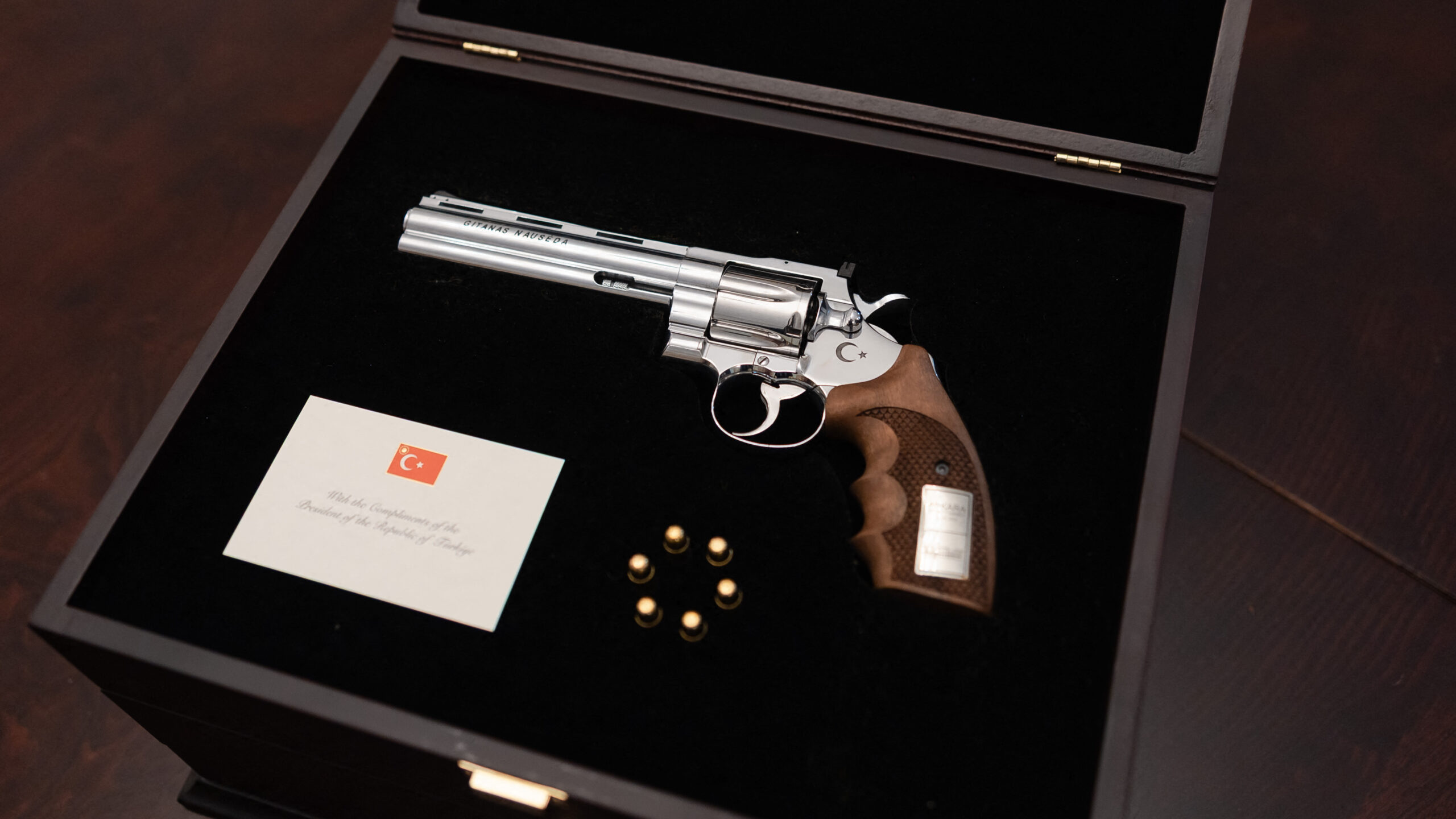
Following a recent NATO summit held in the Turkish capital Ankara, President Recep Tayyip Erdogan surprised alliance leaders with an unconventional, attention-grabbing souvenir: personalized, domestically produced Gumuşay .357 Magnum revolvers complete with live ammunition, Reuters has confirmed. The unexpected gesture was crafted as a deliberate showcase of Turkey’s rapidly expanding domestic defense manufacturing sector, which has become a central pillar of the country’s modern foreign policy and national export strategy.
Photos released by the office of Lithuanian President Gitanas Nauseda offer a clear view of the gift: each revolver is housed in a polished wooden box emblazoned with both the Turkish national flag and the official NATO logo. A placard inside the packaging explicitly labels the Gumuşay as “the first revolver-type handgun produced in our country,” highlighting Turkey’s milestone in domestic small arms production. A spokesperson for Spanish Prime Minister Pedro Sanchez confirmed all attending leaders received the same model, engraved with their individual names to add a personal touch.
In the days following the summit, leaders and their administrations across the alliance have navigated a patchwork of national customs regulations, gun laws, and security protocols to manage the unusual gifts, with outcomes varying widely by country. Belgian Prime Minister Bart De Wever only discovered the revolver and its ammunition in his personal luggage after returning to Brussels, and immediately surrendered the item to police at Brussels Airport for secure storage. An aide to Polish President Karol Nawrocki told local outlet Radio RMF FM that the Polish gift remains held at Warsaw Airport pending customs clearance, and will ultimately be placed in secure storage, with the aide noting “certainly no one will be shooting it.”
The revolvers gifted to the prime ministers of the Netherlands and Sweden remain at their respective countries’ embassies in Ankara, as officials work through import requirements. The Dutch revolver is scheduled to be permanently deactivated, while the Swedish unit awaits completion of import paperwork. A Downing Street source confirmed that British Prime Minister Keir Starmer received his revolver alongside a cleaning kit and 500 rounds of ammunition; additional reports indicate Starmer was unable to bring the firearm into the United Kingdom due to strict national gun regulations, and has left the weapon in Ankara to be decommissioned.
In contrast, Italy’s Prime Minister Giorgia Meloni has already had her personalized revolver transferred to secure storage at Palazzo Chigi, the official headquarters of the Italian government, where it will join other historical state gifts received by past and sitting leaders. European Commission President Ursula von der Leyen plans to donate her revolver to a military museum, while Greek Prime Minister Kyriakos Mitsotakis intends to gift his to Athens’ national war museum for public display.
The unusual gift has sparked widespread discussion online, with some social media users reading political symbolism into Erdogan’s choice of gift, particularly in light of the strict gun control regulations enforced by many European Union member states. One prominent social media post framed the gesture as a deliberate playful provocation of EU governments over their anti-gun policies. For the most part, however, official spokespeople across allied countries have framed the situation as a straightforward matter of navigating customs procedures and diplomatic protocol, rather than a deliberate provocation.
Beyond the social media chatter, the gift draws renewed attention to Turkey’s deliberate push to position its defense industry as a leading global exporter. Data from the Geneva-based Small Arms Survey cited by Reuters places Turkey as the world’s third-largest exporter of small arms between 2019 and 2024, trailing only the United States and Italy, with total small arms exports reaching roughly $3 billion over that five-year period. In recent years, Turkey’s defense sector has recorded dramatic growth, with Turkish drones, armored vehicles, and small arms gaining significant international visibility and market share across global defense markets.