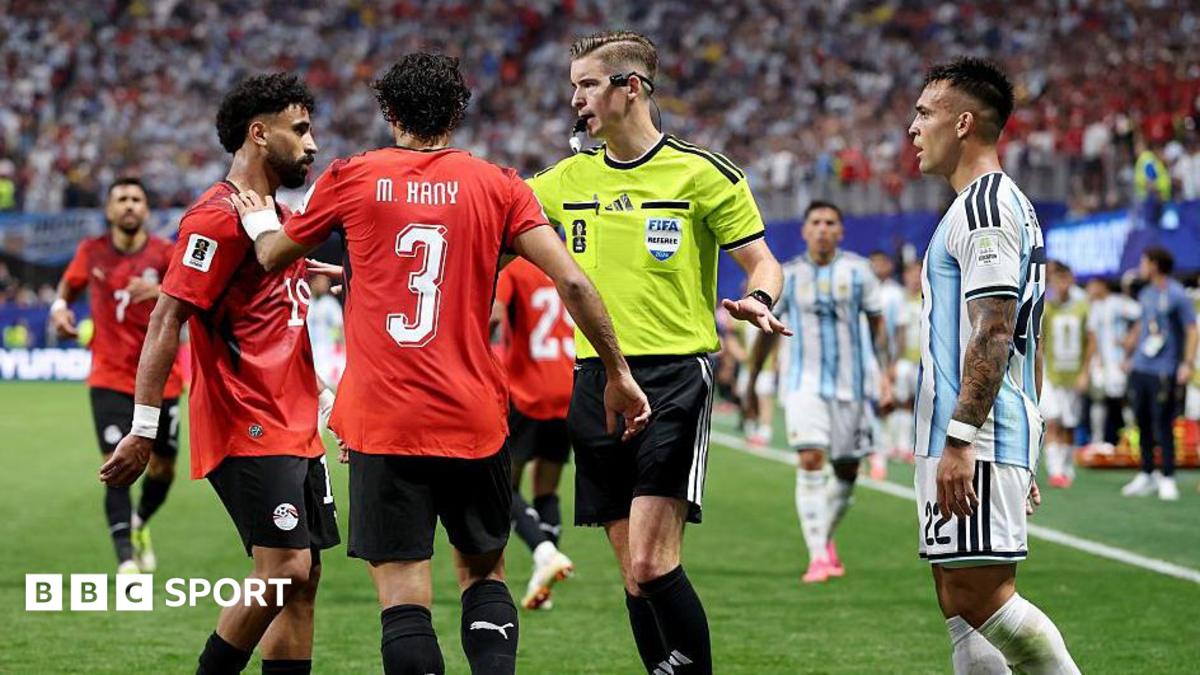
A fresh wave of controversy has swept through the 2026 FIFA World Cup following a dramatic last-16 clash between Egypt and Argentina, which saw the reigning champions overturn a 2-0 second-half deficit to secure a 3-2 stoppage-time win. The Egyptian Football Association (EFA) has launched a formal complaint against the match officials, demanding that they be removed from the remainder of the tournament and that an investigation be opened into allegations of officiating double standards. Now, FIFA’s top refereeing chief is pushing back strongly against what he calls baseless accusations, defending the integrity of the sport’s match officials at the global tournament.
The root of Egypt’s anger lies in two key second-half decisions that altered the course of the match. First, Video Assistant Referee (VAR) intervened to disallow a potential go-ahead goal from Egypt’s Mostafa Zico, after officials determined that midfielder Marwan Attia committed a foul by stepping on Argentina defender Lisandro Martinez’s foot in the opening phase of the attacking build-up. Just moments before Argentina scored their late winning goal, a claimed foul by Egypt star Mohamed Salah in the Argentinian penalty area was also dismissed by match officials.
Speaking publicly about the high-profile dispute — a break from the usual policy of not commenting on specific in-tournament incidents — FIFA Chief Refereeing Officer Pierluigi Collina backed the outcomes of both VAR reviews. He outlined that the protocol for VAR checks requires officials to review every phase of attacking possession leading up to a goal, with no fixed limit on how far back an incident can be reviewed, or how much time can pass between a foul and the resulting goal. If an undetected foul is found that impacted the build-up, Collina explained, VAR is obligated to intervene. “We believe that a foul is a foul,” he said. “Regardless of whether the foul appears ‘obvious’, if the referee did not see it on the field of play, the VAR can intervene.”
Collina added that the second controversial incident, involving Salah and Argentinian forward Julian Alvarez, was correctly ruled as legal, noting that the contact qualified as standard physical play common in football, not a foul. While he acknowledged that a small degree of subjectivity is unavoidable in 50-50 officiating calls, Collina stated the governing body is satisfied with how officiating protocols have been applied across the 2026 tournament.
Egypt’s head coach Hossam Hassan doubled down on the EFA’s allegations after the match, claiming his side had suffered clear unfair treatment. He even suggested officials had deliberately favored Argentina to ensure the defending champions and star player Lionel Messi remained in the competition. Collina rejected these accusations firmly, stressing that no one has grounds to question the integrity of World Cup match officials. “Of course, constructive discussion about decisions will always be part of football, but unfounded allegations have no place in our sport,” he said. “When this happens, it may provoke reactions that lead to threats against [officials] and their families. This is not right.”
Collina also pushed back on claims that FIFA leadership can influence refereeing decisions, noting that FIFA President Gianni Infantino has consistently granted the refereeing department full independence to carry out its work. “Nobody can claim that FIFA refereeing can be influenced by anyone, not even by the FIFA president,” he said. “He has always shown his full support for FIFA Team One while trusting us to work with complete independence. Match officials make honest decisions and, just like players and coaches, they always try to do their best.”
The Egypt dispute is not the only officiating controversy FIFA is navigating at this tournament. The governing body has also faced widespread criticism from UEFA and other stakeholders over its decision to overturn an automatic red card ban for US striker Folarin Balogun from a qualifying match against Bosnia-Herzegovina. European football’s governing body UEFA called the decision “unprecedented, incomprehensible and unjustifiable”, and even former US President Donald Trump confirmed he had asked FIFA to review the initial ruling to lift the ban.