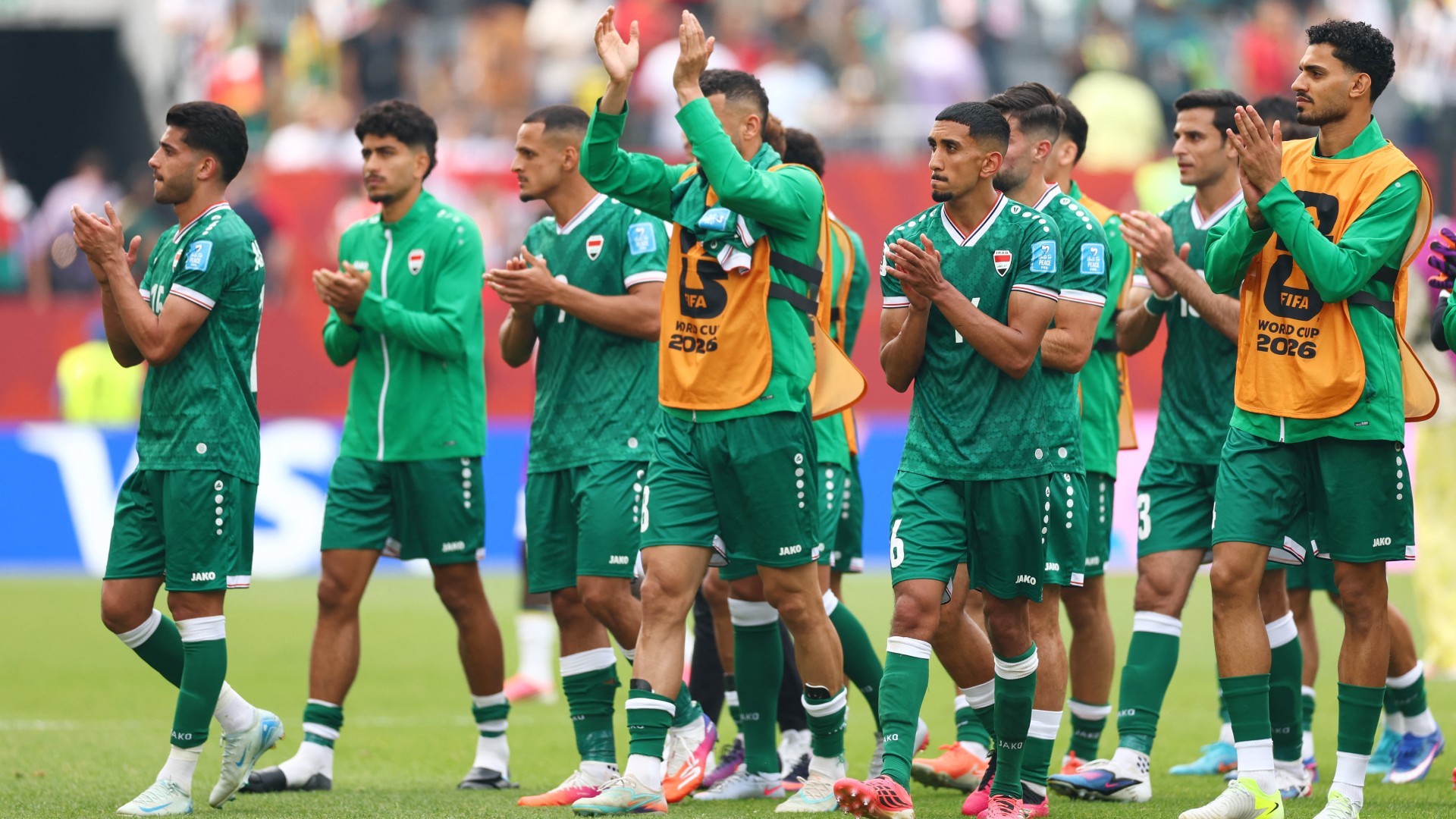
After four decades of waiting, Iraq finally earned its place back at football’s most prestigious global tournament this summer. But lopsided losses across all three of its group stage matches have laid bare the wide gap that still separates the Lions of Mesopotamia from the world’s elite footballing nations.
Iraq’s World Cup campaign got off to a difficult start with a 4-1 defeat to Norway, followed by a 3-0 shutout at the hands of tournament contender France. The team’s return to the global stage ended with a demoralizing 5-0 loss to Senegal, leaving Iraq at the bottom of its group and eliminated from knockout stage contention. Across the group stage, no side conceded more goals than Iraq, a stark statistic that highlights the gap the country must close to compete at the highest level. Many fans and football insiders agree that bridging this divide will take years of sustained work and reform.
Even amid the string of disappointing results, the campaign was not without bright moments that captured the joy of Iraq’s long-awaited return. Talismanic striker Aymen Hussein’s first-half goal against Norway, celebrated in a packed stadium of 60,000 spectators and broadcast to millions of viewers around the world, gave the nation a rare moment of collective celebration. For diaspora fans who never expected to see Iraq compete on the World Cup stage, the mere presence of the team meant more than final scores. “It is hard to describe what it was like to see the flag, hear the songs and just be together,” New York-based Iraq supporter Zainab Hassan told Middle East Eye. “The team lost but it wasn’t about winning, it was just about being there and feeling the excitement. I never thought I would see it.”
While few in Iraq’s football ecosystem expected an easy run against three top-ranked opponents, the lopsided margin of defeat has prompted renewed scrutiny of the national program and its structures. In response, Iraq’s Olympic Committee has announced it will partner with the Iraq Football Association (IFA) to launch a full review of the World Cup campaign, identifying strengths, weaknesses and priority areas for improvement.
Baghdad-based sports commentator Nawar Faeq al-Rikabi, who has covered Iraqi football for years, acknowledged the team underperformed even against tempered expectations. “We tried, but it was hard,” al-Rikabi told Middle East Eye. “We didn’t do that well. We were supposed to play a little better and not lose that badly. We were losing 2-1 to Norway then made a mistake and couldn’t come back. Against France and their stars, we just don’t have the experience. Senegal was a disaster, we should have looked better than this. We have some good players, but didn’t look good.”
For the IFA, qualification for the tournament itself was already a historic milestone after 40 years away from the World Cup. “The primary objective of qualifying for the Fifa World Cup was achieved after a 40-year absence,” IFA spokesperson Ahmed Oudah Zamil told Middle East Eye. “At the same time, the IFA recognises that returning to the Fifa World Cup after four decades presented a new challenge.” Facing off against three established international powers with deep, well-developed talent pools made clear Iraq’s current position in global football, and the federation says its goal now extends beyond simply qualifying for future tournaments: it aims to build a team that can compete consistently with the world’s best. “Competing at the highest level of international football requires experience, continuous development, and thorough preparation,” Zamil said. “Therefore, the focus is now on ensuring the team is fully prepared to represent Iraq with pride and to use this historic qualification as the foundation for long-term success.”
All attention has already shifted to the next chapter of Iraq’s football development, with two major regional tournaments on the near horizon: the eight-team Gulf Cup scheduled for September in Saudi Arabia, followed by the 24-team Asian Cup in the same country this coming January. A central question for the immediate future is whether current head coach Graham Arnold will remain at the helm of the national team. Appointed in March 2025, the Australian tactician led Iraq through its successful qualifying campaign and retains the confidence of the IFA leadership, which has framed technical stability as a core pillar of long-term success. “Technical stability is one of the key factors behind success, so renewing the coach’s contract reflects the federation’s confidence in the current project and its commitment to maintaining continuity,” Zamil said. While Arnold’s future remains the subject of mild speculation amid reported interest from the United Arab Emirates Football Association, many local observers argue his work has already laid critical groundwork for future progress, and retaining him would be the best path forward. “The FA needs to keep Arnold, as he gave the team a personality,” al-Rikabi said. “Even though we lost badly, if they keep him, he has the chance to create a new young team.”
Beyond the leadership of the senior national team, deeper structural reform is needed to unlock Iraq’s undoubted football potential, starting with growing the domestic coaching pipeline. “We have to improve in this field,” al-Rikabi added. “The local coaches need to train, to go on courses and go and see European teams and how they operate at a youth level. In modern football, coaches at the under-17 level are the essence of everything.” Investing in qualified domestic coaching would in turn strengthen youth development, a critical need in a country of 46 million people with a deep, widespread cultural passion for the sport. “We are a nation of 46 million, so it’s not possible we don’t have good players, but we can’t see them,” al-Rikabi said. “Iraqis have a huge passion for football, so if we give attention to players from the age of 12 to 16, then we have great talent; but if no one sees them, they will vanish.”
While Iraq has increasingly tapped into talent from its global diaspora, a growing trend across international football that was visible at this year’s World Cup, long-term progress depends on reforming and strengthening the domestic game. The top-tier Iraq Stars League, the foundation of the country’s domestic football ecosystem, suffers from structural gaps and a lack of sustained investment. “We don’t have a lot of training pitches, which is a huge problem, and there is not enough forward planning,” al-Rikabi said. “There is too much thinking about this year’s results. The fans’ voices are strong and the clubs are afraid of them. We don’t have the right structure for local leagues, we don’t have an under-17 league, we don’t have organised under-20 teams.”
Unlike regional peers such as Saudi Arabia and Qatar, Iraq does not have access to the same level of financial resources for big-ticket football investments. Still, the IFA says it is fully committed to strengthening the domestic league’s foundational structures. “The federation is committed to strengthening the commercial and marketing value of the league, improving club governance and financial sustainability to increase overall competitiveness of the league to produce more players capable of competing at the international level,” Zamil said. “A stronger domestic league will ultimately strengthen the Iraqi national team. Improving stadiums and football infrastructure, raise the professional standards of clubs, invest in youth development and academy systems.”
It will be years before it becomes clear whether Iraq’s 2026 World Cup return will stand as a transformative starting point for Iraqi football or just a one-off, unforgettable moment. If the country qualifies for the 2030 tournament and puts in a competitive showing, it will signal that the lessons from this summer’s campaign have been fully integrated, and that 40 years of waiting marked the start of a sustained upward trajectory. For Iraqi fans, however, the long-awaited return to the world stage was already an unforgettable achievement in its own right. “It was so fantastic to see Iraq on the world stage,” Hassan said. “We would love to do it again.”