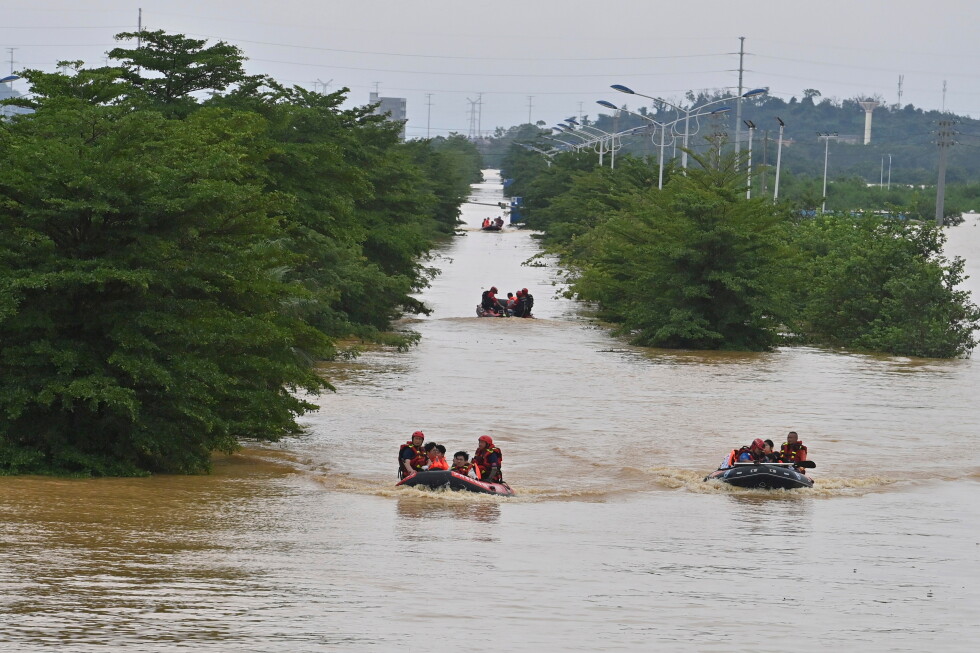
On Thursday, Chinese authorities in the southern region of Guangxi released a devastating update: deadly flooding spawned by Tropical Storm Maysak has claimed 39 lives, even as emergency crews ramp up preparedness for an approaching typhoon forecast to make landfall along China’s eastern coast in the coming days.
Of the 39 fatalities, 26 occurred in Hengzhou, a city under the administrative jurisdiction of Nanning. Nanning’s vice mayor Ding Wei confirmed during an official press briefing that the deaths came after partial collapse of a local reservoir dam unleashed a wall of torrential water that swept through populated areas of the city. Nine additional people remain unaccounted for across Guangxi, underscoring the widespread destruction left by the storm.
Tropical Storm Maysak made landfall over the region last Saturday, dropping unprecedented volumes of rain that overwhelmed water infrastructure and trapped hundreds of residents in their homes and other structures for days. The storm’s death toll has risen sharply from the previously reported six fatalities released to the public on Tuesday.
China’s National Meteorological Center confirmed that rainfall far exceeded initial projections, with many parts of southern Guangxi recording cumulative totals between 10 and 40 centimeters (4 to 16 inches). In the hardest-hit zones, precipitation topped 90 centimeters (35 inches) over just a few days.
As rescue operations continue in flood-ravaged Guangxi, the country is bracing for a second weather event: Typhoon Bavi, currently churning in open waters off the Chinese coast. Forecasters project the typhoon will track just north of Taiwan, dumping heavy rain on the island home to 23 million people, before making landfall in either China’s Zhejiang or Fujian province this Saturday.
Emergency teams were still working Thursday to extract more than 10,000 trapped students and teachers from a group of schools in Guigang, a city located northeast of Hengzhou. Beyond human casualties and displacement, the rising floodwaters have also wreaked havoc on local animal populations and facilities. A Guigang-based zoo reported that more than 100 animals are missing after floodwaters swept through their enclosures, including two zebras, four porcupines, and dozens of tropical bird species. In Hengzhou, dozens of farm-raised snakes escaped into floodwaters, prompting local officials to restock large quantities of antivenom and issue public safety guidance for residents who may encounter displaced reptiles.
Further northwest in Binyang County, an independent animal shelter operator has worked around the clock for days to rescue roughly 200 cats and dozens of dogs from inundated facilities. The operator ferried dogs to safety two at a time through churning, powerful flood currents, while cats climbed to overhead rafters to avoid rising waters as they waited for rescue.
Authorities have mobilized a massive regional relief and rescue operation to reach stranded residents, deploying drones for search and more than 5,700 boats to navigate flooded areas. Rescue crews have navigated hazardous conditions, fighting strong currents and navigating piles of debris to reach cut-off communities. So far, roughly 130,000 residents have been evacuated to safe, dry shelter.
Ding noted that floodwaters across most of Guangxi are now receding, but forecast models call for additional rainfall in some parts of the region over the next 48 hours. Cleanup and recovery efforts are already underway in affected areas: work crews have been deployed to clear mud and debris from public and residential spaces, and carry out disinfection operations across multiple hard-hit towns in Hengzhou. Road repair work is ongoing across the region, and power service has already been restored to more than 60,000 households that lost electricity during the flooding.
Associated Press video producers Wayne Zhang and Olivia Zhang contributed reporting to this article.