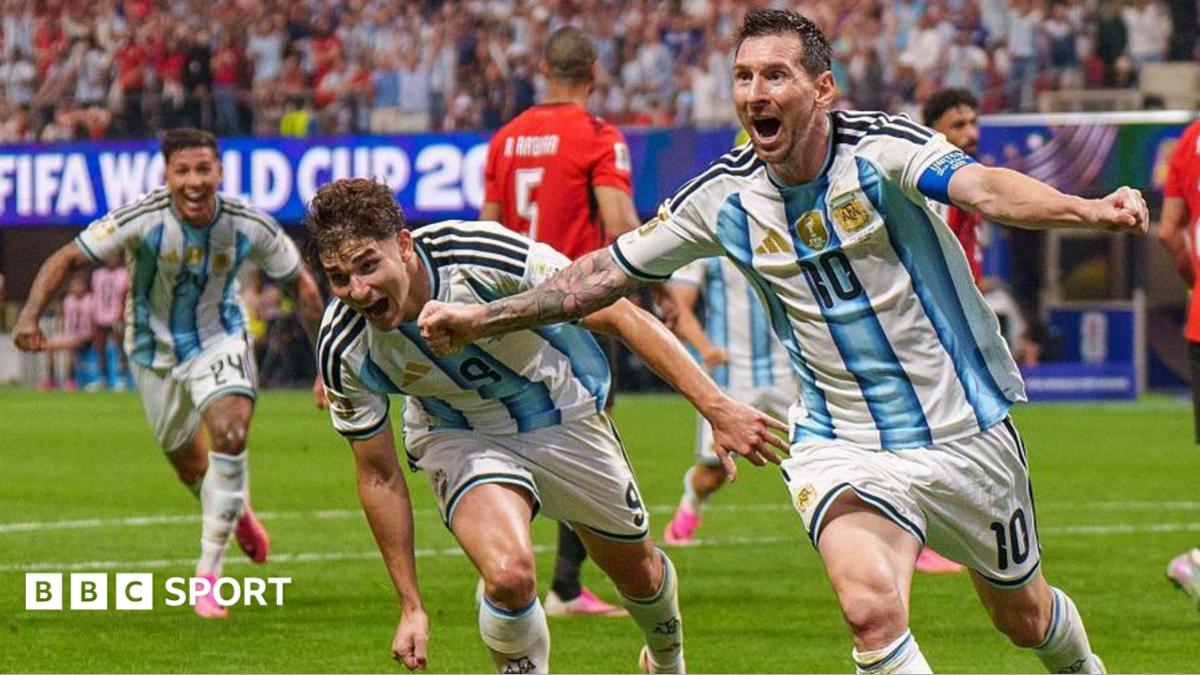
Defending World Cup champions Argentina have booked their spot in the tournament’s quarter-finals, but their passage has been anything but smooth, and has sparked fierce debate over potential officiating favouritism. La Albiceleste entered the first two knockout rounds as heavy favourites to cruise past Cape Verde and Egypt, but on both occasions they scraped by with identical narrow 3-2 wins. Following their latest last-16 exit at the hands of Argentina, Egypt has launched an official complaint to FIFA, demanding the match officials be removed from the remainder of the tournament, and levelling claims of systemic bias designed to protect the defending champions and their global superstar, Lionel Messi.
The dramatic nature of Egypt’s defeat has only amplified their frustration. On Tuesday, the African side held a shock 2-0 lead over Argentina with just 11 minutes left on the clock, on the cusp of pulling off one of the biggest upsets in World Cup history and securing the first quarter-final spot in their nation’s history. But Argentina launched a stunning late comeback, overturned the deficit, and scored the match-winning goal in stoppage time. Egypt has pinned its elimination on serious refereeing errors and inconsistent decision-making from French referee Francois Letexier and his team.
Key contentious calls include a disallowed Egyptian goal chalked off after VAR intervention. Mostafa Zico’s well-taken strike was ruled out following a foul call on Marwan Attia for stepping on the foot of Argentina’s Lisandro Martinez in the build-up. Egypt also argues Argentina’s stoppage-time winner should have been ruled out, and that two clear penalty appeals for their side were ignored. Hamdi Fathy went down under a challenge from Alexis Mac Allister, while star forward Mohamed Salah claimed he was tripped by Julian Alvarez. While the decisions were controversial, BBC Sport’s analysis finds no concrete evidence to back the theory of a deliberate plot to favour Argentina.
This dispute is not the only question mark over officiating and preferential treatment for the defending champions at this tournament. Ahead of Thursday’s high-profile quarter-final clash between France and Morocco, FIFA’s appointment of an all-Argentine on-field officiating team – the first of the tournament – has raised eyebrows. While top Argentine referee Facundo Tello is a highly experienced official who officiated at the 2022 World Cup quarter-finals and would be expected to uphold full professional integrity, critics argue the appointment creates a problematic perception of bias, given Argentina’s clear interest in seeing tournament favourite France eliminated earlier.
Further questions have been raised over inconsistent disciplinary treatment of Messi earlier in the tournament. In the group stage, Messi escaped without even a yellow card for a challenge on Algeria captain Aissa Mandi that had clear contact with the opponent’s upper calf. Just days later, United States forward Folarin Balogun was sent off via VAR review for a near-identical challenge against Bosnia. The US has already formally appealed to have Balogun’s suspension overturned, with many pointing to the Messi incident as proof of double standards. Had Messi been sent off in that group stage match, he would have missed subsequent games, wiping out five of the eight goals he has scored at this tournament – which have already made him the World Cup’s all-time leading top scorer with 21 career tournament goals.
Critics also point to off-field decisions that suggest FIFA has a vested interest in keeping Messi and Argentina in the tournament long-term. They note that FIFA president Gianni Infantino has previously made exceptions to allow Messi to compete in high-profile events, including the 2025 inaugural expanded Club World Cup hosted in the US. Despite MLS play-off winners LA Galaxy earning their spot through competitive merit, host nation berth was given to Inter Miami – Messi’s current club – allowing him to play the opening match of the tournament on home soil at the club’s Hard Rock Stadium.
Structural tweaks to the 2026 World Cup format have also added fuel to the conspiracy claims. Last December, FIFA adjusted the final draw to ensure the world’s top four ranked teams – France, Argentina, Spain and England – were placed in separate quarter-brackets. This guaranteed that, if they won their groups (which all four did), they would not face each other before the semi-finals. While the official rationale is to keep elite matchups for the later stages of the tournament, the structure has given the top sides far easier routes through the knockout rounds – and none have benefited more than Argentina. So far, Argentina have faced only Cape Verde (ranked 67th globally) and Egypt (29th) to reach the quarter-finals, where they will next face 19th-ranked Switzerland. By comparison, Spain has already beaten 5th-ranked Portugal and will face 9th-ranked Belgium, while France takes on 7th-ranked Morocco in their quarter-final tie. Argentina’s path is by far the softest of the remaining elite sides.
Disciplinary data also hints at potential favourable treatment for Argentina. Seventeen players across the remaining quarter-finalists are one yellow card away from suspension for a potential semi-final, but only one Argentine starter – Gonzalo Montiel – is at risk of missing the next round. When comparing the ratio of yellow cards issued to total fouls committed, Argentina receives a caution just once every 19.7 fouls. For context, England, who have committed fewer total fouls than Argentina, receive a yellow card once every 7.7 fouls, meaning Argentina have half as many cautions despite more fouls. Only three other remaining sides have a better (higher) yellow-to-foul ratio than Argentina, suggesting the defending champions have been let off far more lightly for foul play than other nations. This pattern echoes Argentina’s 2022 World Cup win, where they received five penalties – more than any other team in a single World Cup in history. At this tournament, they already lead all sides with three penalty awards, though Messi has missed two of them.