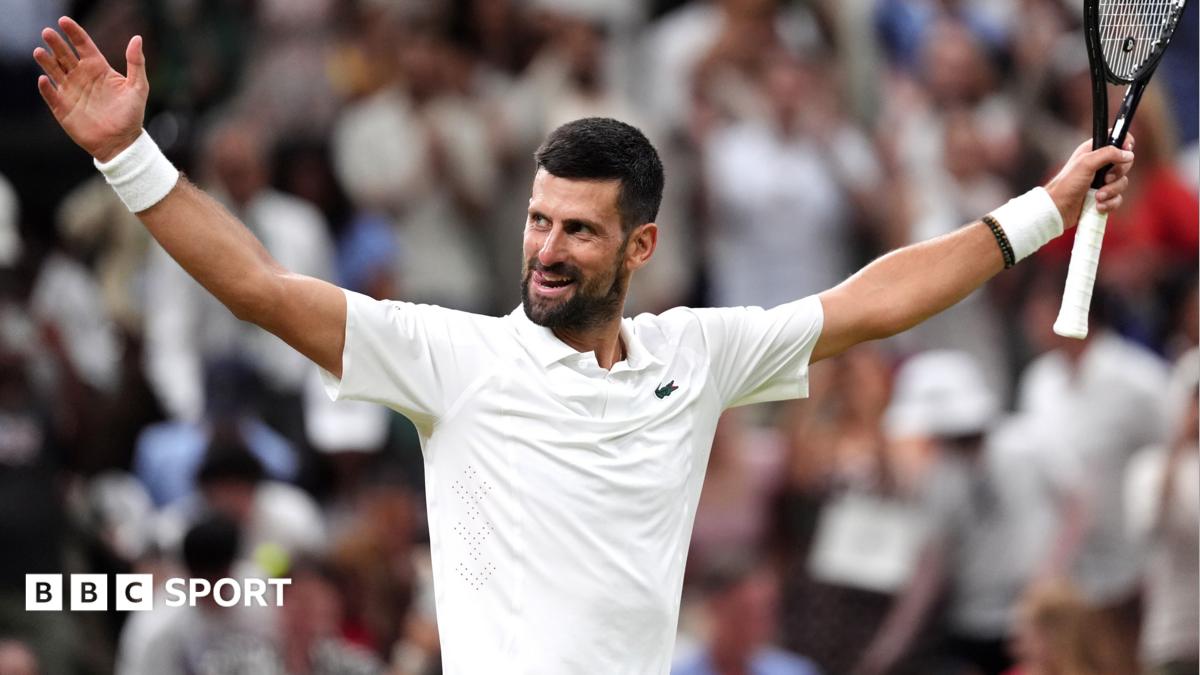
On a tense, electric Centre Court under Wimbledon’s famous floodlights, tennis history unfolded once more on Tuesday, as 39-year-old Novak Djokovic delivered a performance that defies every convention of elite sports and aging to defeat 25-year-old Felix Auger-Aliassime in a five-set thriller that secured his spot in the 2024 Wimbledon semifinals. The epic clash stretched to five hours and 15 minutes – the longest match of this year’s tournament to date – so gripping that it forced a delay to the BBC’s flagship 10 PM news bulletin, as a sold-out crowd remained transfixed by every exchange.
What makes Djokovic’s victory so extraordinary is how it pushes every boundary of what is considered normal for a player of his age. Across more than five hours of high-intensity baseline rallies, desperate net rushes to counter drop shots, and blistering second serves clocked at 122 mph, the 24-time Grand Slam champion never let up on his chase of every ball hit toward him. He slid across the grass, glided from corner to corner, and outcompeted a opponent 14 years his junior in sheer stamina to claim the win.
This is the Djokovic legacy: a competitor who has built his career on silencing doubters, and who stands one Grand Slam title away from breaking the all-time record for most major men’s singles titles. In the match, even a mid-match left calf tweak that forced a medical timeout and hampered his movement in the first set could not derail him. Auger-Aliassime, the tournament’s young underdog, drew early support from the crowd, but after dropping the third set, Djokovic drew a roaring cheer from the stands that carried him through to a decisive fifth-set tiebreak. When Auger-Aliassime sent a backhand long to end the match, the crowd rose as one, chanting Djokovic’s name in celebration.
Tennis legends and analysts were quick to praise the historic performance. Britain’s Davis Cup captain Leon Smith told BBC 5 Live: “To be able to come out and play this level of tennis at that age… it’s not normal. It’s really not normal. I know he spent a lifetime on his body, but to do this, the amount of work that we don’t see must be astonishing. It is amazing. He deserves all the respect that he gets.” Former British number one Tim Henman echoed that sentiment on BBC TV, noting: “I’ve been watching this guy for 20 years and time and time again, in the biggest moments, he delivers. This is the response we have all come to expect from Novak Djokovic.”
Speaking after the match, an exhausted but elated Djokovic said he “won that match with a racquet and a lot of heart” – a summary that encapsulates the latter stages of his iconic career. As the last remaining active member of tennis’s legendary “Big Three” era following the retirements of Roger Federer and Rafael Nadal, many fans have only recently come to fully appreciate how irreplaceable Djokovic’s dominance is. While the sport’s next generation is led by the exciting rivalry between Jannik Sinner and Carlos Alcaraz, Djokovic remains the only player who has consistently beaten both rising stars in major tournaments in recent years, outperforming the younger pair despite their theoretical advantages in youth, power, and speed.
When asked if his current performance level surprises him, Djokovic acknowledged the uniqueness of his run: “Yes and no. I guess yes, at this stage that I’m still able to battle these young guys that have 15 years less than me, that I’m able to beat them at the tightest possible scoreline. In a sense, it is really a nice surprise. But at the same time, I always have the highest expectations for myself. I can be very self-critical, very hard on myself. But I try to enjoy the moments like this.”
All eyes now turn to Djokovic’s upcoming semifinal against Jannik Sinner, where questions remain about how his grueling quarterfinal will impact his performance. Last year, a late, exhausting quarterfinal match left Djokovic hampered throughout the rest of the tournament, allowing Sinner to claim a straight-sets upset. Djokovic has also dealt with consistent minor niggles over the last 18 months, with age-related physical wear becoming a new challenge he has had to adapt to. At this year’s Australian Open, a late five-set win over Sinner left Djokovic fatigued in the final against Alcaraz, where he faded after a dominant opening set.
Djokovic will have two full days to recover before his semifinal clash, but the gap in preparation remains stark: while Djokovic went the full five sets in his quarterfinal, Sinner has not dropped a single set across his four tournament matches so far. Unfazed by the challenge, Djokovic made clear his focus remains on adding another milestone to his career: “I don’t know what tomorrow brings. I still want to go at least one more step further. But this was as good as a final for me. I gave it all that I had.”