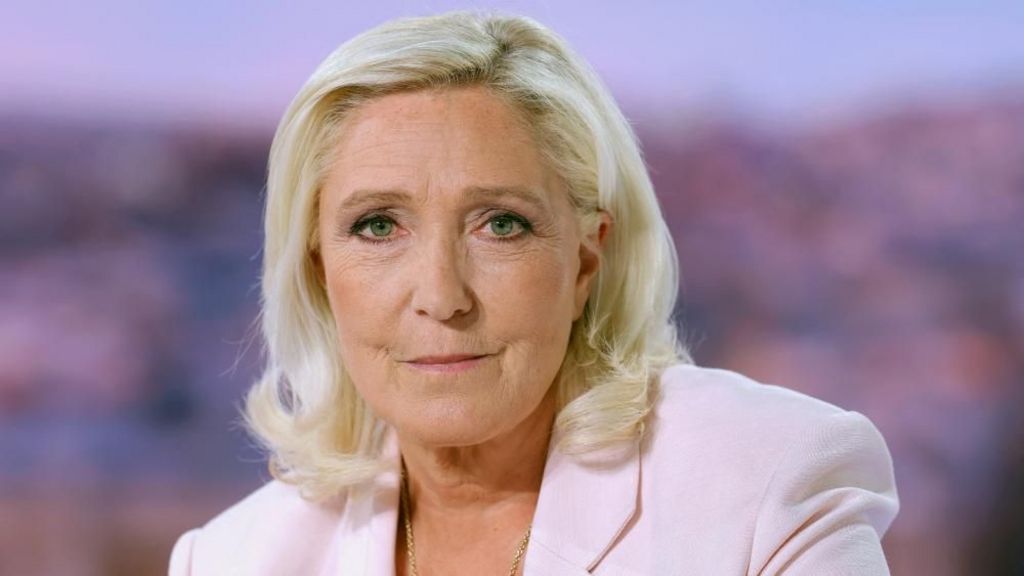
On a Tuesday in mid-2026, a Paris court of appeal handed down a ruling that sent shockwaves across French political life: it upheld far-right nationalist leader Marine Le Pen’s conviction for misappropriation of public funds, but slashed the original five-year ban on running for public office, clearing a path for her to launch a historic bid for the French presidency. By early Wednesday morning, France was still reeling from the rapid cascade of political drama that followed: within hours of the verdict, Le Pen defied all expectations of her political demise and officially confirmed she would contest the 2027 presidential election, immediately rolling out her social media campaign to supporters across the country.
Le Pen’s campaign branding leans heavily into deliberate political messaging. Her online campaign poster, emblazoned with the slogan “Pour la France” (“For France”) and subtitled “La Renaissance” (“The Rebirth”), features Le Pen smiling with outstretched arms against the backdrop of France’s blue-white-red tricolor. The choice of “Renaissance” is no accident: it is the official name of incumbent President Emmanuel Macron’s centrist political party, a sharp jab at the leader who has repeatedly categorized Le Pen’s National Rally as an extremist political force, and who promised upon his first election to eliminate voter support for far-right extremism.
For years, Le Pen has built her political brand around a populist divide: framing her movement as the voice of “the people” and “patriots” pushing back against a detached “metropolitan elite” and what she dismisses as “globalist” interests. Her core platform centers on putting French citizens first in policy, a message that has resonated deeply with a large swathe of the French electorate disillusioned with traditional mainstream politics and frustrated by widening societal inequality. This is not Le Pen’s first attempt at the presidency: she lost twice to Macron in 2017 and 2022, but Macron is constitutionally barred from running for a third term, and current polling puts Le Pen in a stronger position than ever before. She has also repeatedly defied predictions of her political end, bouncing back from major setbacks—including a poorly received 2017 televised debate against Macron—to rebuild her movement and grow her support.
Prior to the appeal ruling, most political observers had predicted the court would reaffirm the full public office ban, effectively ending Le Pen’s decades-long political career. Instead, the court left the decision to run to Le Pen, only requiring her to wear an electronic monitoring tag for 12 months as part of her sentence. Le Pen responded to the verdict with characteristic defiance: in a televised address shortly after the ruling, she confirmed her candidacy, announced she would appeal the conviction to France’s highest court, the Court of Cassation, and refused to wear the ankle tag until the court issues its final ruling, arguing the French electorate should be the ultimate judge of her candidacy.
Critics across the French political spectrum have slammed Le Pen’s move as a Trumpian power play and a high-stakes political gamble. Legal and political analysts note Le Pen and her legal team are likely counting on the Court of Cassation’s famously slow procedural timeline: if a ruling does not come until spring 2027, Le Pen could already have won the presidency and gained the legal immunity that comes with the office for a full five-year term. However, the court could also choose to expedite proceedings given the unprecedented political stakes of the case. If a ruling comes before the election and requires Le Pen to wear the electronic tag during the final stretch of campaigning, it could remind swing voters of her embezzlement conviction, which involved €4.1 million (£3.5 million) in misused public funds drawn from French taxpayers. While the tag would not alienate her loyal base, it could turn off the moderate conservative voters Le Pen has worked aggressively to court in recent years.
Left-wing lawmaker Francois Ruffin, leader of the Debout! Party, summed up the opposition’s position: “She has been found guilty twice of embezzling public money from French taxpayers. That makes her a criminal, and she has no business running for the highest office in the country.”
The outcome of France’s 2027 presidential election carries major implications far beyond France’s borders. As the European Union’s second-largest economy, a nuclear-armed military power, and a key geopolitical actor at a moment of rising global tension with Russia and China, France’s leadership shapes the entire trajectory of European and transatlantic policy. Le Pen and her 30-year-old protégé Jordan Bardella—who Le Pen has tapped as her preferred prime minister if she wins—are both openly Eurosceptic and have expressed skepticism of NATO, continued French military support for Ukraine, and the major increase in defense spending that Macron has pledged. These policy positions have already sparked deep anxiety among European allies, who view a Le Pen presidency as a major shift that could reshape the European political order. While Le Pen is not guaranteed victory, current polling shows she enters the race as one of the most competitive candidates, with a clear path to the Elysee Palace.