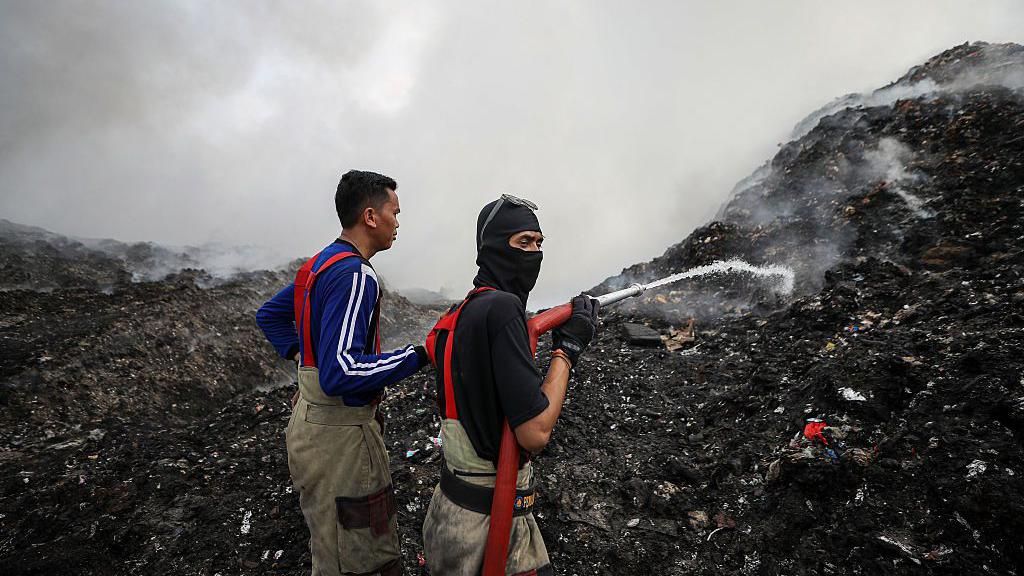
An eight-day underground fire that has ravaged a massive open-air waste mountain on the outskirts of Jakarta has pushed hundreds of residents from their homes, pushed local hospitals to treat a surge of respiratory illness, and laid bare a systemic national waste management crisis decades in the making. The inferno, which ignited on June 30 at the Jatiwaringin Landfill in Tangerang Regency, has spread across more than 15 hectares of piled waste, blanketing nearby residential neighborhoods in thick, toxic smoke that pushed local air quality into hazardous levels, according to Indonesia’s Ministry of Environment.
Initial investigations by environmental activists point to a buildup of methane gas released by decomposing organic waste trapped beneath thousands of tons of uncompacted rubbish as the most likely cause. A small initial spark, fanned by strong seasonal winds, spread the fire across multiple hard-to-reach sections of the waste mountain, where deep-seated smoldering continues to plague firefighting efforts eight days on. Unlike conventional surface fires, this blaze burns within the compacted layers of waste, requiring specialized response tactics. Authorities have deployed a large contingent of resources including helicopters, water tankers, bulldozers, and surveillance drones to contain and extinguish the fire, with officials projecting full containment by the end of the week.
For local residents, the impact has been immediate and devastating. Hundreds have been forced to evacuate their smoke-filled homes to government-run emergency shelters, with many reporting severe respiratory irritation from toxic fumes. “The smoke was so thick you couldn’t see anyone,” 45-year-old local resident Sarmanah told reporters. “It stings the nose, makes you cough and have a runny nose, and makes you unable to breathe… We were forced to leave the house because we couldn’t take it anymore.” As of the latest update, local health authorities have examined at least 234 residents for smoke-related respiratory issues, with 72 confirmed cases of acute respiratory tract infection. While hazardous air quality has eased slightly in recent days, active hotspots and smoldering pockets of fire remain in the western and southern sections of the landfill.
Environmental campaigners say the Jatiwaringin fire is not an isolated accident, but a predictable “ecological disaster resulting from systemic negligence” that has plagued Indonesia’s waste management sector for years. According to the Indonesian environmental NGO Forum for the Environment (Walhi), the Jatiwaringin facility was only designed to handle 2,700 tons of waste per day, which meets just 59% of Tangerang Regency’s total daily waste output. The excess waste is dumped illegally in unregulated open sites within 100 meters of residential neighborhoods, creating sprawling, unmanaged waste mountains that trap methane and create a persistent public safety risk.
Long before the current blaze, local residents reported constant issues with foul odors, pest infestations, and fears of catastrophic landslides from the overgrown waste piles. Climate change and more frequent extreme heat waves have exacerbated the risk, turning these unregulated dumping grounds into what activists describe as “time bombs” waiting for a single spark to ignite. This pattern is not unique to Jatiwaringin: major landfill fires swept across multiple Indonesian sites in 2023, including a 40-hectare blaze at Bandung Regency’s Sarimukti Landfill and a fire that destroyed 80% of a 35-hectare Tangerang landfill, both linked to methane buildup from poor waste management.
In response to the disaster, Indonesian officials announced that a full investigation into the cause of the Jatiwaringin fire will begin once extinguishing operations are complete. The Ministry of Environment and Forestry also plans to conduct a nationwide evaluation of 390 landfills starting in early August 2026, and confirmed that Jatiwaringin already received administrative sanctions for poor management practices in 2025. Authorities have ordered local governments to transition to controlled landfill systems, where waste is compacted and regularly covered with soil to reduce methane buildup and fire risk.
But activists warn that incremental changes and emergency responses are not enough to address the root of the crisis. Walhi campaigner Wahyu Eka Styawan argues that persistent underfunding for regional waste management, weak enforcement of existing environmental regulations, and a lack of public education on source-separated organic waste have created conditions where disasters like this are inevitable. “This is a time bomb of accumulated waste management problems that have been ignored for years without fundamental improvements,” Wahyu said. Without systemic changes that reduce waste at the source, implement consistent sorting, and process organic waste to prevent methane formation, he added, “It could definitely catch fire again if the pattern isn’t changed. Once the weather gets hot again, be prepared for more fires.”