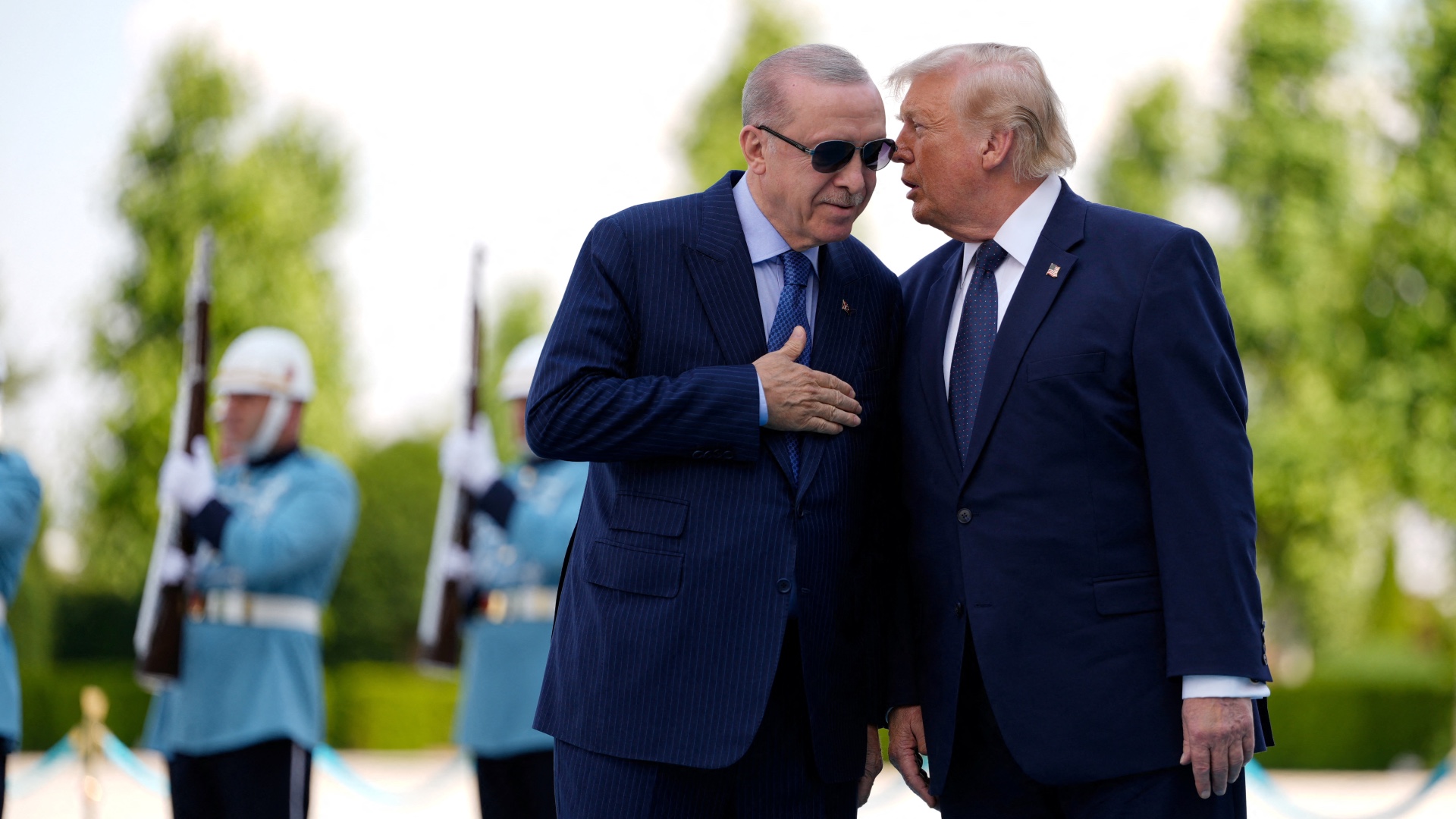
During a bilateral meeting on the sidelines of the NATO summit held in Ankara on Tuesday, U.S. President Donald Trump made a landmark announcement: he intends to remove Turkey from the U.S. sanctions blacklist that he first imposed during his initial presidential term.
Speaking alongside Turkish President Recep Tayyip Erdogan, Trump told assembled reporters, “We’re going to be taking the sanctions off. Okay? It’s time to do that… We don’t want to sanction friends. It’s very simple.” As his remarks were translated, the typically reserved Erdogan reacted with an uncharacteristic broad smile and a public thumbs-up to the announcement, a visible display of approval for the new U.S. stance.
The sanctions in question stem from the 2017 Countering America’s Adversaries Through Sanctions Act (CAATSA), a federal U.S. law that placed Turkey alongside designated U.S. adversaries North Korea and Iran after Ankara moved forward with a deal to purchase Russia’s advanced S-400 air defense system. In addition to being blacklisted, Turkey was expelled from the multinational F-35 stealth fighter jet program over U.S. fears that sensitive military technology could be compromised by Moscow. Trump also noted Tuesday that he is open to reconsidering Turkey’s participation in the F-35 program, opening the door for Ankara’s potential return to the initiative.
Analysts say the announcement marks a significant symbolic shift in bilateral ties. Alper Coskun, a former Turkish diplomat now based at the Carnegie Endowment for International Peace, called the news “music to Ankara’s ears” in comments to Middle East Eye. Coskun emphasized that while the announcement aligns with signals the Trump administration has sent for months, it makes clear Trump intends to work with Congress to formalize the policy change. For sanctions to be fully lifted, Coskun noted, Turkey will likely be required to completely abandon its S-400 acquisition from Russia.
Because CAATSA is a congressional statute, legislative approval will be required to fully roll back the blacklisting. That said, Coskun explained that the Trump administration could take an interim step by reinterpreting existing sanctions rules, arguing that the conditions that triggered Turkey’s blacklisting no longer apply. The president also holds the authority to issue a sanctions waiver, though it remains unclear whether he will pursue that unilateral route or seek bipartisan agreement with a Congress currently controlled by his Republican party. Control of both congressional chambers could shift to the Democratic party following the upcoming November midterm elections, adding uncertainty to the legislative path ahead.
The announcement fits into Trump’s broader pattern of sidelining and criticizing other Western NATO allies while prioritizing closer ties with Ankara. Trump has openly lambasted the leaders of major Western European nations including the United Kingdom, France, Germany, and Spain, accusing them of weak policies on defense and immigration. He launched a high-profile dispute with Denmark over Greenland’s territorial status, and is currently locked in an open public feud with Italian Prime Minister Giorgia Meloni. Since March, he has repeatedly expressed frustration that these allies have refused to back his hardline policy against Iran.
Trump made his tilt toward Turkey explicit during Tuesday’s press interaction, saying, “I was very disappointed with NATO, and frankly, if [the summit] weren’t held in Turkey, where my friend happens to be a very strong leader, a very strong person, it’s possible that I wouldn’t have attended. I felt I had to attend because of the fact that, you know, I know he’s gone all out…but we weren’t treated well [by western Europe] because we did something in Iran. We don’t need anybody’s help. I didn’t even want their help, but before I asked, they said they wouldn’t be there.”
He went on to frame the bilateral relationship in stark terms, adding, “We have a better relationship with Turkey,” and praising what he described as Turkey’s unique loyalty compared to other NATO allies.