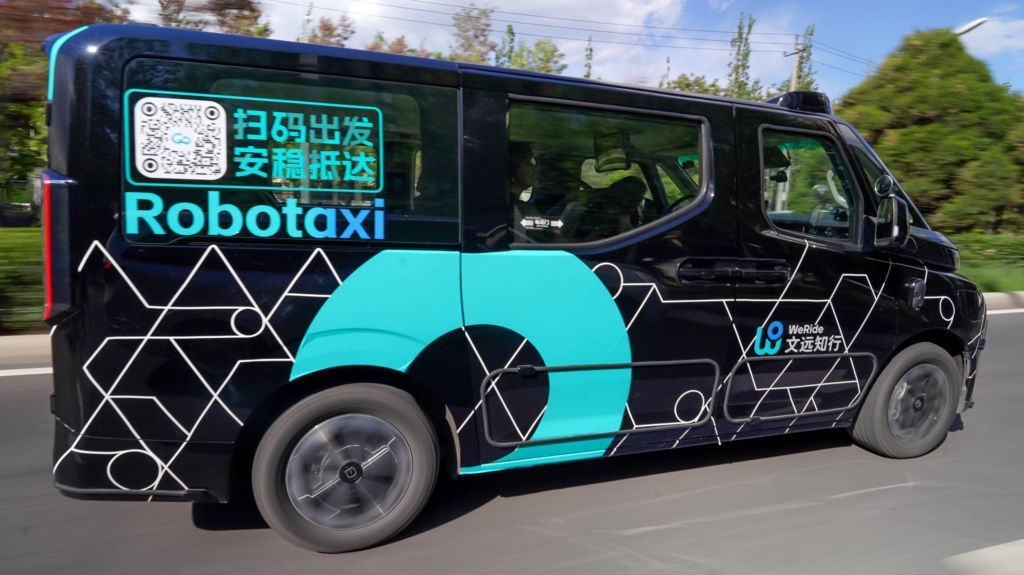
Across multiple major Chinese cities, driverless robotaxis are no longer a distant vision of the future — they are already weaving through daily commuter traffic. In Beijing’s high-tech Yizhuang district, these steering-wheel-empty vehicles share asphalt roads with traditional human-driven cars, while autonomous delivery vans cruise dedicated lanes moving packages to pickup hubs across the area. The district has emerged as one of China’s flagship testing and commercialization zones for autonomous driving technology, with domestic industry leaders including Baidu, WeRide, and Pony.ai already offering paid commercial robotaxi rides within clearly demarcated zones. Booking a service takes just a few taps on a mobile app; within minutes, an uncrewed vehicle arrives, and after confirming the destination on an in-car touchscreen, it smoothly merges into Beijing’s dense, chaotic mix of buses, cyclists, electric scooters, and pedestrians, navigating varied hazards with surprising confidence. The underlying technology is still maturing, but one pressing question is already at the forefront of global industry discussion: can Chinese firms replicate the success they achieved in electric vehicles, and turn robotaxis into another globally dominant sector?
Chinese autonomous vehicle developers already hold a critical structural advantage: the sprawling industrial ecosystem that turned China into the world’s largest EV market, which now overlaps directly with self-driving technology. Unlike Tesla, which develops most of its autonomous driving hardware and software in-house, China’s self-driving sector is built on an interconnected network of specialized suppliers and manufacturers. Established domestic automakers such as BYD, Chery, Geely, and SAIC build the base vehicles, while dedicated technology firms develop and refine the autonomous driving software. Critically, autonomous vehicles rely on most of the same core components as electric cars: batteries, sensors, processing chips, and onboard computing hardware. Since these supply chains already operate at massive, proven scale in China, companies can iterate on technology far faster and at much lower development costs than many global competitors. “What you see is a pace of innovation and adaptation in the Chinese EV industry that I don’t think is matched anywhere else around the world,” explained Kyle Chan, a foreign policy fellow at the Brookings Institution. “China’s EV capacity doesn’t just stop there. It actually spills over into other related industries through something that I call these overlapping tech industrial ecosystems.”
Supportive government policy has also accelerated the rollout. National and local governments have rolled out pilot programs across dozens of cities that allow companies to test fully driverless vehicles on public roads, creating the space for real-world refinement beyond closed testing tracks. China also offers an unrivaled training ground for autonomous algorithms: extremely diverse and complex real-world driving conditions. A single trip through a major Chinese city can expose a self-driving system to everything from jaywalking pedestrians to illegally parked scooters, mixed-traffic buses, and unpredictable last-minute maneuvers from other road users. “The traffic environment here in China is very complex,” Maeve Zhang, chief marketing officer at WeRide, told the BBC. This variety of road scenarios generates massive volumes of unique driving data that developers use to refine and improve their software at an accelerated rate.
While China-based driving data is a major asset, companies face significant hurdles when planning rapid expansion into overseas markets, each with their own unique environmental challenges that domestic data cannot fully prepare systems for. “In the Middle East, the temperature is very high. In South East Asia, there is heavy rain… and in Switzerland, winter temperatures can be very, very low,” Zhang notes. Extreme heat and cold can degrade battery performance and reduce component lifespan, while heavy precipitation, fog, and snow interfere with the cameras and lidar sensors that autonomous systems depend on to detect surrounding obstacles.
Robotaxis are just one pillar of China’s broader autonomous driving ambitions. QCraft, another major domestic player, is adapting its autonomous software for passenger cars, public transit buses, and last-mile delivery vehicles. The company reports its autonomous buses are already operating in more than 20 Chinese cities, and it is actively expanding into international markets. “It’s very promising on the technology side that maybe the next five, seven, at most 10 years, it will get into everybody’s life,” said James Yu, QCraft’s chairman and chief executive.
Chinese companies are already expanding globally at a rapid pace, and their primary commercial rivals remain based in the United States. Waymo, Alphabet’s standalone robotaxi division, still holds the position of global commercial leader, operating paid fully driverless services in multiple U.S. cities. Amazon-owned Zoox and Tesla are moving forward with development far more cautiously, while Uber abandoned in-house autonomous vehicle development years ago, after a fatal 2018 testing crash derailed the program. Today, both Uber and its U.S. ride-hailing rival Lyft are actively partnering with Chinese autonomous driving firms to bring driverless services to their platforms. This partnership model gives U.S. ride-hailing firms immediate “access to millions of customers that they wouldn’t have if they created their own app,” explained Tu Le, founder of automotive industry consultancy Sino Auto Insights. “Through these partnerships, they’re able to commercialise and broaden their scope.”
Despite Chinese firms’ advantages in low-cost manufacturing, Waymo has spent years building out mature customer service systems and app infrastructure that many newer competitors have not yet matched. “Having experienced Waymo and the WeRides and the Ponys… I would have to say the user experience for Waymo is much better than all the other competitors. I feel like Waymo is really becoming a standard mode of transportation for California,” Le noted.
Public and political perceptions of driverless technology also differ sharply across global markets. In the U.S., labor unions have raised widespread alarms that mass deployment of robotaxis could displace hundreds of thousands of workers in taxi, delivery, and freight industries. In China, policymakers frame wide-scale automation as a solution to the country’s shrinking working-age population, but broad public discussion of potential downsides is limited by government censorship of dissenting views, making it difficult to accurately measure broader public opinion. Chinese President Xi Jinping has positioned AI and robotics as core components of the country’s push to develop “new quality productive forces” that will create high-skilled jobs and drive long-term economic growth, giving companies strong policy and financial incentives to invest heavily in autonomous driving development.
Proponents of the technology argue that widespread robotaxi adoption could deliver major public benefits, particularly for underserved groups. “If we can bring the cost down for a robotaxi ride so that it’s as cheap – or maybe even cheaper – than hailing an Uber with a normal driver, then it really helps broaden mobility,” Le said. “Elderly folks, folks that are disabled – these robotaxis really allow them a lot more ability to travel.”
Even with these potential benefits, widespread public and regulatory acceptance faces major headwinds, particularly around safety concerns. Earlier this year, a software glitch in Baidu’s Apollo Go robotaxi service left roughly 100 uncrewed vehicles stranded across Wuhan, with some passengers reporting they were trapped inside after doors automatically locked following the malfunction. Baidu suspended services in the city for several weeks, though the company says it remains on track to launch commercial service in the United Kingdom later this year. The incident underscored how high-profile technical failures can quickly erode public trust in the technology, mirroring similar issues that have derailed autonomous driving projects elsewhere. General Motors shuttered its Cruise robotaxi division last year to refocus its autonomous development efforts on personal consumer vehicles, after California regulators suspended Cruise’s operating permit in 2023 following a crash where one of its robotaxis dragged a pedestrian several meters after she was first struck by a human-driven vehicle.
These challenges have led many analysts to argue that robotaxis will be far harder to export globally than electric vehicles. Deploying a commercial robotaxi network requires far more than building a capable vehicle: developers must navigate complex local regulatory approval processes, build high-resolution local road maps, establish on-the-ground local operation and maintenance teams, and win sustained public trust — all hurdles that even well-established U.S. firms have struggled to overcome. Chinese companies also face growing geopolitical barriers to global expansion. Unlike traditional electric vehicles, robotaxis continuously collect large volumes of mapping, location, and visual road data, which makes them a target for national security concerns in many overseas markets that are wary of Chinese-based technology firms accessing sensitive geographic information.
Despite these well-documented challenges, industry leaders remain optimistic that regulatory attitudes are shifting in favor of autonomous driving. “We see very positive attitudes and very good policies and regulations coming out from governments both here in China and in some other international markets,” Zhang said.
For Brookings’ Chan, the global race to commercialize robotaxis represents far more than just the arrival of a new transportation option. “China is trying to create this sort of high-tech economy that’s digitally connected, that’s AI-powered, and that builds on its existing strengths today in batteries, EVs, motors and other related technology,” he explained.