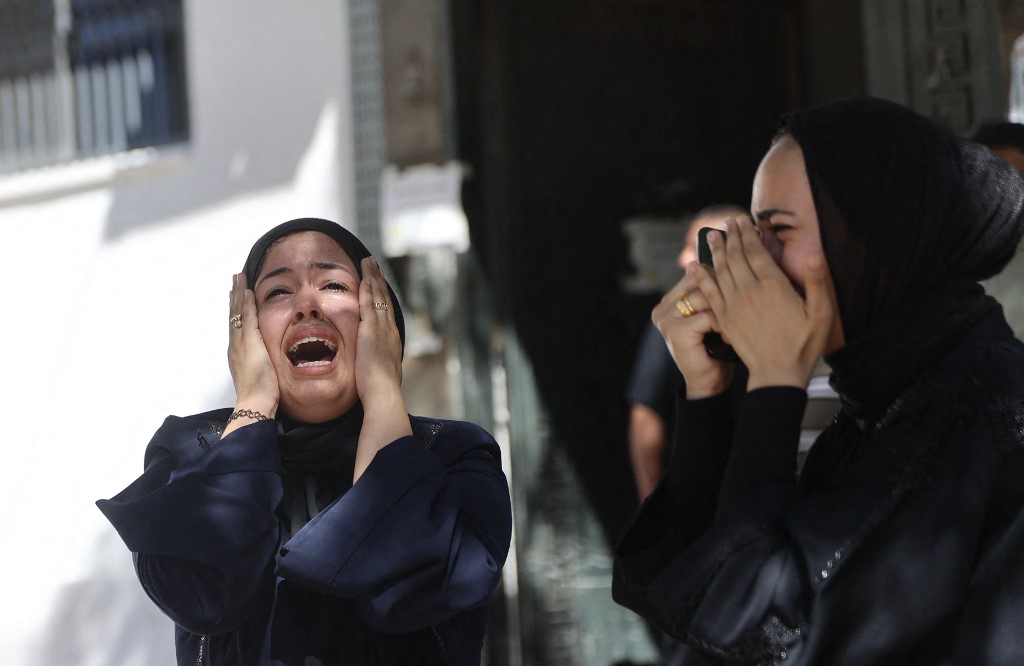
In the final stretch of joyful wedding preparations for his daughter, 43-year-old Khalil al-Masri had every reason to smile. Less than two weeks before the ceremony, he traveled with his eldest son to Gaza City’s Rimal neighborhood to finalize payment and confirm the reservation for his daughter’s dream wedding dress. With that task complete, the pair stopped at a nearby confectionery to mark the happy occasion, joining two friends for a seat at an outdoor table. What came next was a senseless, sudden tragedy: a live bullet tore through Masri’s skull, leaving him unconscious as his son and friends stared on in terror.
Rushed to Gaza’s al-Shifa Hospital for emergency care, Masri, a father of seven, succumbed to his fatal wound on June 14. His brother Mahmoud al-Masri described the jarring turn of fate in an interview with Middle East Eye. “It was a complete shock. He was very happy and laughing with his friends. He ordered a dessert, but the bullet penetrated his head before the order was served,” Mahmoud said. “The wedding was turned into a funeral.”
Captured on the sweet shop’s entrance surveillance footage, Masri’s killing is far from an isolated incident. The deadly shooting unfolded against a backdrop of steadily escalating Israeli fire targeting Palestinian civilians across multiple regions of the Gaza Strip in recent weeks, even as the event is framed as occurring under a ceasefire agreement. While the exact source of the bullet has not been officially confirmed, Mahmoud says the gunfire originated from the east, pointing to two likely sources: an Israeli surveillance quadcopter operating in the area minutes before the shooting, or an Israeli military “lifter” – a fortified watchtower fitted with heavy machine guns – positioned roughly 1.7 kilometers away in the contested Yellow Zone.
The Yellow Zone is an area Israel was required to withdraw from as part of the second phase of an earlier ceasefire deal, after occupying it in the agreement’s first stage. To date, Israel has refused to cede control of the territory, and now holds more than 60 percent of the entire Gaza Strip. Deployed at 23 separate locations across the eastern Gaza Yellow Zone, per data from the Palestinian Centre for Human Rights, these military lifters elevate weapons and surveillance hardware to extend visual range and enable open fire across large civilian-populated areas.
The same day Masri was killed, at least five more Palestinians were hit by Israeli fire in another central Gaza City neighborhood. Among them was 19-year-old university student Muhammed Abu Hassira, who was walking home from the gym along al-Wehda Street when Israeli forces opened fire. Just like Masri’s case, witnesses could not confirm whether the fatal shot came from a quadcopter or a military watchtower.
Khaled al-Tarshawi, Abu Hassira’s uncle, recounted the teen’s final moments to Middle East Eye. “Muhammed was on his way home from the gym at around 7pm, he was on al-Wehda Street when the Israeli occupation suddenly opened fire, hitting him and other pedestrians. He and four or five others collapsed to the ground,” al-Tarshawi said. “He was shot in the abdomen. People rushed to carry him and the other wounded to the hospital. He was transported on the seat of a wheelchair because there were no vehicles. Doctors tried to save him, but by the time he arrived, he had already lost a significant amount of blood.”
Abu Hassira had just wrapped up his second semester studying engineering at a Gaza university, having earned his high school diploma and enrolled despite the ongoing conflict. “He was intelligent, patient, and always devoted to his parents. His mother was devastated when she received the news, but his father was even more heartbroken. Muhammed was his eldest and most beloved son,” al-Tarshawi said. “Muhammed survived the devastating Israeli attacks throughout the two and a half years of the genocide and refused to leave Gaza City. He refused to evacuate to the south and managed to stay alive during the worst periods of the genocide. But he was killed during the ceasefire by a quadcopter or a lifter.”
Fatal Israeli fire has continued through all avenues of daily life in Gaza in the months following the October 2023 ceasefire agreement. In addition to watchtower sniper fire and quadcopter strikes, Israeli tanks and ground snipers deployed within the Yellow Zone have repeatedly opened fire on pedestrians and displaced families’ makeshift shelters in areas formally labeled “safe zones,” leaving dozens dead and injured over the past eight months.
Just 24 hours after the killings of Masri and Abu Hassira, 13-year-old Amir al-Bashiti was killed by an Israeli bullet inside his family’s displaced person tent in Khan Younis, southern Gaza. His father Emad al-Bashiti said the bullet, which likely came from an Israeli tank, struck the boy just moments after he came inside for the night. “It was around midnight and he was playing with his cousins and friends outside the tent. I called on him to come in and sleep and I wish I didn’t,” Emad said. “He came in carrying his blanket and told me ‘I want to tell you what happened’. At the time, there were sounds of Israeli tanks moving and some gunfire close to the camp. I told him to sit down and go to sleep because there were shootings. He insisted on telling me the story before he went to sleep.”
Before Amir could finish sharing his story, the explosive bullet tore through his head and exited his neck, killing him instantly in front of his entire family. “It wasn’t a normal bullet, it was an explosive one. I heard it explode after it penetrated his head,” Emad recalled. “He fell on the ground and vomited blood. I held his hand but he was unconscious. By the time I carried him and rushed outside to reach the hospital, he was already dead.” Amir and his family had been displaced from Rafah and had sought shelter in Khan Younis’ Batn al-Samin, a zone designated as safe for displaced people that now hosts tens of thousands of fleeing Palestinians.
In recent weeks, the targeting of Palestinian civilians has expanded far beyond the contested Yellow Zone, with deadly strikes hitting even areas marked as safe under the ceasefire framework. On a single Friday in June, one Palestinian child was killed and two members of the Totah family wounded when an Israeli quadcopter dropped an explosive on the group as they collected water east of Gaza City. Another Palestinian was killed by Israeli fire the same day east of Deir al-Balah in central Gaza.
Official data confirms the scope of the ongoing bloodshed: since the ceasefire agreement took effect in October 2024, at least 1,072 Palestinians have been killed and 3,463 more injured across the Gaza Strip. Since October 2023, Israeli attacks have killed at least 73,098 people in Gaza, with thousands more still missing and presumed dead under the rubble of destroyed buildings.
For families like the al-Bashitis, the term “ceasefire” bears no relation to the reality on the ground. “Whoever calls this a ceasefire is overlooking what is actually happening on the ground. It is not a ceasefire, it is continued fire,” Emad al-Bashiti said.