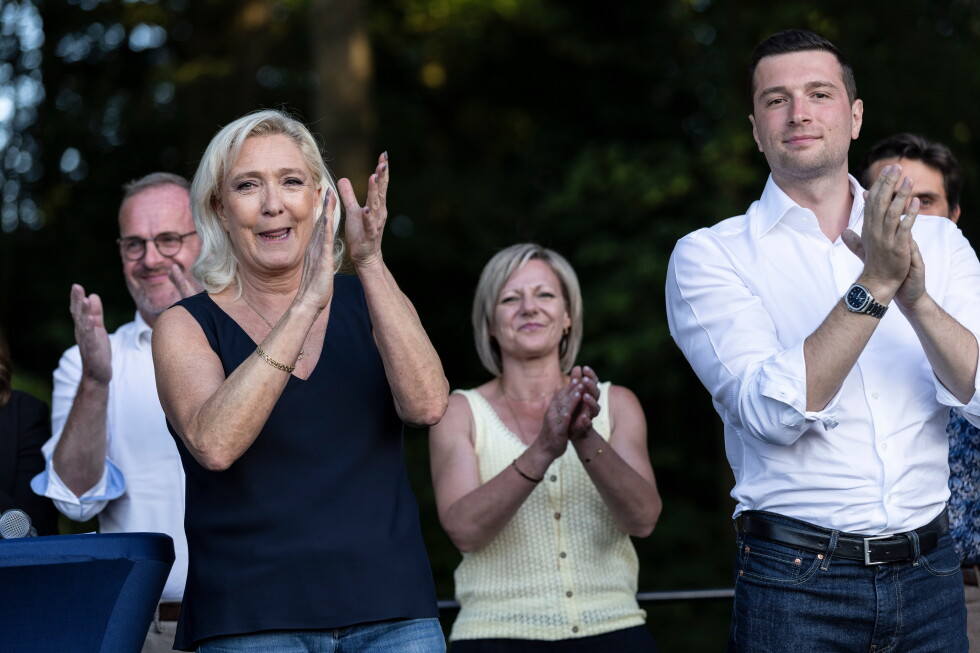
PARIS – A pivotal ruling from Paris’s Court of Appeal on Tuesday will shape the future of France’s far-right politics, determining whether National Rally co-founder Marine Le Pen will be eligible to compete in the 2027 presidential election. If the court upholds her prior conviction and public office ban, 30-year-old party president and Le Pen protégé Jordan Bardella is poised to take her place on the national ballot.
The legal battle stems from a March 2025 corruption conviction handed down by a lower Paris court, which found Le Pen and multiple other senior National Rally figures guilty of diverting European Parliament public funds between 2004 and 2016. Prosecutors alleged the party misclassified party staffers as parliamentary assistants, paying their salaries with European Union funds despite the fact that the employees performed no official legislative work for the parliament. The initial ruling sentenced Le Pen to a term of imprisonment and imposed an immediate five-year ban on holding any elected public office, a penalty that would automatically disqualify her from running for president in 2027. Le Pen has appealed the verdict, and a conviction on appeal could result in additional penalties beyond the office ban, including court-ordered electronic monitoring.
To understand the stakes of this ruling, it is necessary to trace the decades-long evolution of France’s modern far-right movement and its two current leading figures. The movement’s roots stretch back to 1968, when Marine Le Pen was born in Neuilly-sur-Seine, the youngest daughter of Jean-Marie Le Pen, who would go on to found the National Front (the predecessor to the modern National Rally) in 1972. Jean-Marie Le Pen built the party on a platform of fierce nationalism and anti-immigration policy, but his repeated denial of the Holocaust and multiple convictions for antisemitism, racial discrimination, and incitement to racial violence cemented the party’s reputation as a fringe extremist movement for decades.
Jordan Bardella, who would become Le Pen’s handpicked successor, was born in 1995 in Drancy, a northeastern Paris suburb located in one of mainland France’s poorest regions. Raised in public housing to parents of Italian and Algerian descent, Bardella joined the National Front at just 17 years old, shortly after Marine Le Pen made her first presidential bid in 2012. That year, Le Pen finished third in the first round of voting with nearly 18% of the national vote, marking the first major sign of the party’s growing mainstream acceptance.
Marine Le Pen had taken over the party leadership from her father in 2011, launching a deliberate, long-term campaign to detoxify the party’s brand, broaden its electoral appeal, and distance it from its extremist origins. She followed through on this project in 2015 by expelling her father from the party after he made another round of inflammatory, controversial remarks, and rebranded the National Front as the National Rally in 2018 to complete the image overhaul.
Le Pen’s gradual push into the political mainstream gained steady momentum over the next decade. In 2002, Jean-Marie Le Pen had already upended French politics by advancing to the presidential runoff, where he lost in a historic landslide to Jacques Chirac but proved the far right could no longer be ignored as a national political force. Marine Le Pen matched that feat in 2017, advancing to the runoff against centrist incumbent Emmanuel Macron and winning 33.9% of the national vote. By 2022, she improved on that performance dramatically, earning more than 41% of the vote against Macron in the runoff – the strongest result for a far-right presidential candidate in French history.
Alongside Le Pen’s rise, Bardella climbed quickly through the party ranks. By 2017, he had become one of the party’s most prominent spokespeople, a familiar face on national television news and political programming. In 2019, at just 23 years old, he led the National Rally’s candidate list in European Parliament elections, where the party finished first in France, earning him a seat as a Member of the European Parliament and a promotion to party vice president. He took over as National Rally president in 2022, and in the 2024 parliamentary elections, the party became the largest single caucus in France’s powerful National Assembly, falling just short of an outright majority.
Now, the 2027 presidential election – scheduled for April 18 and May 2, to replace term-limited incumbent Emmanuel Macron – hangs in the balance. Tuesday’s appeal ruling will not only decide Marine Le Pen’s political future, but will also set the course for France’s far-right movement as it aims to seize the presidency for the first time in the nation’s modern history.