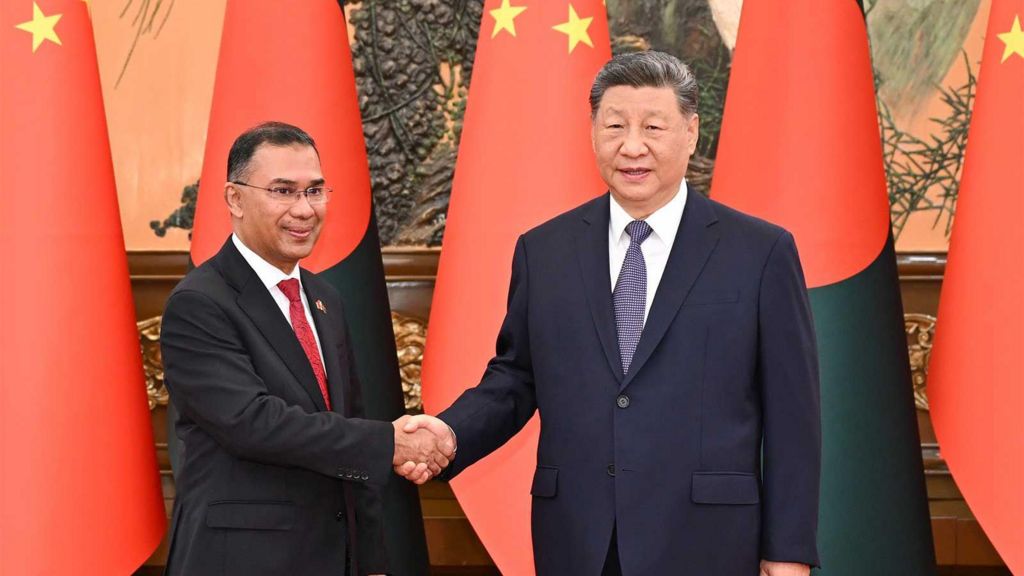
In a move that has reshaped regional diplomatic dynamics, Bangladesh’s newly inaugurated Prime Minister Tarique Rahman recently concluded high-level talks with Chinese President Xi Jinping during his visit to Beijing, the second stop on his first official overseas trip since taking office. The visit, which comes as Dhaka pursues a recalibration of its foreign policy priorities amid efforts to reset strained ties with traditional partner India, underscores the new government’s push to attract increased Chinese investment and deepen bilateral cooperation to reboot Bangladesh’s sluggish post-uprising economy.
Rahman’s itinerary – which included a first stop in Malaysia followed by the Beijing trip – has been closely parsed by geopolitical analysts, who frame the choice of destinations as a clear signal of Dhaka’s new strategic direction. Breaking from longstanding convention that sees newly elected South Asian leaders make New Delhi their first overseas port of call, Rahman’s Beijing stop has been interpreted in some Indian policy circles as a deliberate signal to Delhi, which has maintained close ties to ousted former Prime Minister Sheikh Hasina following her 2024 ouster.
The 2024 mass uprising that toppled Hasina’s government fundamentally altered Bangladesh’s diplomatic landscape. After Hasina fled the country and received refuge in India, relations between Dhaka and Delhi turned sharply frosty, a tension that persisted through the tenure of the interim government led by Muhammad Yunus, when India avoided high-level diplomatic exchanges with Dhaka. Following Rahman’s landslide electoral victory in February 2026 at the head of the Bangladesh Nationalist Party, however, both sides have taken incremental steps to reduce tensions and move toward a reset of bilateral ties.
Former Indian Foreign Secretary Shyam Saran notes that a noticeable de-escalation has already occurred: cross-border economic activity has gradually normalized, India has resumed issuing tourist visas to Bangladeshi citizens, and passenger bus services between the two countries – suspended for 18 months – have partially restarted, connecting Kolkata to Dhaka and Dhaka to Agartala. Earlier this year, when global fuel supplies were disrupted by the Middle East conflict, Delhi delivered thousands of tonnes of emergency fuel to Bangladesh via the cross-border Friendship Pipeline. Most recently, India appointed new High Commissioner Dinesh Trivedi to Dhaka, a move that carried a symbolic signal of intent to improve ties: Trivedi was elevated to cabinet rank, a rare step for an Indian high commissioner to Bangladesh.
Even with these incremental improvements, full rapprochement between Dhaka and Delhi remains out of reach, with multiple persistent irritants still straining bilateral relations. Widespread anti-India sentiment in Bangladesh, rooted in New Delhi’s past support for Hasina, continues to shape public opinion. A bitter controversy has also emerged over Dhaka’s claims that India’s Border Security Force has pushed thousands of predominantly Bengali-speaking Muslims deemed illegal immigrants into Bangladesh without following formal repatriation processes, a move that has sparked widespread public anger in Bangladesh. Compounding these tensions, inflammatory comments targeting Bangladesh made by Hindu nationalist politicians during recent West Bengal state election campaigns have sent confusing and unwelcome signals to Dhaka, according to former Bangladeshi diplomat Humayun Kabir. After the Hindu nationalist Bharatiya Janata Party ended 16 years of Trinamool Congress rule in the border state, which shares deep linguistic, cultural and ethnic ties with Bangladesh, these political frictions have taken on added significance.
Two agreements from Rahman’s Beijing trip have drawn particular scrutiny from New Delhi, where geopolitical competition with China remains a core national security priority: a joint agreement to conduct a technical feasibility study for Teesta River management projects, and a deal to develop a special economic zone near Bangladesh’s Mongla Port. For India, any Chinese involvement in Teesta River projects is a highly sensitive security issue. The transboundary river, long the subject of a stalled water-sharing negotiation between India and Bangladesh, sits close to the strategic Siliguri Corridor – the 22-kilometer “Chicken’s Neck” strip that connects India’s mainland to its seven northeastern states. “Any Chinese involvement in any project close to our border will always be a matter of concern. So, we would certainly not welcome that at all,” Saran explained.
Bangladeshi officials push back on these concerns, noting that previous Bangladeshi governments extended an invitation for India to participate in Teesta development, but New Delhi dragged its feet on a decision. They argue China possesses both the technical expertise and financial capital needed to deliver large-scale infrastructure projects like dredging and desilting work required to restore the river’s flow for agricultural use. For its part, Beijing has moved to ease Indian anxieties, emphasizing that its cooperation with Bangladesh is not aimed at any third party. “China-Bangladesh cooperation does not target any third party and should be free from third party influence,” Chinese Foreign Ministry Spokesperson Guo Jiakun told reporters during Rahman’s visit.
Beyond the Teesta and special economic zone projects, Rahman’s visit produced another major strategic announcement: China offered to advance development of the China-Myanmar-Bangladesh Economic Corridor, which would connect China’s Yunnan Province to both Southeast Asian nations. China already holds significant economic and security clout in Bangladesh: it is the country’s largest defense supplier, accounting for more than 70% of Bangladesh’s arms imports, and Dhaka holds more than $6 billion in debt to Beijing.
For India, which has long viewed South Asia as its traditional sphere of influence, China’s steady expansion of its footprint across the region – from Bangladesh to Sri Lanka and the Maldives – represents a major strategic challenge. India’s efforts to reset ties with Rahman’s government are further complicated by the ongoing presence of Hasina in Delhi: Dhaka has formally requested Hasina’s extradition to face execution after she was convicted in absentia of crimes against humanity for a 2024 crackdown on student protests that left hundreds dead. Hasina has denied all charges. “As long as Hasina is in Delhi, it may be somewhat difficult politically for Rahman to come to India,” Saran noted.
Even with these barriers, many analysts argue that a full breakdown in India-Bangladesh ties is unlikely, as India remains too economically and strategically important for Dhaka to ignore. For India, stable relations with Bangladesh are also a critical national security priority, as it helps counter ethnic separatist movements active in India’s northeastern states. Ultimately, for Prime Minister Rahman, navigating relations between the two competing Asian regional powers will remain one of the most delicate and consequential diplomatic balancing acts of his premiership, with outcomes that will shape Bangladesh’s economic future and regional geopolitics for years to come.